Snake plants have a reputation for being almost impossible to kill, and that reputation is mostly earned. What it leaves out is the other half of ownership. Snake plant disadvantages rarely show up in the first week. They show up in the second season, when the plant has barely grown and a moving-day scar is still on the leaf.
This guide ranks the disadvantages of a snake plant in plain order, starting with the one that can actually kill the plant. Each drawback comes with a judgment call, because a disadvantage is not the same for every home.
Small homes get extra attention, because that is where these problems bite hardest. A sharp leaf tip is a non-issue in a wide room and a daily irritation in a narrow hallway, and a plant that outgrows its pot is a real problem in a studio with no spare floor space.
Snake Plant Disadvantages: The Quick Answer
Yes, snake plants have disadvantages, and two of them matter far more than the rest. The biggest snake plant disadvantages are root rot from overwatering, the one problem that can kill the plant, and saponins in the leaves, which make the plant toxic to cats and dogs. Most other drawbacks are manageable with the right placement.
Snake Plant Disadvantages at a Glance
The table below is the whole article in one screen. Read the sections that match your home in full.
| Disadvantage | Who it hits hardest | Deal-breaker or manageable | First fix |
|---|---|---|---|
| Root rot from overwatering | Owners who water on a schedule | Manageable, but the one killer | Dry soil checks, gritty mix |
| Slow growth | Buyers filling an empty corner | Manageable | Buy the size you want |
| Toxic to cats and dogs | Homes with plant-chewing pets | Deal-breaker if no closed room exists | High shelf or closed room |
| Mildly toxic to children, sap irritates skin | Homes with toddlers | Manageable | Out of reach, gloves |
| Sharp leaf tips | Small homes, narrow walkways | Manageable | Place by traffic flow |
| Leaf damage never heals | Anyone moving the plant | Manageable, partly | Inspect leaves before buying |
| Picky about soil | Owners keeping nursery soil | Manageable, one-time fix | Fast-draining mix |
| Cold damage | Draughty windows and doors | Manageable | Move from cold glass |
| Top-heavy when mature | Tall varieties on shelves | Manageable | Heavy pot, floor placement |
| Rhizomes crack pots | Owners who never inspect roots | Manageable | Check the pot yearly |
| Flowers rare, air claims overstated | Buyers sold on blooms or clean air | Expectation problem | Buy it for the leaves |
| Pests and fungal leaf spot | Humid rooms, still air | Manageable | Keep leaves dry |
| Slow to propagate | Owners wanting free plants fast | Manageable | Divide rhizomes instead |
Why a Plant This Tough Still Causes Problems
Most snake plant disadvantages trace back to the traits that make the plant tough. It stores water in thick leaves and in fat underground stems called rhizomes. That storage is why it survives a forgotten month, and also why extra water has nowhere to go: wet soil around a full rhizome leads to rot, not growth.
The plant also runs a slow metabolism shaped by dry, rocky ground in central and western Africa, where wasting nothing beats growing fast, so indoors it produces few new leaves and recovers slowly from damage. And it defends itself with bitter saponins and tips that harden into points.
Overwatering and Root Rot: The Disadvantage That Actually Kills the Plant
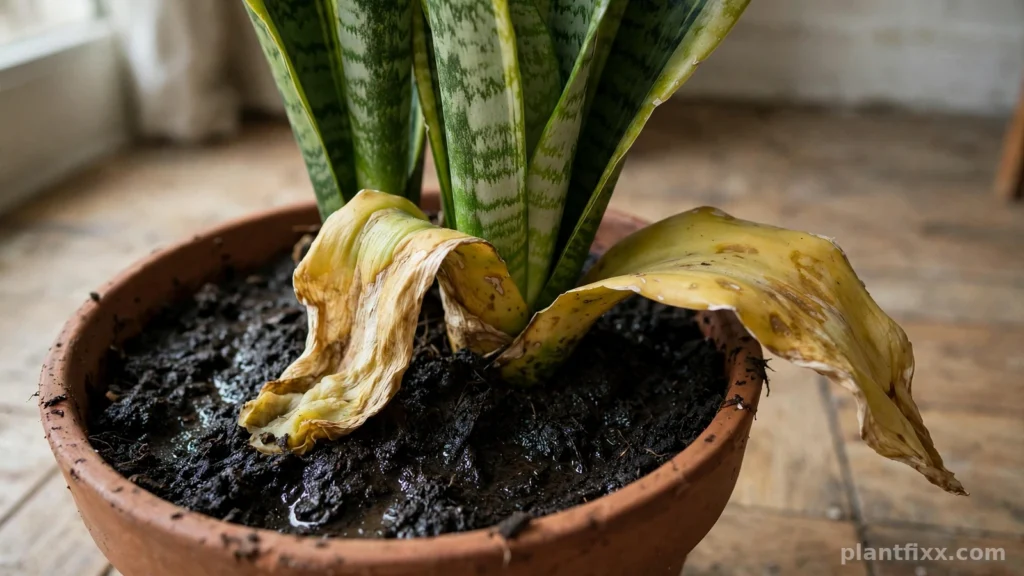
Snake plants almost never die of neglect. They die of kindness. The surface looks dry, so the plant gets watered, and the rhizome sits wet week after week until it softens and rots. The NC State Extension Plant Toolbox puts it plainly: do not overwater, as the roots will rot, and in winter the plant may need water only every one to two months.
Early rot is invisible. Leaves stay upright and green while the base decays below the soil line, so watch for snake plant overwatering signs such as soil that stays damp for weeks and a sour smell at the base.
Signs the Rot Has Already Started
Check the base of the innermost leaves first, because rot works from the centre outward. Leaves soft at the base, a fan that wobbles when touched, and yellowing at the bottom are the classic signs. Our guide to snake plant root rot signs and fixes walks through the unpotting check in full.
When You Can Still Save It, and When You Cannot
One soft leaf with a firm rhizome is usually salvageable: unpot it, cut away every soft part with a clean blade, let the cuts dry, and repot into dry, gritty mix. A rhizome that is soft all the way through is done, and keeping it risks spreading fungal problems to nearby plants. Prevention is one habit: water only when the soil is dry all the way down, and treat a fixed weekly schedule as the enemy.
Slow Growth That Tests Your Patience
A healthy snake plant typically adds only a few new leaves in a growing season, and growth nearly stops in winter. That is the ceiling for the species, not a sign your care is failing. Owners misread it constantly and add water or fertilizer, creating the rot problem described above.
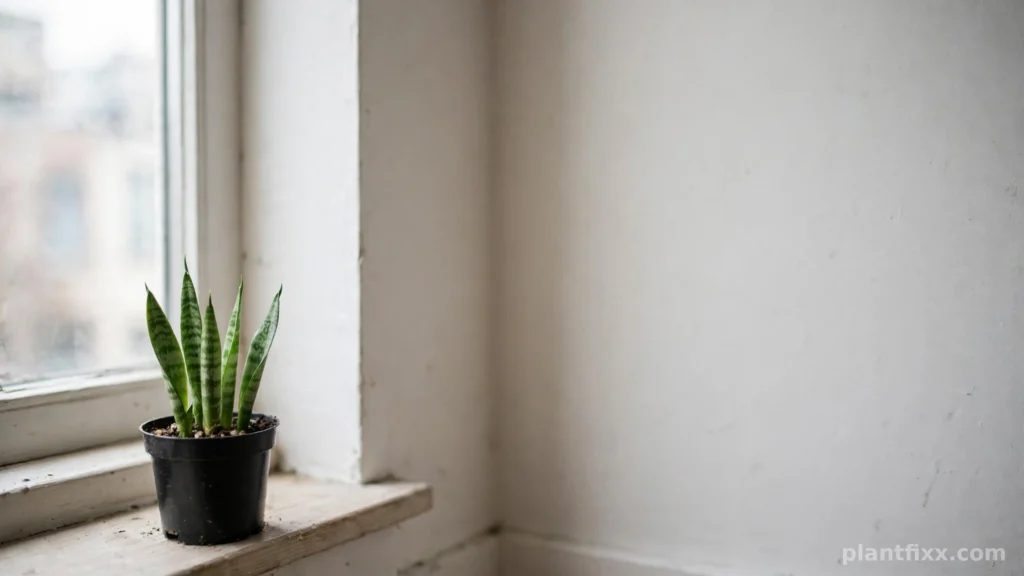
Light is the one lever that moves the rate at all. A dim corner gives survival at the slowest pace, while brighter, indirect light gives its best rate, which is still slow. The full picture is in our guide to snake plant light requirements. The buying lesson is simpler: buy the size you want to live with, because a small plant may still look small two years later.
Toxic to Cats and Dogs
The ASPCA lists the snake plant, under its older name Sansevieria trifasciata, as toxic to dogs and cats, with saponins as the toxic principle and nausea, vomiting and diarrhea as the expected signs. The entry is on the ASPCA toxic plant list for dogs. NC State Extension rates the severity as low, and the bitter leaves stop most pets after one bite.
Uncommon is not impossible. Kittens and puppies explore with their mouths, and some dogs chew anything green regardless of taste, so the only reliable control is distance. Our article on whether a snake plant is toxic to cats and dogs covers symptoms, what to do if a pet eats a leaf, and when to call your vet.
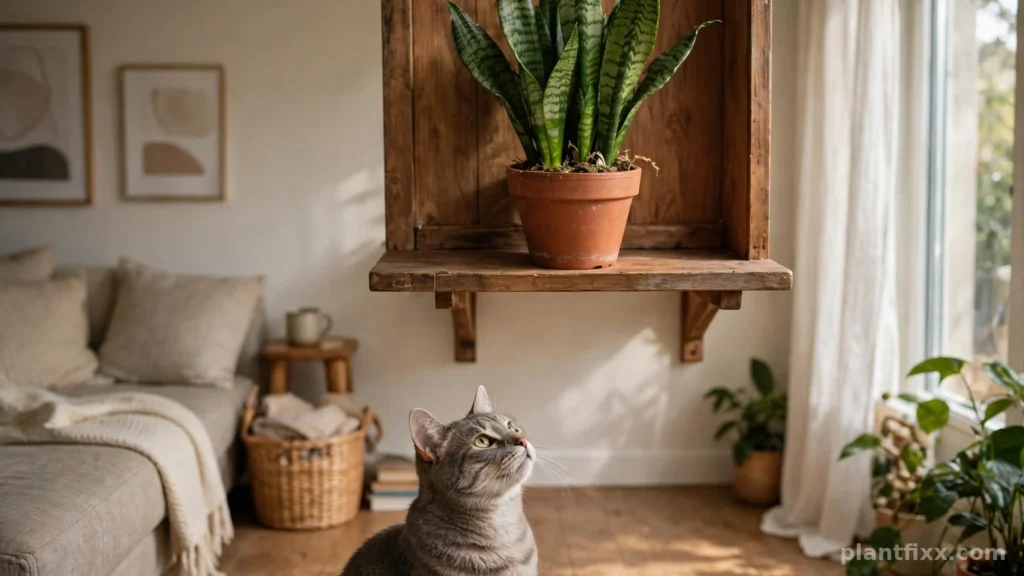
Placement advice assumes a high shelf or a room the pet never enters, and a studio flat may have neither. If your cat can reach every surface and chews plants, this disadvantage is a genuine deal-breaker and a pet-safe plant is the honest recommendation. If your pet ignores plants, it drops to a minor placement note.
Mildly Toxic to Children, and Sap That Irritates Skin
For people the risk is smaller but real. NC State Extension lists the snake plant as poisonous to humans with low severity, with saponins in all parts of the plant and nausea, vomiting and diarrhea as the signs if a leaf is eaten. See the full entry in the NC State Extension Plant Toolbox profile. Adults face no meaningful risk. Toddlers, who pull leaves and chew what they pull, are the group that matters.
The sap can also irritate skin, most often when you cut a leaf or divide the plant, so gloves and a hand wash afterwards close the issue. If a child chews a leaf, call Poison Control in the US at 1-800-222-1222 rather than waiting to see how it develops.
Sharp Leaf Tips in Tight Spaces
A mature leaf ends in a rigid point, and older leaves harden the most. Brushing past one at the wrong angle can scratch skin, and a tip at toddler eye height or pet face height is a worse idea than the same tip at adult waist height. In a wide room, nobody passes within a metre of the plant.
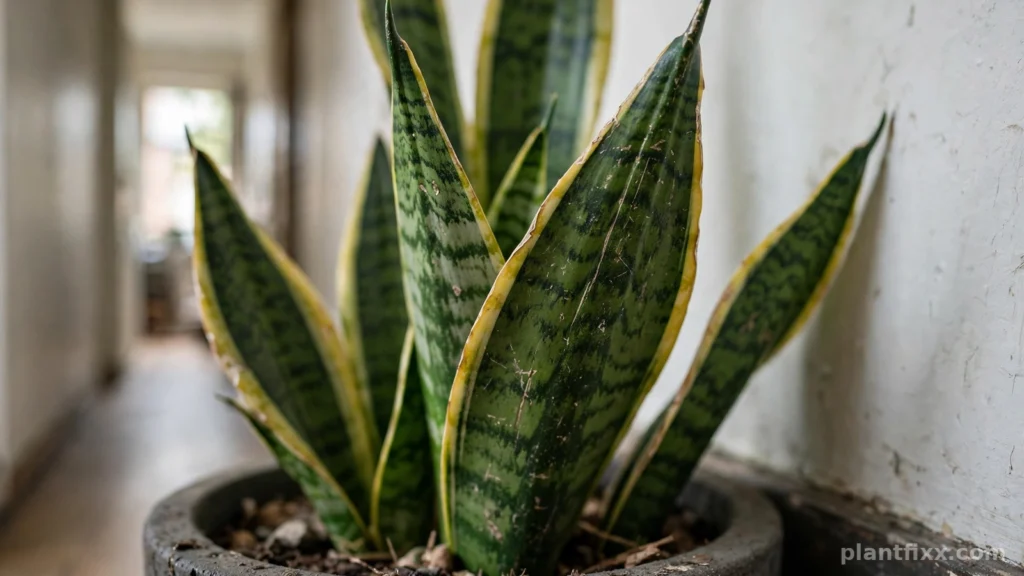
In a small apartment, the only free corner is often beside the bathroom door, the hallway, or the side of the bed you get out of in the dark, exactly where a pointed plant should not stand. Choose the spot by traffic flow first and looks second. Snipping the very end off a sharp tip blunts the point and barely changes the leaf.
Leaf Damage Never Heals
A snake plant leaf cannot repair itself. A crease from transit stays creased, a scar from a knock stays visible, a brown tip stays brown, and cold marks last for the life of the leaf. The only fix is removing the damaged leaf at the base and waiting for a replacement.
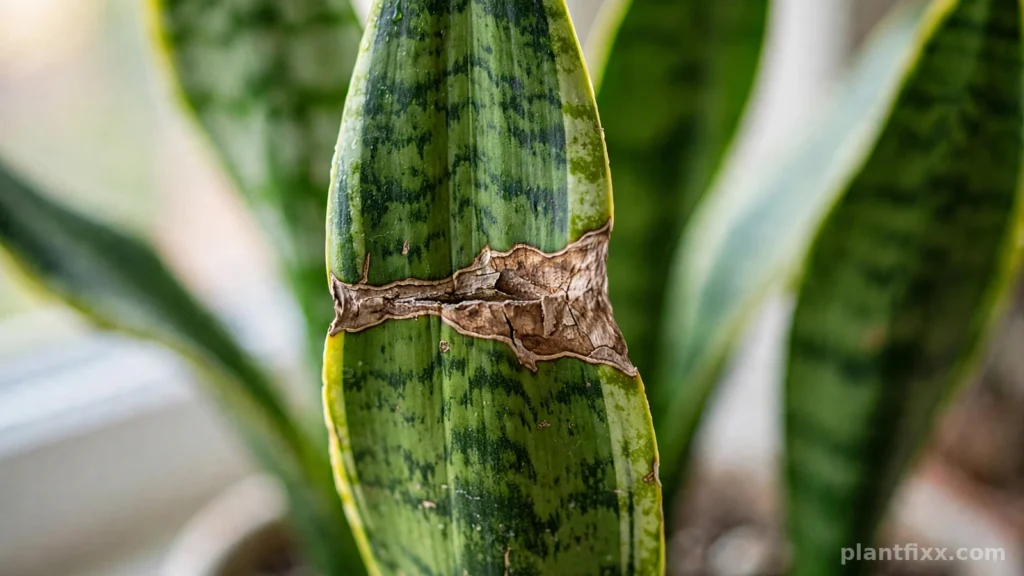
So inspect the plant in the shop. Turn the pot and look for bent leaves, pale scars and cracked tips, especially on outer leaves. A discounted plant with three damaged leaves is no bargain if it will look damaged for two years. When you move one, carry it by the pot and keep the leaves clear of door frames.
Picky About Soil and Cold Behind the Low Maintenance Label
The low maintenance label hides a setup cost. Standard potting mix holds water far longer than this plant tolerates, and most nursery plants arrive in a mix chosen for fast nursery growth, not for years on your shelf. Keep that mix and water like a fern, and the rot problem is built into the pot from day one. The one-time fix is in our guide to the best soil mix for snake plants: a gritty, fast-draining blend that drains fast instead of sitting around the rhizome.
Cold is the second hidden sensitivity. The plant tolerates cool rooms down to around 50 degrees Fahrenheit, about 10 degrees Celsius, but prolonged cold below that range softens and marks the leaves permanently. In apartments the danger spots are predictable: winter window glass, a draughty front door, an unheated spare room. Our notes on snake plant temperature tolerance cover the safe range and the damage signs. The plant is low maintenance after setup, not instead of it.
Heavy, Top-Heavy and Hard on Pots
A mature snake plant carries most of its weight high. Tall varieties commonly reach three to four feet indoors, with broad leaves rising from a compact root system in a small pot, so the pot that felt stable in year one starts to rock in year three, and on a shelf that means a heavy pot falling from height. The fix is weight and position: a heavy pot, sized with our guide to the right pot size for a snake plant, lowers the centre of gravity, and floor placement removes the fall entirely.
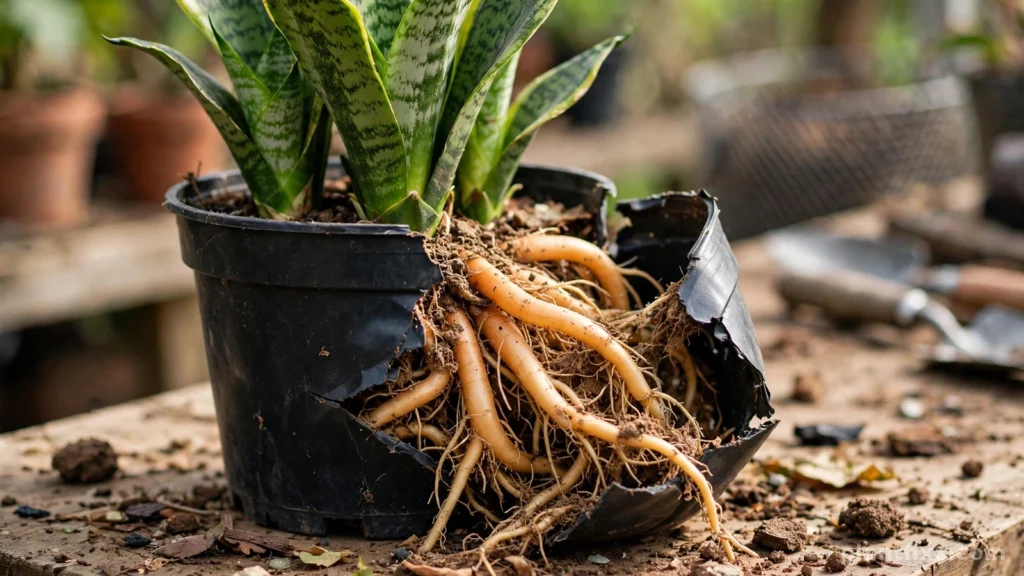
Underground, rhizomes push outward as the plant spreads, and in a confined pot that pressure builds until a plastic pot bulges or a clay pot cracks. Check the plant every year or two. When the pot wall starts to bow or the root mass feels solid at the edges, follow the steps for how to repot a snake plant and divide it or move it up one size.
Flowers Almost Never Happen, and the Air Cleaning Claim Is Overstated
Snake plants can flower, sending up a spike of small, pale blooms. Indoors it is rare and unpredictable: NC State Extension notes that the plant blooms in winter in its native habitat but rarely blooms as a houseplant. Our page on snake plant flowering explains the conditions linked to blooms and why none of them guarantee anything.
The air cleaning claim needs the same honesty. The famous research behind it measured plants in small sealed chambers, not in lived-in rooms with windows, doors and ventilation, and a 2019 review that recalculated those results for real buildings found the effect of potted plants negligible next to ordinary air exchange. Buy this plant for its looks and toughness, not as an air purifier. Its broad leaves also collect dust, so add an occasional wipe to the real care list.
Pests and Fungal Problems Still Show Up
Snake plants are less pest-prone than most houseplants, not immune. NC State Extension advises monitoring for mealybugs and spider mites. Mealybugs gather as white cottony clusters in the tight centre of the rosette, where a quick glance never reaches. Our guide to snake plant mealybugs shows where to look and how to remove them before they spread.
Wet leaves and still, humid air bring fungal leaf spot, showing as reddish brown patches that spread and never heal. A steamy bathroom with no airflow is where leaf spot thrives, so keep water off the leaves and give the plant air movement. In a small home, quarantine space is the hidden cost, since a treated plant should sit away from the rest.
Slow and Awkward to Propagate
A leaf cutting pushed into soil or water can take months to root and longer still to produce a pup. Cuttings from variegated types such as Laurentii usually grow into plain green plants, because the yellow edge pattern sits in the leaf margin tissue a cutting does not carry over. Dividing the rhizome is the reliable route to a copy that matches the parent, and that means waiting for offshoots worth separating. Cuttings in jars also occupy a windowsill for a season or more.
Snake Plant Pros and Cons: The Honest Balance
A fair decision needs both columns in one place. The full positive case is in our article on snake plant benefits. The short version:
| Pros | Cons |
|---|---|
| Survives low light that defeats most houseplants | Root rot from overwatering is a constant, silent risk |
| Tolerates missed waterings for weeks | Toxic to cats and dogs if chewed |
| Upright shape fits narrow floor space | A small plant stays small for years |
| Lives for many years with basic care | Leaf damage is permanent, replacements grow slowly |
| Few pests compared with softer-leaved plants | Needs a gritty soil setup and a heavier pot over time |
| Handles dry indoor air without complaint | Almost never flowers, air claims overstated |
Read the two columns against your own home rather than in the abstract. Most snake plant pros and cons are conditional: the cons are mostly about the match between the plant and one specific room, pet or expectation.
Who Should Buy a Snake Plant, and Who Should Skip It
Buy one if you want structure more than change, your schedule is irregular, and your spot offers modest light. Buy one if you can give it a free-draining mix, a stable pot and a position out of the traffic line. Under those conditions the disadvantages shrink to background noise, and the plant will likely outlast the furniture around it.
Skip it if a pet that chews plants can reach every surface in your home, because toxicity cannot be trained, fed or watered away. Skip it if you are buying a small plant to transform a corner this season, or if regular flowers are part of the point, or if your only spot is a cold winter windowsill.
Two comparisons settle most remaining doubts. Snake plant vs pothos plant is slow, upright and unbothered versus fast, trailing and forgiving in a different way. The snake plant vs zz plant comparison is closer, since both are slow and drought-tolerant, and the deciders are usually leaf shape, pet plans and light.
What is the biggest disadvantage of a snake plant?
Root rot from overwatering, because it is the one problem that can kill the plant, and it develops out of sight below the soil line. Rot does, silently and often completely.
Are snake plants toxic to cats and dogs?
Yes. The ASPCA lists the snake plant as toxic to cats and dogs because its leaves contain saponins, with nausea, vomiting and diarrhea as the signs. The bitter taste puts most pets off after one bite, but kittens, puppies and persistent chewers should be kept away entirely.
Can I keep a snake plant in my bedroom?
Yes, for most people a bedroom is a good spot, since it tolerates low light and asks for little attention. Keep it out of the path you walk in the dark, because the leaf tips are sharp, and choose a different plant if a pet that chews leaves sleeps there with free access to it.
Do snake plants really clean the air?
Not in any way you would notice in a real room. The claim rests on studies in small sealed chambers, and a later review found the effect of potted plants in real buildings negligible next to normal ventilation.
Why is my snake plant not growing?
Slow growth is normal for this species, and growth nearly stops in winter, so a plant unchanged for months is usually healthy. If it produced nothing across a full spring and summer, check the light first, and resist adding extra water.
Can a damaged snake plant leaf heal?
No. Snake plant leaves do not repair creases, scars, brown tips or cold marks. Trim a brown tip back to green tissue for looks, or remove a badly damaged leaf at the base and wait for new growth.
Are snake plants safe around children?
They are mildly toxic if eaten, with low severity, so the rule is placement rather than panic. Keep the plant out of reach of toddlers who pull and chew leaves, and teach older children not to handle cut leaves, since the sap can irritate skin.
Can a snake plant crack its own pot?
Yes, a mature plant can. Its rhizomes spread and press against the pot walls for years, until a plastic pot bulges or a clay pot cracks. Check the pot every year or two, and repot or divide when the wall starts to bow.
None of these drawbacks cancel the reasons the plant is everywhere. They define the terms. Set it up in the right mix and pot, in a spot chosen by traffic and pets rather than by looks alone, and most of this list never becomes your problem. For the full care routine, follow our complete snake plant care guide.
Pingback: Snake Plant vs ZZ Plant: Key Differences & Winner (2026)