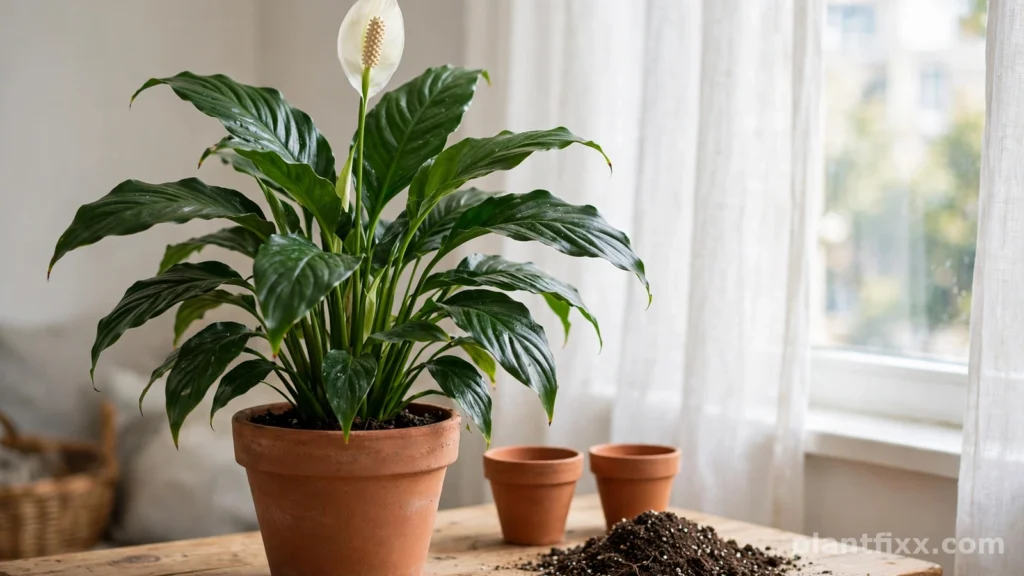
If you have ever stood a peace lily leaf in a jar of water and waited for roots that never came, the method was wrong, not you. Peace lily propagation works in exactly one way for home growers, and it is the easiest propagation job on your shelf. Can you propagate a peace lily? Yes. This guide covers the method that works, the two that never will, how to tell a healthy recovery from a failing division, and the aftercare that gets new plants growing.
Yes, but only by division. Peace lily propagation works by splitting a plant into crowns, each with its own roots and leaves, then potting each crown on its own. Leaf and stem cuttings never root because the plant has no nodes. Divide in spring, keep the new plants evenly moist, and expect droop for one to two weeks.
Why Peace Lily Cuttings Never Root: The Crown and Rhizome Rule
Most houseplant cuttings work because of nodes. A pothos stem carries a node at every leaf joint, with dormant tissue inside that can build roots and a new growing tip. A peace lily has none of that structure above the soil. What looks like a stem is only a leaf stalk, a petiole, rising straight from the base. It carries no node, no dormant bud, and no tissue that can turn into roots. A leaf in water is living on stored energy. It may stay green for weeks, but it will never root.
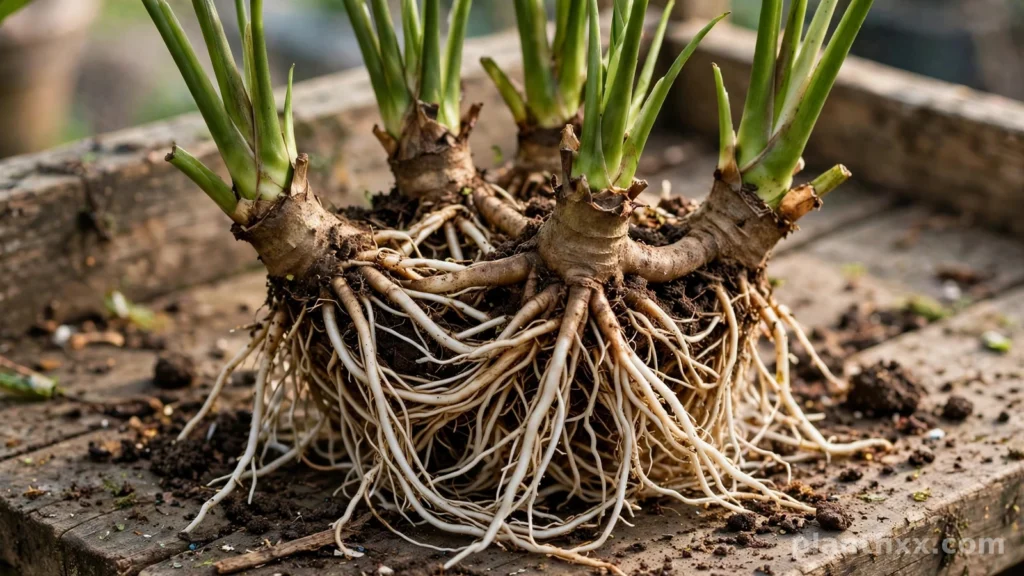
All real growth happens at the crown, the thickened base where a fan of leaves joins the underground rhizome, the horizontal stem that creeps through the soil and stores the plant’s reserves. Each crown is a complete growing point with its own leaf fan and roots, and the rhizome keeps adding crowns, which is why older plants form a full clump. In nursery terms, spathiphyllum propagation means one thing: dividing that clump so every crown keeps its roots and leaves. You are not creating a new plant from a piece. You are separating plants that already exist. That changes how to propagate peace lily clumps: split cleanly, damage few roots, and support each crown while it adjusts.
How to Tell if Your Peace Lily Is Ready to Divide
Division only works when the plant has something to divide. Slide it out of its pot, or part the leaf fans and study the soil line. Look for at least two, ideally three or more, separate crowns: distinct leaf fans, each rising from its own thickened point on the rhizome. A rootball that holds its shape, with white roots between crowns, will split well.
Wait if your plant has a single crown, however big its leaves are. A one-crown plant has nothing to spare, and tearing it apart leaves two halves with no complete growing point. Also wait if the plant is already stressed, with widespread yellowing, a mushy base, or a recent pest problem. Fix that first. Dividing a plant in full bloom usually costs the current flowers, because the plant redirects energy into root repair, so if the blooms matter this month, enjoy them and divide at the next repot.
When to Propagate a Peace Lily (And When to Wait)
The best time is late winter into spring, combined with repotting, when the plant is restarting active growth and new roots form fastest. North Carolina State Extension guidance puts repotting in February or March, and dividing at that same session means one recovery period instead of two.
You can divide in summer if needed, but avoid midwinter. Peace lilies grow best at daytime temperatures of 68 to 85 degrees Fahrenheit, and cold, dark weeks slow root repair to a crawl. A division in cold, wet mix in December risks rot, so treat timing as the cheapest success factor you have.
What You Need Before You Start
None of this is special equipment, just the basics for how to propagate peace lily divisions cleanly and without spreading disease between cuts:
- A mature peace lily with at least two or three visible crowns
- A sharp knife or clean pruning shears for dense rootballs, plus rubbing alcohol to disinfect the blade
- Fresh potting mix with perlite for drainage (never reuse old mix for new divisions)
- One pot per division, only slightly wider than that division’s roots, each with a drainage hole
- Gardening gloves, because peace lily sap irritates skin
- A watering can with room temperature water
- A clear jar of water, only if you plan to hold a division briefly (explained below)
Skip rooting hormone. It does nothing here, because the roots already exist.
A Quick Safety Note Before You Cut
Peace lily leaves, stalks, and rhizomes contain calcium oxalate crystals called raphides. They are why the species appears on the ASPCA list of houseplants that cause trouble for pets: a pet that chews the plant releases the crystals into its mouth, causing pain, drooling, and vomiting. Serious cases are rare, but the irritation is real. On the day: wear gloves, sweep every trimmed piece into a bin pets cannot reach, and wash your hands before touching your face. For symptoms and first aid in full, read our guide on whether a peace lily plant is toxic to cats and what to do if one chews it before you start.
How to Propagate a Peace Lily by Division, Step by Step
Step 1: Water the Plant the Day Before
Water the parent plant thoroughly about 24 hours before dividing. Hydrated roots are flexible and break far less during separation, and the plant rides out the shock afterward much better. The mix should be moist on the day, not soggy, so do not water again that morning.
Step 2: Tip the Plant Out and Expose the Crowns
Turn the pot on its side, support the leaf fans with one hand, and ease the rootball out. If it resists, squeeze a plastic pot or run a knife around the inside edge. Never haul the plant out by its leaves, because stalks snap at the crown, and each snap costs the division a leaf. Shake away loose mix until the rhizome and crowns are clearly visible. This moment decides the whole division, so take your time.
Step 3: Find the Natural Split Lines
Study where the crowns join. In most clumps the split is obvious: each crown has its own leaf fan and root bundle, joined by rhizome. Decide your split lines before you pull or cut anything. A good division has three things together: a crown, several healthy leaves (three to five at minimum), and a solid share of roots. A crown with leaves but almost no roots will struggle, and roots with no crown will never grow. If a piece fails that test, change the split line.
Step 4: Separate by Hand First, Cut Only What Resists
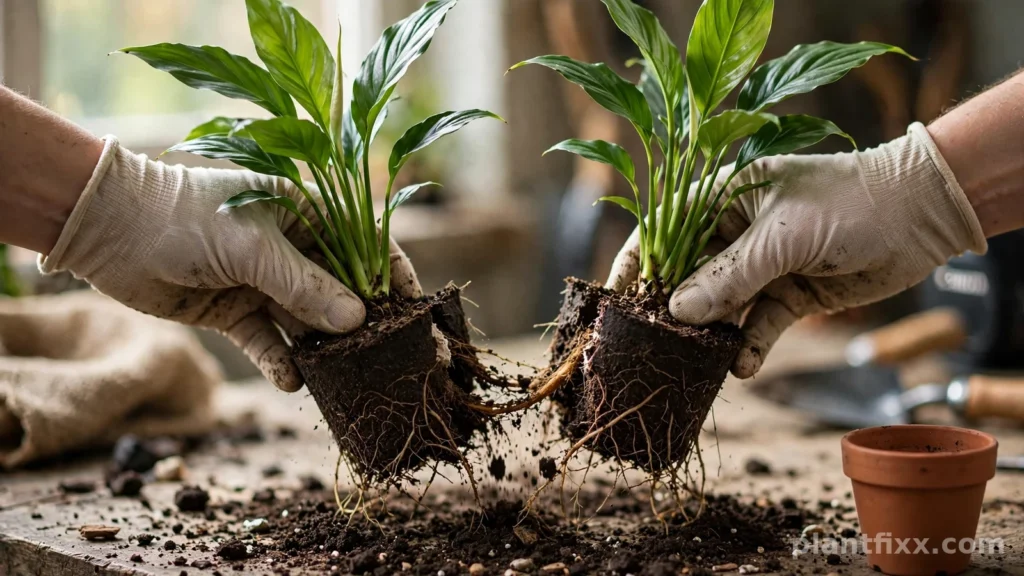
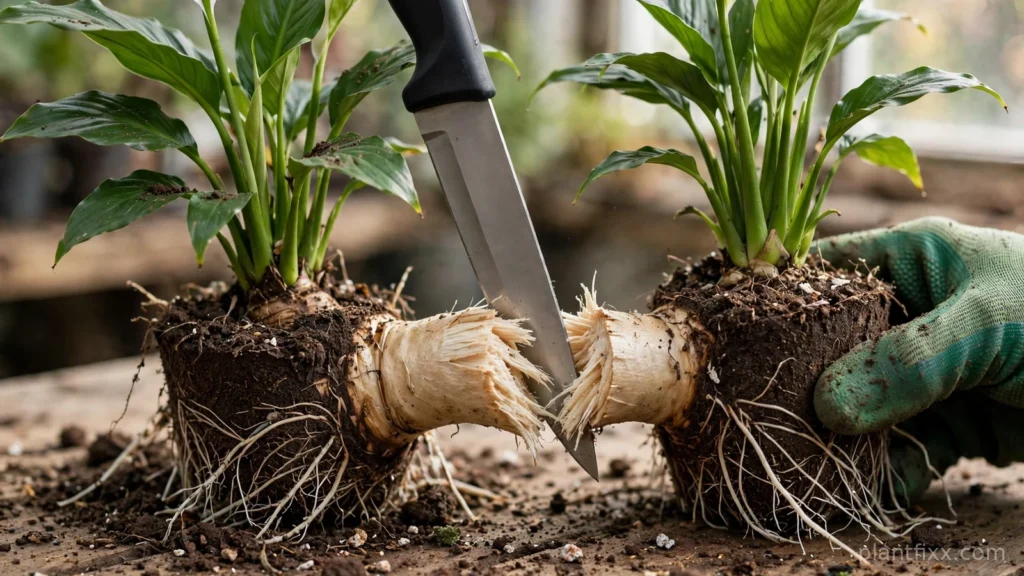
Work your fingers into the split line and tease the crowns apart slowly, untangling roots as you go. Most clumps separate almost entirely by hand, which tears the fewest roots. Where the rhizome is thick and will not yield, make one clean cut through it with your disinfected knife rather than sawing or twisting. Some fine root loss is unavoidable and harmless. What matters is that each division keeps its crown intact and a root system that matches its leaf fan.
Step 5: Pot Each Division at the Same Depth
Set the division in its new pot on fresh mix, crown at exactly its old depth: where stalks meet roots sits at the surface, never buried. Fill around the roots, firming gently so the plant stands without being packed hard. Burying the crown is a quiet killer: mix against it holds moisture on the growing point and invites rot. Choose the pot by the roots, not the leaves. Peace lilies like to stay somewhat pot-bound, so the pot should hug the rootball with little room to spare. A big pot around a small division holds far more water than the roots can use, the most common route to failure in this whole process.
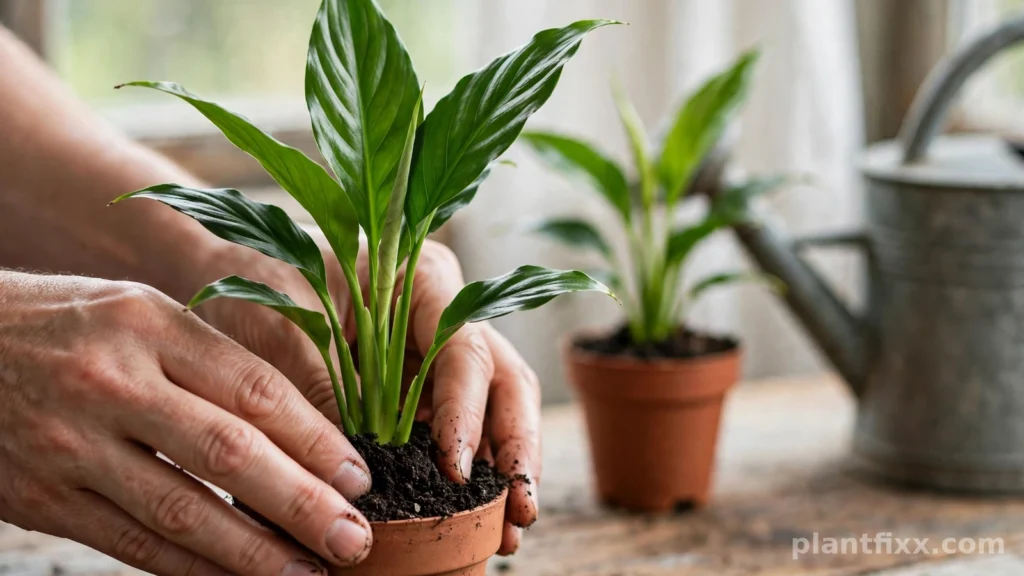
Step 6: Water In and Settle the Plant
Water each pot slowly until it drains from the base, settling the mix against the roots and removing air pockets. Move the divisions to bright, indirect light, out of direct sun, and leave them alone. Expect drooping within a day. That flop is the plant balancing water loss through its leaves against a root system not yet pulling at full capacity. It is the normal start of recovery, not a sign you did something wrong.
Can You Propagate a Peace Lily in Water?
Only in a limited sense, and precision matters here, because this is where most online advice goes wrong. You cannot root a peace lily cutting in water. No version of this roots a leaf or stalk in a jar. What you can do is hold an already rooted division in water briefly: rinse the soil off, set the roots (not the crown, not the leaves) in clean water, and keep it there while you prepare pots, changing the water every few days.
Treat water strictly as a waiting room, not a home. A division left in water for months weakens and declines. Pot it into mix as soon as you can. A peace lily thriving permanently in a vase is a rooted division on borrowed time, not a propagation method.
Growing a Peace Lily From Seed: Possible, Rarely Worth It
A peace lily can technically be grown from seed. It is covered here so your picture is complete, not as a recommendation. Indoor plants rarely get pollinated, and most home flowers never produce viable seed. When seed is available it must be fresh. It germinates slowly and unevenly under constant warmth and humidity, and seedlings need years before they resemble the parent or flower. Division hands you a mature, flowering-size plant the same afternoon. Seed is a curiosity for patient collectors. For everyone else, division is the whole answer.
Signs Your Division Is Working
- The initial droop peaks in the first days, then leaves lift a little more each morning
- Leaves feel firmer when you lift one gently, instead of hanging limp
- Leaf loss stops, and yellowing stays limited to one or two older outer leaves
- By weeks three to five, a new leaf spear shows at the center of the crown, proof the growing point is healthy
- The pot gets lighter at a steady rate between waterings, showing the roots are drinking
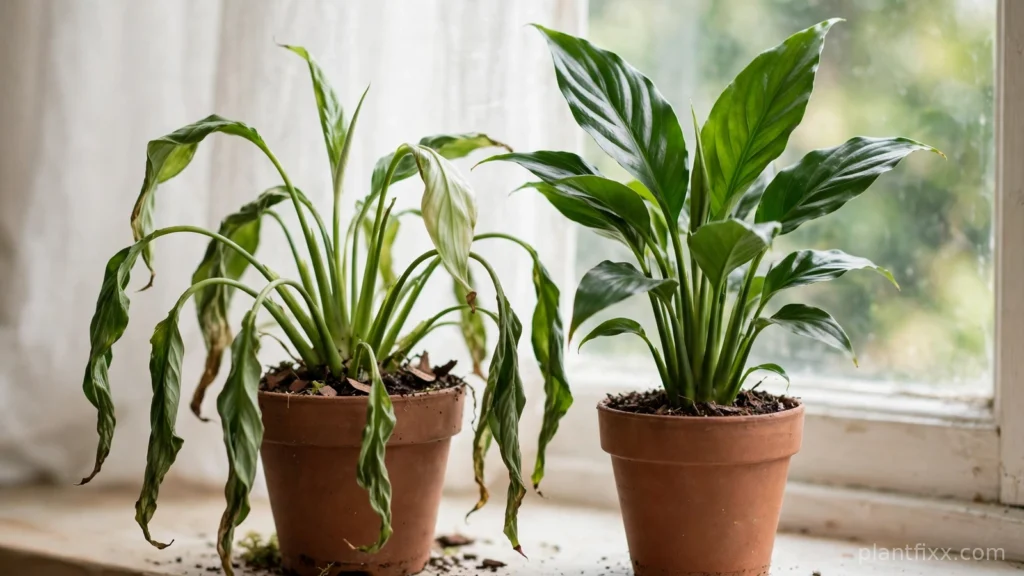
The droop looks worse than it is. A division following this pattern needs only steady care and time.
Signs Your Division Has Failed
- The crown base feels soft or mushy when pressed, or smells sour
- Leaves yellow and collapse from the base upward rather than one older leaf at a time
- The plant stays fully wilted for over a week despite moist mix, pointing to roots that no longer work
- Black or dark brown slime appears on roots when you tip the plant out to check
- New growth never appears, and existing leaves thin out week after week
Mushiness at the crown means rot has reached the growing point, and that division cannot be saved. Remove it, and disinfect the blade again before using it elsewhere. Not sure if the problem is too much water or too little? Compare your plant against our breakdown of overwatering versus underwatering signs and how to tell them apart before changing anything, because the two look alike but need opposite fixes.
What to Do if a Division Stalls or Keeps Drooping
First, give it honest time. Divisions droop for one to two weeks, and full recovery after repotting can take three to five weeks, as we detail in our guide to plant shock after repotting and how long it really lasts. A plant slightly droopy at day ten, with firm leaves and moist mix, is recovering on schedule. Leave it alone.
If the droop worsens, work through the causes in this order. Check moisture first: push a finger two inches into the mix. Dry at that depth means water thoroughly once, because damaged roots cannot reach moisture sitting deeper in the pot. Wet and heavy at that depth, with a still-wilting plant, means the roots are failing. Tip the plant out, trim black or slimy roots back to firm white tissue, and repot into fresh, barely moist mix in the smallest pot that fits. Check light second: a division in a dark corner stalls, and one in direct sun wilts no matter how much you water, so move it to bright, indirect light. Check temperature third, away from cold drafts and radiators. Humidity helps too, so group it with other plants or use a pebble tray. What not to do is feed it: fertilizer burns stressed roots and makes every problem worse.
Aftercare Schedule for New Divisions
Follow this rhythm:
- Weeks 1 to 2: keep the mix evenly moist, never soggy and never fully dry. Bright, indirect light only. No fertilizer, no repotting, no moving the plant.
- Weeks 3 to 5: water when the top inch feels dry, and watch for the first new leaf spear.
- Month 2 onward: regular peace lily care. Keep the soil lightly moist, letting it dry slightly between waterings, per North Carolina State Extension guidance on Spathiphyllum care.
- Feeding: wait 4 to 6 weeks, then feed at one quarter of the label strength in spring and summer only. Flush with plain water between feeds, because salt build-up burns leaf tips and roots.
- Long term light: peace lilies tolerate low light but flower far better in medium to bright indirect light, which is why they sit on our list of the best low light indoor plants for small spaces that actually thrive.
Place new plants with pets in mind: peace lily is not pet safe per our pet safe plant checker for cats and dogs, so use shelves pets cannot reach.
Peace Lily Propagation Methods Compared
Here is the honest comparison:
| Method | What it really is | Time to a growing plant | Difficulty | Use it when |
|---|---|---|---|---|
| Division | Splitting crowns, each with roots and leaves | Already a plant, with new growth in about 3 to 5 weeks | Easy | Every normal case, the default method |
| Water holding | A rooted division kept in water briefly | No growth until potted into mix | Easy, but temporary | A short delay before potting |
| Seed | Growing from pollinated, fresh seed | Months to grow on, years to flowering size | Hard and unreliable indoors | Only as a patient experiment |
| Leaf or stem cutting | A detached leaf or stalk | Never. The piece has no growth point | Impossible | Never. It cannot work on this plant |
Common Peace Lily Propagation Mistakes
- Tearing apart a single crown plant and ending with two dying halves instead of one healthy plant
- Potting a small division into a large pot, where extra mix stays wet and rots roots
- Burying the crown, which keeps the growing point wet and invites rot
- Pulling the plant out by its leaves and snapping stalks at the base
- Cutting with a dirty blade, which carries disease from one crown into the fresh cuts of the next
- Watering on a fixed schedule instead of checking the mix, leaving new roots parched or drowned
- Fertilizing in the first weeks, which burns stressed roots
- Panicking at the normal first-week droop and repotting or moving the plant, resetting its recovery each time
- Leaving a water-held division in its jar for months, then blaming the method when it fades
Conclusion
Peace lily propagation is simple once you stop fighting the plant’s anatomy: there are no cuttings to root, because every growth point sits in the crowns. Split a healthy clump in spring, give every crown its own roots, leaves, and a snug pot, then hold your nerve through the droop while aftercare does its work. Start with the healthiest, fullest clump you own, and divide it at its next repot.
Can you propagate peace lily cuttings in water?
No. A cutting has no node and no growth point, so it cannot root in water or soil. Water only works for holding an already rooted division briefly before potting. For a new plant, divide the clump.
Will a peace lily leaf ever grow roots?
No. A detached leaf may stay green for weeks on stored energy, but it has no crown tissue and will never root or grow.
How long does peace lily propagation take before new growth shows?
Expect drooping for the first one to two weeks. The first new leaf spear typically appears within three to five weeks in spring conditions. Flowers take longer, because the plant rebuilds roots first.
Do peace lilies grow pups I can pull off?
Not like spider plants or succulents. A peace lily grows extra crowns on its rhizome, forming one connected clump. You separate them by unpotting and dividing the rootball, not by snapping babies off the surface.
Can I divide a peace lily while it is flowering?
You can, but the plant usually drops its current blooms while it repairs roots. If the flowers are the point right now, wait until they fade and divide at the next repot.
How many new plants can I get from one peace lily?
As many as the clump has healthy crowns, provided each piece keeps its own roots and three to five leaves. Two or three solid divisions beat five weak ones. Small, root-poor pieces stall and fail.
Why is my divided peace lily still drooping after two weeks?
Mild droop at two weeks can still be normal, especially outside spring. Worsening droop is not. Check whether the mix is dry deep down or wet and heavy, the light, and whether the crown base feels firm.
When can I fertilize a newly divided peace lily?
Wait four to six weeks, until new growth appears. Then feed at one quarter strength in spring and summer, flushing with plain water between feeds to stop salt build-up.
Pingback: Is a Peace Lily Plant Toxic to Cats? Symptoms and First Aid
Pingback: 15 Best Low Light Indoor Plants for Small Spaces (2026)
Pingback: Prayer Plant Propagation: Divide or Root Cuttings in Water