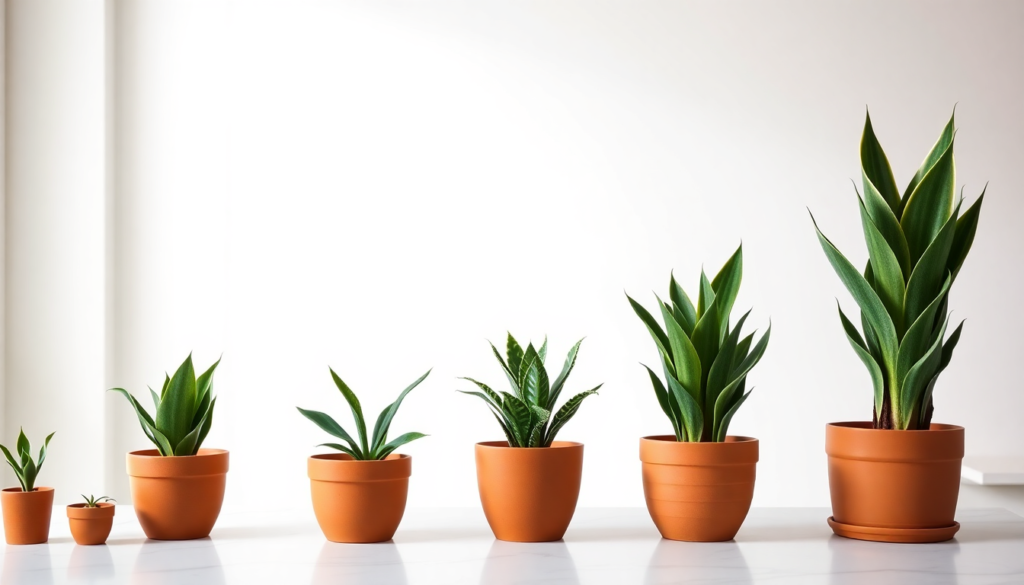
The most common snake plant pot size mistake is going too big. It feels logical: give the roots more room, get a bigger, healthier plant. With snake plants specifically, the opposite is true. A pot significantly larger than the root ball holds excess wet soil that the roots cannot access, which creates the anaerobic, oxygen-poor conditions that cause root rot, even when you water correctly and use fast-draining soil.
Getting snake plant pot size right is one of the highest-leverage decisions in snake plant care. The correct pot size directly controls how fast the soil dries, how often you water, and whether root rot risk is high or low over the plant’s life in that container.
Quick Answer
Snake plants need a pot 1 to 2 inches larger in diameter than their current root ball. Use wider, shallower pots rather than deep ones since snake plants spread horizontally via rhizomes. A 4-inch pot suits pups and small varieties. An 8 to 10-inch pot suits most standard indoor plants. Never jump more than one pot size at a time.
Quick Take Snake plants prefer to grow slightly tight in their pots. They thrive in pot-bound conditions and do not need repotting often. The correct snake plant pot size is the smallest container that comfortably fits the current root ball with 1 to 2 inches of space around the sides. Too small restricts growth and dries the soil too fast. Too large holds wet soil the roots cannot reach, raising root rot risk dramatically. Because Sansevierias like to spread out as they grow, they do not need a deep pot. A deep pot has more soil mass at the bottom which leads to water retention and root rot.
Why Snake Plant Pot Size Matters More Than Most Plants
A pot that is too large holds onto moisture for far too long, creating a soggy environment that snake plant roots absolutely despise. This matters more for snake plants than for tropical houseplants because snake plants store water in their thick leaves and rhizomes. They use far less water than moisture-loving tropicals. In an oversized pot, the soil outside the root ball stays wet for days or weeks after watering since the roots never reach it. That persistently wet zone breeds Fusarium and Pythium fungi that spread inward toward the roots.
Snake plant wants a cramped, poor quality home to mimic the soil conditions of its native habitat. In West Africa, snake plants grow in rocky, shallow soil where roots spread laterally rather than downward. Their natural growing environment is essentially a shallow, well-draining substrate, which explains why they respond so well to wide, shallow pots and poorly to deep containers with significant soil volume below the root zone.
One mistake many plant owners make is choosing pot size based on plant height rather than root ball size. A 3-foot-tall Laurentii has a surprisingly shallow root system and does not need a pot as large as its height suggests. Match the pot to the roots, not the leaves.
The Snake Plant Pot Size Formula
Use this formula for every pot size decision: the new pot should be 1 to 2 inches larger in diameter than the current root ball diameter, and no deeper than necessary to accommodate the root ball with 1 to 2 inches of soil below it.
When repotting a snake plant, go up one pot size. If yours is in a 6-inch grow pot, then an 8-inch pot would be the size to use. This one-size-up rule applies at every stage of the plant’s life. An 8-inch plant should go into a 10-inch pot, and a 10-inch plant into a 12-inch pot.
The only exception applies to very large mature plants. When repotting a 6-foot snake plant from a 10-inch grow pot, moving to an 18-inch pot is appropriate because the size is proportionate to the plant. At this scale, strict one-size-up rules produce a pot that looks visually undersized relative to the plant. For standard indoor specimens under 4 feet, the one-size-up rule applies without exception.
Snake Plant Pot Size by Variety and Growth Stage
| Plant Stage or Variety | Recommended Pot Size | Notes |
| Fresh pup or propagated cutting | 4 inches | Small root system needs small soil volume |
| Bird’s Nest Hahnii (mature) | 4 to 6 inches | Compact rosette, shallow root system |
| Twisted Sister (mature) | 4 to 6 inches | Hahnii hybrid, similar compact root system |
| Sansevieria Cleopatra (mature) | 4 to 6 inches | Slow grower, small root ball |
| Standard trifasciata, 12 to 18 inches tall | 6 to 8 inches | Most common indoor size range |
| Laurentii or Zeylanica, 2 to 3 feet tall | 8 to 10 inches | Wider spread needed for rhizome expansion |
| Large specimen, 3 to 4 feet tall | 10 to 12 inches | Stable base important at this height |
| Floor plant, 4 to 6 feet tall | 12 to 14 inches | Wide, heavy pot prevents tipping |
| Very large mature plant, 5 to 7 feet | 14 to 18 inches | Division often better than further upsizing |
Wide vs. Deep: Why Shape Matters as Much as Size
Because Sansevierias like to spread out as they grow, they do not need a deep pot since deep pots have more soil mass at the bottom which could lead to water retention and root rot. This is one of the most important and least-discussed aspects of snake plant pot size selection.
Snake plants grow from rhizomes, which are horizontal underground stems that spread outward rather than downward. New pups emerge from rhizome extensions moving sideways through the soil. The root system follows this lateral pattern, producing a root network that is wider and shallower than most people expect when they first unpot a mature plant.
A wide, shallow pot matches this growth pattern perfectly. It gives the rhizomes room to extend laterally, keeps the total soil volume low enough to dry at the right rate, and prevents the deep soil column that stays perpetually wet below the root zone. A standard bowl-shaped pot or a wide terracotta bulb pot works better for snake plants than a tall, narrow orchid pot or a deep nursery pot.
When choosing between two pots of similar diameter, always choose the shallower one for a snake plant. The extra depth does not benefit the roots and only adds wet soil volume that raises rot risk.
Pot Material: How It Changes Your Effective Pot Size
The material your pot is made from changes how quickly the soil dries, which affects how the pot size behaves in practice. Two snake plants in identical soil with identical watering schedules behave differently based purely on pot material.
Terracotta is porous and actively wicks moisture from the soil through its walls. A snake plant in a terracotta pot dries its soil 30 to 40% faster than the same plant in a plastic pot of identical size and soil. This means you can use a slightly larger terracotta pot without the same rot risk you would face with a larger plastic pot. Snake plants store water in their thick leaves and rhizomes, so their roots absolutely hate sitting in wet soil. Terracotta’s wicking action compensates for this by accelerating drying.
Plastic retains moisture the longest. A plastic pot of a given size behaves like a larger terracotta pot in terms of moisture retention. If you prefer plastic pots, stay at the strict lower end of the sizing range and use a more aggressively draining soil mix with higher perlite content.
Glazed ceramic falls between the two. The glaze prevents the porous wicking of terracotta but the weight and wall thickness of ceramic pots help moderate temperature swings around the root zone.
| Pot Material | Drying Speed | Sizing Approach |
| Terracotta | Fastest | Use standard 1 to 2 inch larger formula |
| Unglazed clay | Fast | Use standard formula |
| Glazed ceramic | Moderate | Stay at lower end of size range |
| Plastic | Slowest | Use strict lower end, increase perlite |
| Fabric grow bags | Very fast | Reduce size slightly, water more often |
The Oversized Pot Problem: How It Causes Root Rot
Getting the pot size right is the secret to a happy thriving snake plant. A pot that is too large holds onto moisture for far too long, creating a soggy environment that snake plant roots absolutely despise. Here is the exact sequence of events when a snake plant goes into an oversized pot:
The root ball occupies the center of the pot and the soil around the edges stays outside the root zone. When you water, the root ball gets the moisture it needs but the surrounding soil also gets saturated. The root ball dries within the normal window of 24 to 48 hours. The surrounding wet soil stays moist for 5 to 10 days longer. That soil becomes oxygen-depleted. Fusarium and Pythium spores that exist naturally in all potting soil germinate and establish in the wet anaerobic zone. The fungal colony spreads inward toward the root ball. By the time the plant shows visible symptoms (yellow leaves, mushy base, foul-smelling soil), the root system is already compromised.
This entire sequence can happen even with perfect watering habits and high-quality fast-draining soil, simply because the pot is too large. The solution is never to water less to compensate for an oversized pot. The solution is to use the correctly sized pot from the beginning.
Signs Your Snake Plant’s Pot Is Too Small
A too-small pot causes its own set of problems. When roots fill the entire container, the root-to-soil ratio shifts to the point where there is almost no growing medium left to hold water or nutrients. The plant effectively becomes drought-stressed even with regular watering.
Watch for these signals that your snake plant has outgrown its pot: roots visibly emerging from the drainage holes or circling the surface of the soil, water draining through the pot almost instantly with very little absorption, the plant drying out within 24 hours of thorough watering, zero new growth during spring and summer despite adequate light and fertilizing, and pups crowding the base of the pot with no room to develop their own root systems.
A lot of snake plants will actually crack the pots they are contained in, so do not place one in a pot you are too attached to. Plastic nursery pots are especially vulnerable to cracking under rhizome pressure once the plant becomes severely root-bound.
Signs Your Snake Plant’s Pot Is Too Large
The signs of an oversized pot are subtler and develop slowly over weeks. Soil stays wet for 4 or more days after thorough watering rather than drying within 24 to 48 hours. A faint musty or sour odor develops from the soil between waterings. Lower leaves begin to yellow slowly despite seemingly correct watering. The plant shows minimal growth despite good light and seasonal fertilizing.
If you identify an oversized pot before root rot develops, the fix is straightforward: unpot the plant, shake off excess soil, confirm the roots look healthy and white, and repot in a correctly sized pot with fresh fast-draining soil. Do not add extra perlite to compensate for an oversized pot since this reduces moisture retention to the point where the root ball dries too fast while the outer soil remains wet, which is worse than both alternatives.
Drainage Holes: Non-Negotiable for Every Pot Size
Correct pot size without adequate drainage produces the same root rot outcome as an oversized pot. Choose pots with integrated drainage holes and thick sidewalls to prevent root rot and provide stability. Every snake plant pot, regardless of material, size, or price, must have at least one drainage hole. For pots larger than 10 inches in diameter, two or more drainage holes significantly improve drainage performance.
Never use a pot without drainage holes, even temporarily. Never block drainage holes with gravel, mesh, or pot shards under the belief that this improves drainage. Gravel at the bottom of a pot creates a perched water table that keeps the soil above it wetter for longer, not drier. The drainage hole serves one function: allowing water to exit the pot completely after every watering. Nothing substitutes for it.
If you want to use a decorative outer pot without drainage holes, keep the snake plant in a plastic nursery pot with drainage holes inside the decorative cover. Remove the inner pot to water, let it drain completely, and return it dry to the cover pot.
When to Move Up a Pot Size
The timing of pot size changes matters as much as the size itself. Early spring before the growing season begins is the best time since active metabolism supports faster root establishment in the new soil volume. Moving up a size in the middle of winter during dormancy leaves the plant in an oversized pot with no metabolic activity to quickly colonize the additional soil volume with roots, which maximizes the wet soil risk window.
Watch for the specific signals that the plant is ready rather than repotting on a fixed timeline. They prefer to grow slightly tight in their pots. A snake plant that still has visible potting mix between its leaves and the pot wall is not ready to move up regardless of how long it has been in that pot.
Frequently Asked Questions
What size pot does a snake plant need? A snake plant needs a pot 1 to 2 inches larger in diameter than its current root ball. For most standard indoor snake plants between 12 and 24 inches tall, an 8 to 10-inch pot works well. Compact varieties like Bird’s Nest Hahnii thrive permanently in a 4 to 6-inch pot. Large floor plants at 3 to 4 feet tall need a 10 to 12-inch pot. Never jump more than one size at a time.
Is it better to have a bigger or smaller pot for a snake plant? Smaller is always safer than larger for snake plants. They thrive in pot-bound conditions and prefer a snug fit. An undersized pot causes the plant to dry out too fast and eventually restricts growth. An oversized pot holds wet soil outside the root zone for too long and causes root rot. If you are unsure, choose the smaller of two options.
Do snake plants like deep or shallow pots? Shallow and wide is always better than deep and narrow for snake plants. Because Sansevierias like to spread out as they grow, they do not need a deep pot. Deep pots have more soil mass at the bottom which leads to water retention and root rot. Their rhizomes spread horizontally, not downward, so shallow pots match their natural growth pattern.
What happens if a snake plant pot is too big? An oversized pot holds wet soil in the zones the roots cannot reach. That wet soil becomes oxygen-depleted within 24 to 48 hours and creates ideal conditions for Fusarium and Pythium root rot fungi. The plant shows symptoms (yellowing, mushy base, foul soil smell) weeks after the rot begins. By then the root system is already compromised. Fix by repotting into a correctly sized container before rot becomes established.
How do I know when to move my snake plant to a bigger pot? Move up one pot size when you see roots emerging from drainage holes, water draining almost instantly without absorption, the plant drying out within 24 hours of watering, zero new growth during the growing season despite good light and watering, or pups crowding the base with no room to develop. Do not repot based on a fixed timeline. Watch for these specific signals.
Does pot material affect which size I should choose? Yes. Terracotta dries 30 to 40% faster than plastic because its porous walls wick moisture. In a terracotta pot you can use the standard one-to-two-inch larger formula. In plastic, stay at the strict lower end of the range and use soil with higher perlite content since the slower drying rate means even a correctly sized plastic pot holds moisture longer than an equivalent terracotta.