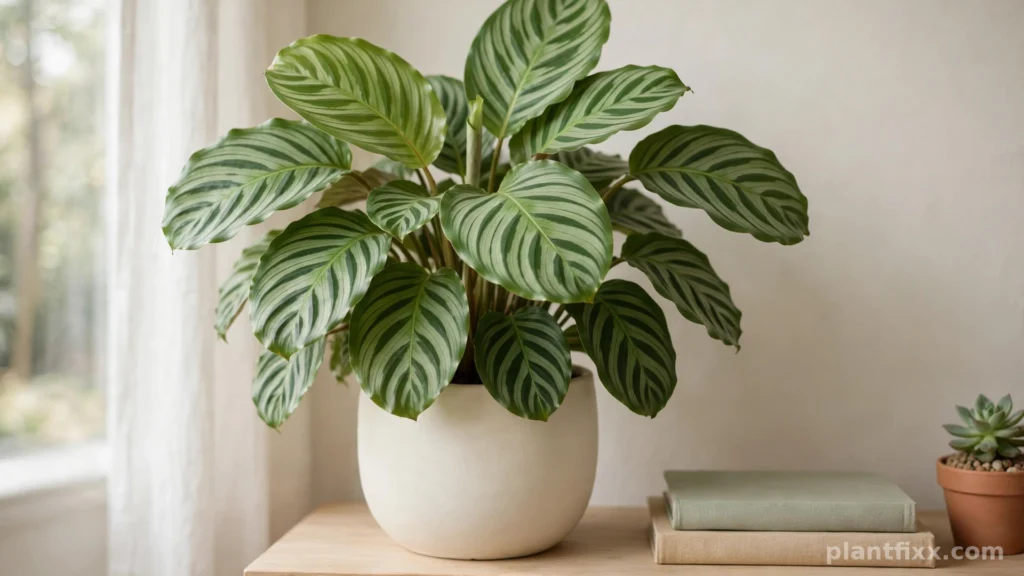
Calathea care comes down to four steady habits: bright indirect light, soil that stays evenly moist, humidity above 50 percent, and soft water. Hold those four and this famous drama plant grows steadily. Let any one of them swing and the leaves report it within weeks, first as curling, then as brown edges.
This calathea care guide gives you the full routine: the light, water, humidity, soil and feeding targets, the variety choices that make the job easier or harder, and what each leaf problem is telling you.
One more reason it suits small homes: calathea is non toxic to cats and dogs, one of the few bold patterned plants a pet owner can place without a safety plan.
Why Calathea Care Feels Hard: The Rainforest Floor Rule
Every calathea demand traces back to one habitat. In the wild these plants grow on the floor of Central and South American rainforests, under a tree canopy that blocks direct sun, in air that stays warm and wet, on ground that rarely dries out.
Leaves are the plant’s reporting system. A calathea folds its leaves up at night and opens them flat in the morning, a movement called nyctinasty.
It runs on water pressure: a small joint at the base of each leaf stalk, the pulvinus, pumps water in and out of its cells, and the leaf rises or folds as the pressure changes.
Stress uses the same system, so curling leaves, crispy edges and faded patterns are not bad luck. Each points at a gap between your room and the rainforest floor, with a specific fix.
The second rule is consistency: average conditions held steady beat good conditions that swing. How to care for calathea well is mostly how to remove the swings.
What You Need Before You Start
Calathea plant care needs a short list of basics, and two of them surprise new owners:
- A pot with drainage holes, only 1 to 2 inches wider than the root ball
- A moisture holding but airy potting mix (recipe in the soil section below)
- Rainwater, distilled water or filtered water if your tap water is hard
- A pebble tray or small humidifier, or a bathroom shelf with light
- A balanced liquid houseplant fertilizer
- Clean scissors for trimming dead leaves
Skip the misting bottle as your main humidity plan. Misting raises the air moisture for minutes, not hours, and wet leaves in still air invite leaf spot.
Calathea Care at a Glance
| Factor | Target | First sign it is off |
|---|---|---|
| Light | Bright indirect, medium light tolerated | Faded patterns, scorched patches in sun |
| Water | Evenly moist, water when the top inch is dry | Curling when dry, yellow when soggy |
| Water type | Rain, distilled or filtered if tap water is hard | Brown crispy tips and edges |
| Humidity | 50 to 60 percent or higher | Crispy edges, curling, spider mites |
| Temperature | 65 to 85 degrees Fahrenheit, never below 60 | Drooping, stalled growth in cold |
| Soil | Peaty or coir mix with perlite, slightly acidic | Stays wet for weeks or dries in days |
| Feeding | Half strength, monthly, spring and summer only | Brown tips if overfed |
Light: Bright Indirect, and What That Means in a Small Home
A calathea wants the light of a forest floor: bright, but filtered before it lands.
Direct sun through glass scorches the thin leaves and bleaches the patterns in days. These leaves have little protective tissue, so they burn faster than the thick leaves of a snake plant or ZZ plant.
Deep shade does slower damage: the plant stops replacing leaves and the markings dull toward plain green.
The dulling is a survival trade: patterned leaf tissue carries less chlorophyll, so in weak light the plant grows greener leaves to gather more energy, and the pattern fades first.
A spot a few feet back from an east or south window is the classic answer. A north window works if the plant sits close to the glass.
Light drops off fast with distance. A plant six feet from a window may get a small fraction of the light it would get on the sill, even in a room that feels bright.
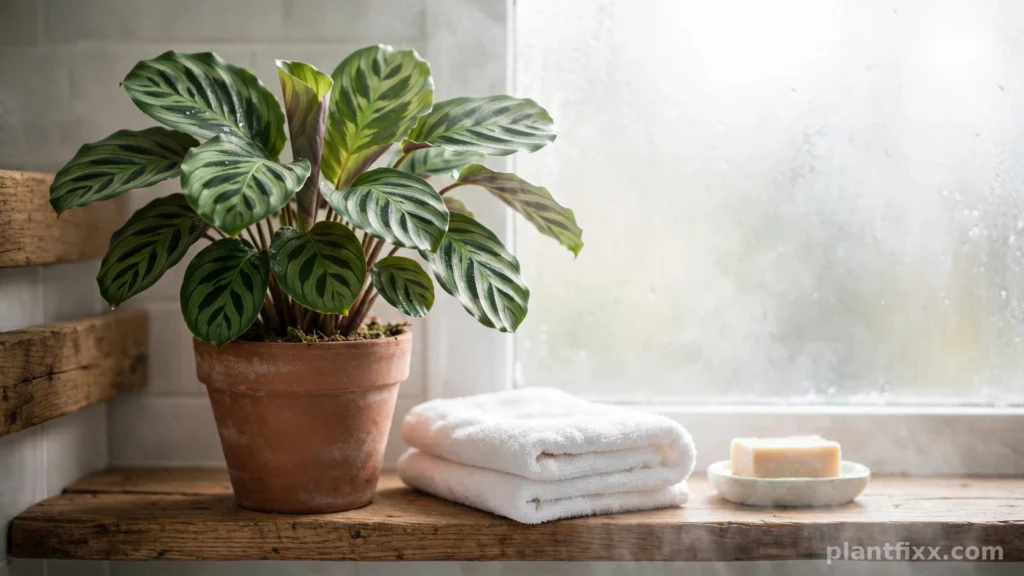
A bright bathroom window is often the best seat in the home, pairing light with humidity. Rotate the pot weekly so it grows evenly.
Calathea tolerates the medium light most apartments actually have, which is why it earns a place on our list of the best low light indoor plants for small spaces.
Tolerates is the honest word: expect slower growth and softer patterns, and move it closer to the window if new leaves arrive smaller than the old ones.
For exact levels, see calathea light requirements, measured in foot candles.
Water: Keep It Evenly Moist, and Watch What Is in the Water
Calathea breaks the standard houseplant rule. Pothos and snake plants want a full dry out between drinks.
A calathea wants the opposite: soil that stays evenly moist, never soggy and never bone dry. Let the mix dry out completely and the leaves roll into tubes.
The working routine is a finger check. Push a finger an inch into the mix.
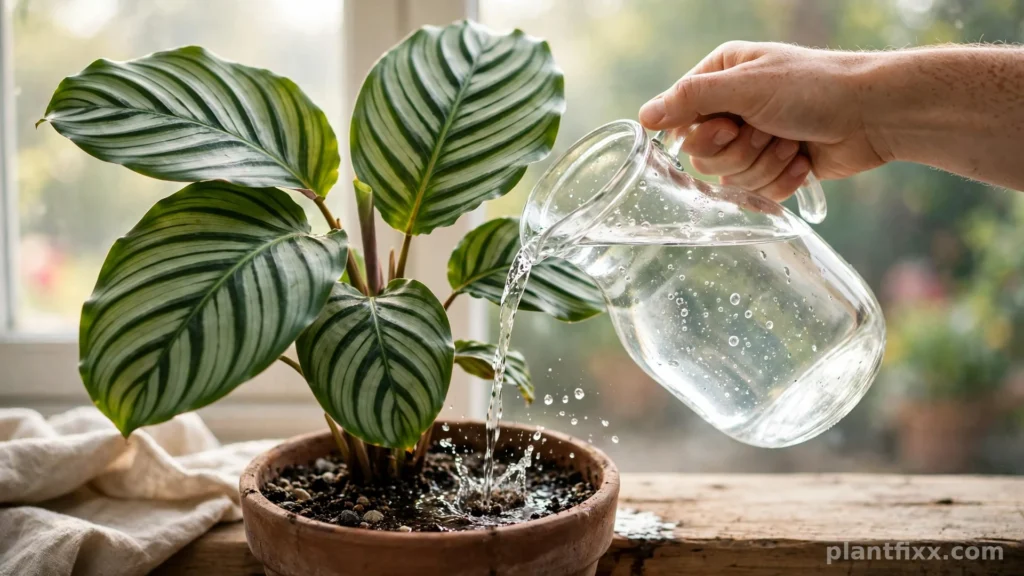
Dry at that depth means water now, until it runs from the drainage holes, then empty the saucer. Damp means check again in two or three days.
In most homes this means about once a week in the growing season and less in winter. The finger check decides, not the calendar.
Evenly moist has a hard edge, because roots breathe. Waterlogged mix pushes the air out, roots suffocate, and rot organisms take over.
That is why drainage holes are not optional on this plant.
Water quality is the part of calathea plant care most guides rush, and it causes more brown tips than any schedule.
Calathea leaves are sensitive to the fluoride, chlorine and salts in many tap supplies. North Carolina State Extension guidance for calathea is direct: water with rain water or distilled water, and avoid tap water because its fluoride turns the foliage brown.
The mechanism explains the pattern. Water travels up the plant and evaporates from the leaves, and fluoride rides along, but the plant cannot break it down or shed it. It concentrates at the end of the line, the leaf tips and margins, until the tissue burns, which is why damage shows at the edges first.
In practice, rank your options. Rainwater and distilled water are the safe defaults, and filtered water helps in many areas.
Tap water left standing overnight is a partial fix only. Standing lets chlorine off gas, but it leaves fluoride and salts behind.
If your tap supply is soft and the tips stay clean, your water is fine as it is. If tips brown while moisture and humidity are right, change the water before anything else.
Humidity: The Factor That Decides Almost Everything
If one factor decides whether a calathea thrives or crisps, it is the moisture in the air.
These plants do best at 50 to 60 percent humidity or higher, the range North Carolina State Extension lists for the plant.
Heated and air conditioned homes often sit at 30 to 40 percent. The plant reads that gap on its leaf edges within weeks.
The reason is pull: dry air draws water out of the leaves faster than roots can replace it, and the edges, furthest from the supply, dry first.
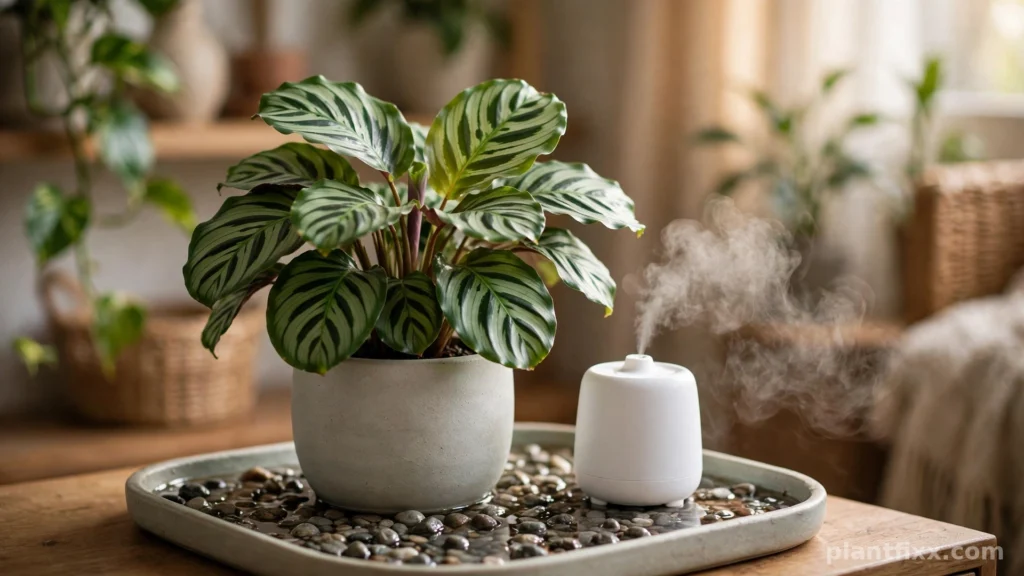
Three methods work, in order of reliability. A humidifier is the only one that holds a set level all day, and the fix for a dry home in winter.
Grouping plants on one tray raises the humidity in that shared pocket of air, since each plant releases moisture the others use. A pebble tray under the pot adds a modest local lift.
A bathroom with a window gives free humidity at every shower. A spot beside a radiator or vent gives the driest air in the home, and no tray cancels that.
Soil and Potting: Moist, Airy, Slightly Acidic
The mix has to hold moisture and air at the same time, and building it from parts solves that.
A reliable home recipe is 2 parts peat based or coco coir potting mix, 1 part perlite, and 1 part fine orchid bark.
The parts do different jobs. Peat and coir hold thin films of water around their fibers, while perlite and bark hold the mix open in larger pores that drain and refill with air. Roots drink from the films and breathe from the pores.
The result should feel like a wrung out sponge after watering, damp through, never heavy.
Standard peat or coir mixes land in the slightly acidic range it prefers.
Avoid dense garden soil, and avoid a chunky succulent or orchid mix that drains faster than this plant can use.
Repot in spring, every one to two years, or when roots circle the drainage holes.
Move up only 1 to 2 inches in pot size. A far bigger pot holds wet mix the roots cannot reach, and sitting water rots them.
Calathea resents root disturbance, so keep the root ball as intact as the job allows. Spring repotting is the one moment to divide a crowded plant, since it propagates by division and never from leaf cuttings.
See our full guide to calathea propagation by division.
Temperature and Feeding: Warm, Steady, Light Handed
Calathea is a warm room plant. It grows well between 65 and 85 degrees Fahrenheit and sulks below 60.
In practice that means keeping it away from winter window glass, exterior doors and air conditioning vents, since sudden swings harm more than a steady cooler room.
Feed lightly. A balanced liquid fertilizer at half the label strength, once a month in spring and summer, is enough.
Stop feeding in autumn and winter, when growth slows and food only adds salts.
Fertilizer salts build up in a mix that stays moist, because little water passes through to carry them away. The first place it shows is the leaf tips.
If tips brown on a fed plant with good humidity, flush the pot with plain distilled water before the next feed.
Wipe the leaves with a damp cloth every few weeks. Dust slows the light they take in and hides the first spider mites.
Calathea Varieties: Pick the One That Forgives You
Most calatheas sold for homes grow 1 to 2 feet tall and wide, but their temperaments differ more than their sizes.
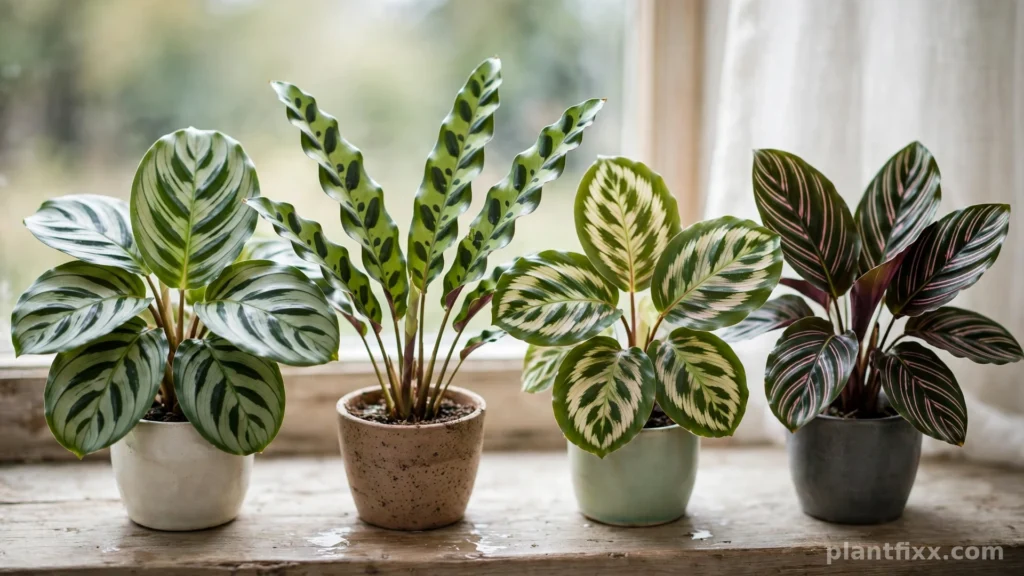
Start with the forgiving end if this is your first calathea. Rattlesnake plant (Calathea lancifolia) carries long wavy leaves with dark spots and a purple underside.
It tolerates average home humidity better than most of the family. Peacock plant (Calathea makoyana) shows feather patterns in green and cream and handles medium light well.
The middle of the ladder asks for steadier humidity. Pinstripe plant (Calathea ornata) has deep green leaves lined with fine pink stripes that fade fast in dry air.
Medallion types (Calathea roseopicta) carry bold painted patterns and brown at the edges when the air or the water is wrong.
At the top sit the two famous ones. Calathea orbifolia, with wide silver striped leaves, is slow growing and quick to mark in dry rooms.
Calathea white fusion is the most humidity demanding calathea in normal trade. Its white center stripe carries no chlorophyll, so the plant runs on its green margins alone and grows slowly.
Both are poor first plants. Buying the forgiving variety first is the cheapest care upgrade there is.
For the dark-leaved form with a pink stripe, see our calathea dottie plant care guide.
Is a Calathea Plant Safe for Cats and Dogs
Yes. This is one of the clearest answers in houseplant safety.
The ASPCA lists Calathea as non toxic to dogs, cats and horses, under the family Marantaceae.
The contrast is structural. Pothos, philodendron and peace lily carry needle shaped calcium oxalate crystals in their leaves, which burn a chewing pet’s mouth.
Calathea leaves carry none. A cat can chew a leaf without that poisoning risk, which is a large part of why this plant suits pet homes.
Two honest limits belong with that answer. Eating any plant material can give a dog or cat a mild stomach upset, so non toxic does not mean a salad bar.
And a determined pet will still shred the leaves, which harms the plant rather than the pet.
Checking a plant before it comes home? Run it through our pet safe plant checker for cats and dogs, and browse the full guide to pet safe indoor plants for cats and dogs.
For the cat-specific details, see whether calathea is toxic to cats.
Common Calathea Problems and What Each One Means
Work every problem in one check order: soil moisture first, then humidity, then water type, then light.
Leaves Curling
Curling is the plant protecting itself. A thirsty calathea rolls its leaves into tubes to cut water loss, and low humidity triggers the same roll.
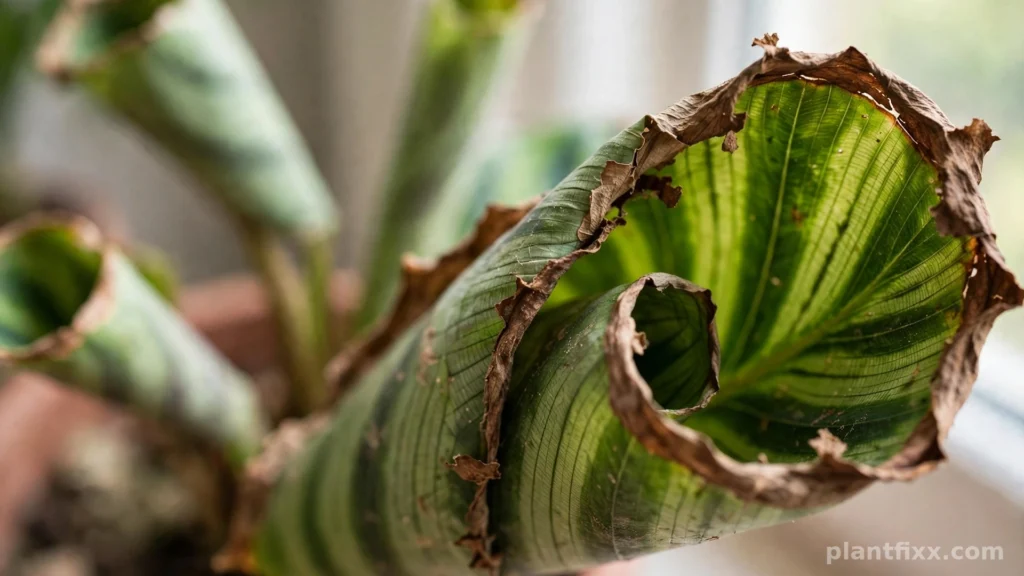
Rolling works because a curled leaf exposes less surface to dry air. It is a short term defense, not a state the plant can hold.
Dry soil an inch down means water now, and the leaves usually unroll within a day. Moist soil with curled leaves points at the air: raise humidity and move the plant away from vents.
One edge case saves needless worry: the normal nighttime fold lifts leaves upright, while a stress curl stays rolled at midday. Judge curling at noon.
Brown Tips and Crispy Edges
The most common calathea complaint has three usual causes: low humidity, minerals in the water, and salt build up from feeding.
The pattern separates them. Crisping on many leaves at once in winter points at dry heated air.
Slow browning creeping inward over months points at the water. Browning after a feeding change points at salts, and a flush with distilled water fixes it.
Trim the brown off with clean scissors, because it will not turn green again.
Yellow Leaves
One older leaf yellowing at the base now and then is normal leaf turnover. Several leaves yellowing together is a root zone problem.
In a plant that stays moist, the first suspect is too much water. Roots in airless wet mix stop working, and the plant yellows even while the pot feels wet.
Check whether the mix stays wet for more than a week and whether the pot stands in drained water.
If you are unsure which side of the line your plant sits on, our breakdown of overwatering versus underwatering signs and how to tell them apart walks through the checks.
Pests: Spider Mites and Fungus Gnats
Spider mites are the pest of dry air. Look for fine webbing and pale speckling on leaf undersides.
Wash the leaves and raise humidity to treat an early case, since mites thrive in the dry conditions the plant hates anyway.
Mealybugs, scale and aphids come off with a damp cloth or insecticidal soap.
Fungus gnats breed in surface wet mix, so let the top inch dry between waterings. The plant tolerates that well, because its roots drink deeper down.
Signs Your Calathea Care Is Working
- New leaves unfurl regularly in spring and summer, as large and patterned as the last
- Leaves fold up at night and open flat in the morning
- Leaf edges stay clean, with no new browning between monthly checks
- The mix dries at a steady pace instead of staying wet for weeks
A plant showing these signs needs no new product and no new routine, just more of the same.
The Honest Limits: Who Should Skip a Calathea
This plant does not suit everyone. Skip calathea if your watering style is neglect, because even moisture is the one thing it will not forgive.
Skip it too if your home has hard water and winter heating and you will not run a humidifier or keep distilled water on hand. The leaf edges will tell that story all year.
Skip white fusion and orbifolia until a lancifolia has lived with you happily for a season.
Choose calathea if you keep pets, if your rooms have the medium light that leaves fussier plants sulking, and if you enjoy a plant that responds visibly to care within weeks.
The Routine, in One Place
Hold the four habits steady and the plant does the rest. It only insists that you do not skip weeks.
Placing one in a dim room with pets? Our guide to pet safe low light indoor plants shows where calathea sits among the other safe choices.
How often should I water a calathea?
Water when the top inch of soil feels dry, about once a week in the growing season for most homes. The finger check decides, because pot size, light and humidity change the pace.
Why are my calathea leaves curling?
Curling means the plant is protecting itself from water loss. Check dry soil first and low humidity second. Water a dry plant and the leaves usually unroll within a day. If the soil is moist, raise the humidity.
Can a calathea grow in low light?
It survives medium to low light better than most patterned plants, but not a dark corner. Growth slows and patterns fade toward green. Bright indirect light gives the full color.
Is calathea safe for cats?
Yes. The ASPCA lists Calathea as non toxic to cats, dogs and horses. A cat that chews a leaf may get a mild stomach upset, as with any plant material, but there is no poisoning risk.
Does a calathea need a humidifier?
Not always. A bright bathroom, grouped plants and a pebble tray can be enough in a mild climate. In a heated or air conditioned home below 40 percent, a small humidifier is the only method that holds 50 to 60 percent all day.
Why does my calathea fold its leaves up at night?
That folding is called nyctinasty, the normal healthy behavior that gives the prayer plant family its name. Leaves rise at night and open flat in the morning. See the prayer plant care guide for Maranta.
Can I use tap water on a calathea?
You can if your tap water is soft and the leaf tips stay clean. Hard or fluoridated water browns the edges over time. Standing overnight removes chlorine but not fluoride, so switch to rainwater, distilled or filtered water if tip burn appears.
Pingback: 10 Pet Safe Indoor Plants for Cats and Dogs (2026 Guide)
Pingback: Best Pet Safe Low Light Indoor Plants for Cats and Dogs
Pingback: 15 Best Low Light Indoor Plants for Small Spaces (2026)
Pingback: Calathea Orbifolia Care: Light, Water, Humidity and Brown Edges
Pingback: Calathea Lancifolia Care: Rattlesnake Plant Guide
Pingback: Calathea Dottie Care: Dark Leaves and Pink Stripe Guide
Pingback: Calathea Medallion Plant Care Guide: Feathered Pattern, Light and Humidity
Pingback: Calathea Dottie Plant Care Guide: Dark Leaves, Pink Stripe, Light and Humidity
Pingback: Calathea Orbifolia Care Guide: Light, Water, Humidity and Brown Edges
Pingback: Prayer Plant Propagation: Divide or Root Cuttings in Water
Pingback: Prayer Plant Leaves Curling: Causes and Fixes That Work
Pingback: Prayer Plant Yellow Leaves: Causes by Pattern and Fixes
Pingback: Brown Tips on Prayer Plant: Causes and Fixes That Work
Pingback: Prayer Plant Problems: Symptom Guide, First Checks and Fixes
Pingback: Calathea Leaves Curling: Read the Curl Pattern and Fix It
Pingback: Calathea Light Requirements: How Much Light, Measured
Pingback: Calathea Propagation by Division: Why Cuttings Fail
Pingback: Calathea Plant Propagation by Division: Why Cuttings Fail
Pingback: Calathea Plant Light Requirements: How Much Light, Measured
Pingback: Calathea Spider Mites: Confirm, Treat and Prevent Them