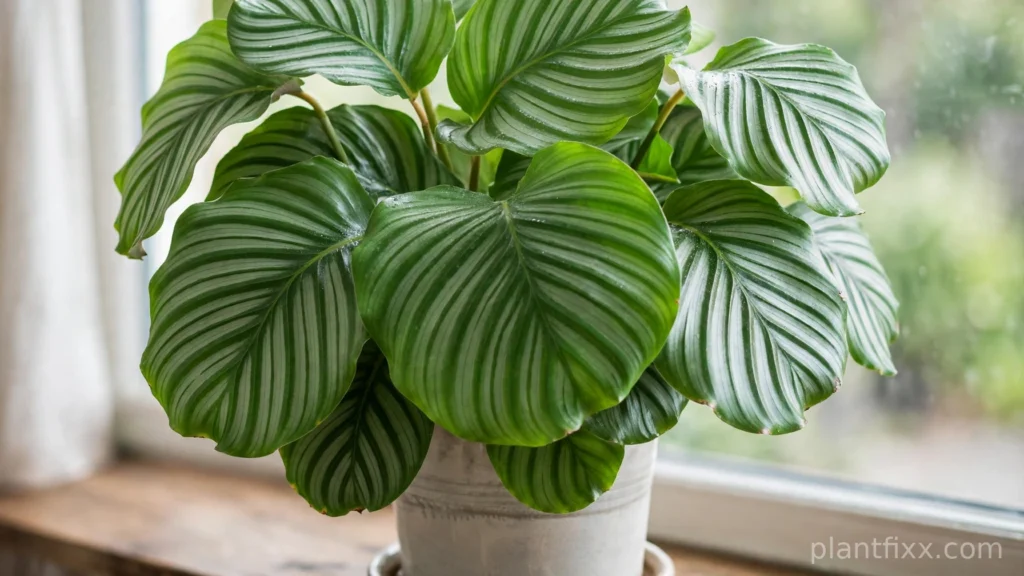
Calathea orbifolia care is about holding five things steady: bright indirect light, evenly moist soil, humidity of 60 percent or higher, temperatures between 65 and 80 degrees Fahrenheit, and soft water with low fluoride. Get those right and the round silver striped leaves keep growing clean edges. Let humidity drop or water quality slip and brown edges appear within weeks.
This guide covers the full routine for Goeppertia orbifolia, the plant sold as Calathea orbifolia: light, watering, humidity, soil, feeding, and how to fix brown edges, curling leaves and other problems.
It also covers what most guides skip: how to keep this humidity lover happy in a small apartment, and why your tap water may be the real problem.
What Is a Calathea Orbifolia Plant?
Calathea orbifolia is a tropical understory plant from eastern Brazil, where it grows on the rainforest floor under tree cover. Botanists now call it Goeppertia orbifolia, with Calathea orbifolia kept as the familiar synonym, and you will see both names in shops.
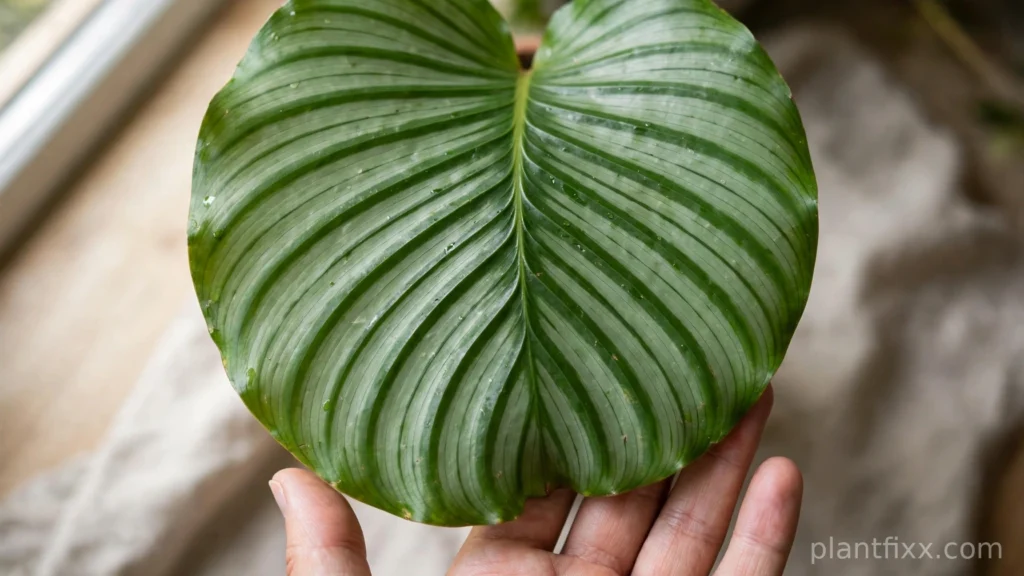
The plant earns its name from its leaves. Each leaf is almost perfectly round, up to 12 inches wide, with pale silver green stripes running across a deep green surface. A mature plant reaches about 2 to 3 feet tall, and RHS lists its height at 0.5 to 1 metre under indoor conditions.
Like all prayer plants, it moves. The leaves fold upward at night and flatten out in the morning, a rhythm called nyctinasty.
That nightly folding is completely normal and happens on a healthy plant. What matters is the difference between night folding and daytime curling, because daytime curling is a thirst signal and needs a fix.
New to the family? The complete calathea plant care guide covers every variety and the shared rules behind them. The folding habit is explained there too, in the prayer plant care guide, where nyctinasty gets its own section. For a popular patterned variety, see our Calathea Medallion plant care guide.
Calathea Orbifolia Light Requirements
Give it bright indirect light for most of the day. An east facing window is close to perfect, and a west window works if a sheer curtain softens the afternoon sun.
Direct sun through glass is the fastest way to damage this plant. The leaves are thin, with little protective tissue, so a few hours of unfiltered sun can scorch pale patches that never recover.
Too little light causes slower harm. The plant stops pushing new leaves, growth stalls, and the silver striping dulls toward plain green as the plant trades pattern for chlorophyll.
Light falls off quickly with distance from a window. A plant sitting six feet back in a room that feels bright may be getting a small fraction of the light on the sill, so keep it within a few feet of the glass.
A bright bathroom window often suits this plant best, pairing light with the humidity it wants. Rotate the pot a quarter turn each week so growth stays even on all sides.
If your best window is weak, a small grow light helps, and our roundup of the best low light indoor plants for small spaces explains how far light really reaches in an apartment.
How to Water Calathea Orbifolia
Keep the soil evenly moist, never soggy and never bone dry. This plant breaks the standard houseplant rule of letting soil dry out fully between drinks.
Use the finger check instead of a schedule. Push a finger 1 to 2 inches into the mix, and water when that depth feels dry, pouring until liquid runs from the drainage holes, then empty the saucer.
In most homes that means about once a week during the growing season and less often in winter. The finger check decides, not the calendar, because a cool dark corner dries far slower than a bright shelf.
Drainage holes are not optional. Waterlogged mix pushes air out of the soil, roots suffocate, and rot organisms take over, which shows up as yellowing leaves and a sour smell at the base.
Water quality matters as much as the schedule. Leaves of this plant are sensitive to fluoride and chlorine in many tap supplies, and NC State Extension notes the foliage browns on fluoride containing water.
The brown edges have a clear mechanism. Water travels up the plant and evaporates from the leaves, fluoride rides along, and the plant cannot break it down or shed it. It concentrates at the leaf tips and margins until the tissue burns, which is why damage shows at the edges first.
Rank your options in this order. Rainwater and distilled water are the safe defaults. A jug filter does not remove fluoride, so filtered tap water is only a partial answer.
Letting tap water sit out for 24 hours helps with chlorine only, because chlorine off gases while fluoride and salts stay behind. If tips brown while moisture and humidity are right, change the water before anything else.
Humidity and Temperature
Humidity is the factor that decides almost everything for this plant. It wants 60 percent humidity or higher, the level NC State Extension lists for Goeppertia orbifolia.
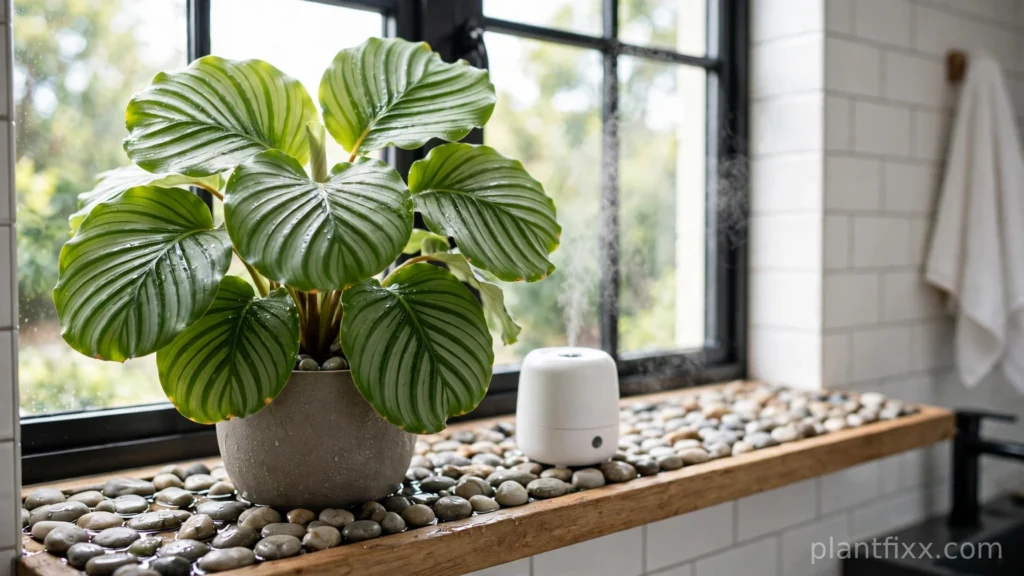
Heated and air conditioned homes often run at 30 to 40 percent. The plant reads that gap on its leaf edges within weeks, first as dry tips, then as curling and spider mites.
Dry air pulls water out of the leaves faster than the roots can replace it, and the edges, furthest from the supply, dry first. That is the same edge pattern fluoride causes, which is why the two problems get confused.
A humidifier is the only method that holds a set level all day, and it is the fix for a dry home in winter. Grouping plants together on one tray raises the humidity in that shared pocket of air, and a pebble tray under the pot adds a modest local lift.
Keep temperatures between 65 and 80 degrees Fahrenheit, and never let the plant sit in cold drafts. RHS rates Goeppertia orbifolia at H1A, needing a minimum of about 16 degrees Celsius, so an unheated room in winter is too cold.
Air conditioner vents, radiators and unsealed windows give the driest, coldest air in the home. No pebble tray cancels an AC vent blowing across the leaves.
Best Soil and Pot for Calathea Orbifolia
The mix has to hold moisture and air at the same time. Soil that dries in a day stresses the plant, and soil that stays wet for weeks rots the roots.
A reliable home recipe is 2 parts peat based or coco coir potting mix, 1 part perlite, and 1 part fine orchid bark. The coir or peat holds water, the perlite keeps air pockets, and the bark stops the mix compacting.
Aim for slightly acidic soil, around pH 6.0 to 6.5. Most quality indoor mixes sit in that range already, so a dedicated test is rarely needed unless growth looks off.
Choose a pot with drainage holes, only 1 to 2 inches wider than the root ball. An oversized pot holds more wet soil than the roots can use, and that is where rot starts.
Terracotta dries faster than plastic or glazed ceramic because the clay breathes. In a dry apartment that extra drying is a disadvantage for this plant, so plastic or glazed pots usually suit it better.
Feeding Calathea Orbifolia
Feed lightly and only in the growing season. A diluted balanced liquid fertilizer every 4 to 6 weeks in spring and summer, mixed at half the label strength, is enough.
Pause feeding in winter when growth slows. Fertilizer pushed into a resting plant builds up salts in the soil, and this species is salt sensitive.
Salt damage looks like the other edge problems: brown tips and margins that appear even when water and humidity are right. If you have been feeding at full strength, flush the soil with plain soft water and cut back to half strength.
More food does not grow bigger leaves on this plant. Steady moisture, humidity and light do, and overfeeding only adds the salt problem on top.
Calathea Orbifolia Brown Edges, Curling Leaves and Other Problems
Brown edges on this plant have three real causes, and the fix order matters. Check water quality first, humidity second, and soil moisture third, because each cause needs a different fix.
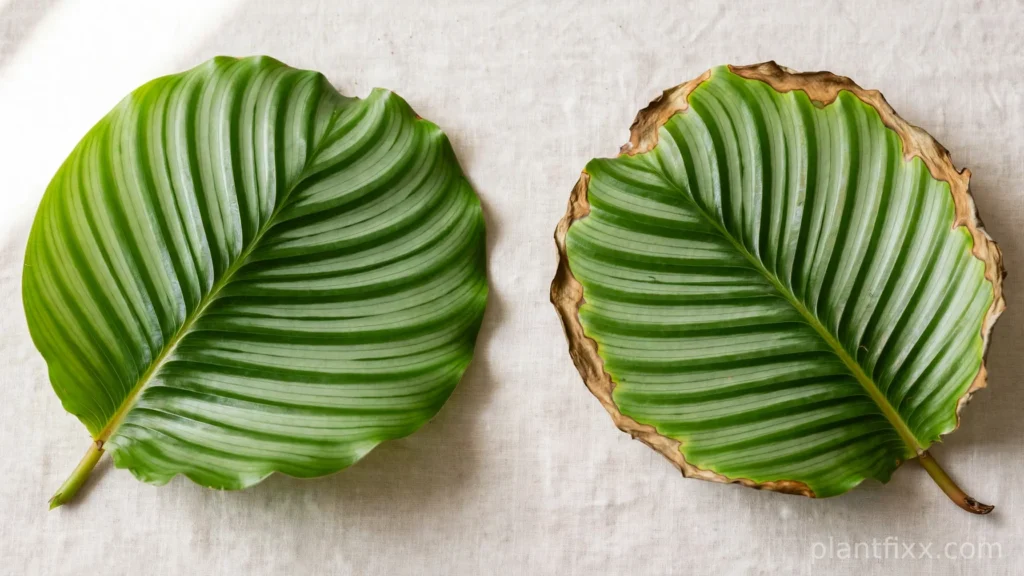
Fluoride in tap water burns the tips and margins while the rest of the leaf stays healthy. Low humidity dries the edges and makes them feel crisp and papery. Soil drying out completely rolls the whole leaf inward before the edges brown.
| Problem | Most likely cause | Fix |
|---|---|---|
| Brown crispy edges | Fluoride in tap water, or humidity below 50 percent | Switch to rain or distilled water, then raise humidity |
| Leaves rolling inward in daytime | Soil dried out, or roots damaged | Water until it drains, and check the roots if it repeats |
| Yellowing leaves | Overwatering, poor drainage, or natural aging of an old leaf | Let the top 1 to 2 inches dry, and confirm drainage holes are clear |
| Soft dark base, sour smell | Root rot from waterlogged soil | Unpot, trim black mushy roots, repot in fresh mix |
| Pale scorched patches | Direct sun through glass | Move to bright indirect light, sheer curtain on south windows |
| Faded striping, leggy growth | Too little light | Move closer to a window or add a grow light |
Trim brown tips with clean scissors, cutting just inside the green tissue and following the leaf edge shape. Trimming is cosmetic, so do it for looks, but only after the cause is fixed, or the new growth browns again.
Daytime curling deserves a clear rule. Leaves folded up at night are the plant asleep, and leaves rolled inward during the day are the plant asking for water.
If curling repeats even with moist soil, check the roots. Damaged roots cannot take up water, so the plant curls as if it were dry while sitting in wet soil, and watering more makes it worse.
Calathea Orbifolia Pests
Spider mites are the main pest, and they arrive with dry air. Fine webbing under the leaves and tiny pale speckles on the top surface are the first signs, often before you see the mites themselves.
Mealybugs show as white cottony clusters in leaf joints, aphids gather on new growth, and scale appears as small brown bumps along the stems. All four spread faster on a stressed plant.
Check the undersides of leaves weekly, since that is where the early colonies sit. A damp cloth wipe removes light infestations, and neem oil or insecticidal soap handles the rest, applied to both leaf surfaces.
Raising humidity is part of pest control here, because spider mites thrive in dry air and struggle above 60 percent. Quarantine any new plant for two weeks before it joins the group.
How to Propagate and Repot Calathea Orbifolia
Propagation is by division only, done at repotting time. This plant cannot grow from a leaf cutting, because a leaf without part of the root system has no way to feed itself.
Repot every 1 to 2 years, in spring when growth restarts. Slide the plant out, gently separate the root ball into two or three clumps, and make sure each clump keeps several leaves and healthy roots.
Pot each division in fresh mix in a container only slightly larger than its roots. Water once, let it drain, and keep it in bright indirect light while it settles.
Roots of this plant dislike disturbance, so expect a pause of a few weeks after division. Do not judge the division a failure in that window, and do not add extra fertilizer to push it.
Choose repotting time by the roots, not the calendar. Roots circling the drainage holes and pushing through the surface mean it is ready, while a plant still filling its pot can wait.
Is Calathea Orbifolia Safe for Cats and Dogs?
Yes. Calathea orbifolia is non toxic to cats and dogs, which makes it one of the safer choices for a pet home with bold patterned leaves.
Non toxic does not mean chew proof. A cat that eats leaves may still get an upset stomach from the plant matter itself, so keep it out of reach if yours is a determined chewer.
For a full list of safe options, see our guide to pet safe indoor plants for cats and dogs, where this plant sits alongside the other pet friendly choices.
Growing Calathea Orbifolia in a Small Apartment
Small spaces are where this plant is hardest, because apartments run dry and light is limited. The good news is that one setup solves most of it.
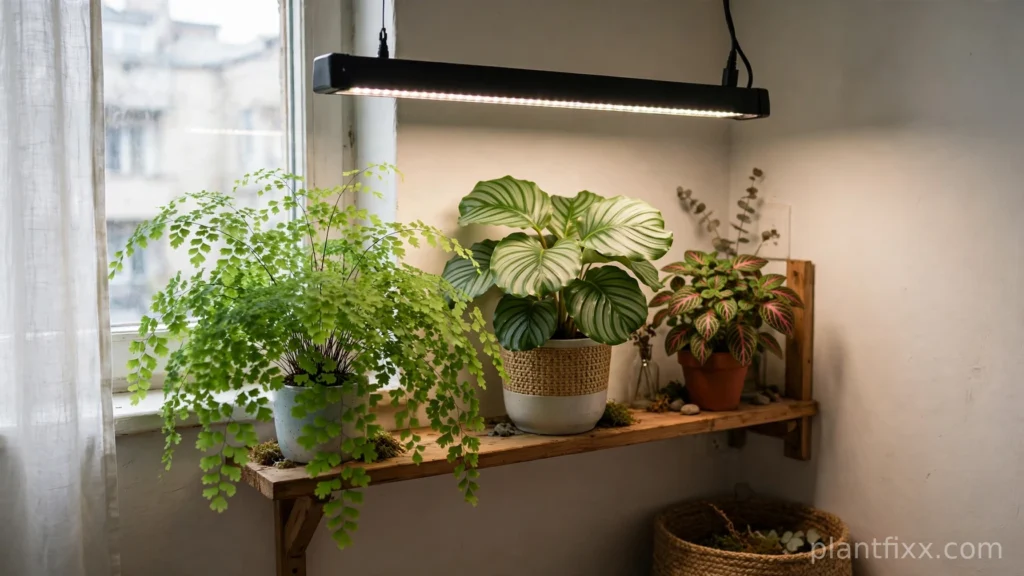
A bathroom with a window is the best seat in a small home, since every shower adds free humidity. If the bathroom has no window, group this plant with two or three other humidity lovers on one tray near your brightest window.
One small humidifier on that shelf serves the whole group, which is cheaper and tidier than chasing humidity plant by plant. Keep the humidifier a foot or more from the leaves so mist does not sit on the foliage.
For light, measure the distance instead of guessing. A grow light hung about 12 to 18 inches above the leaves, run for 12 to 14 hours, holds the striping that weak window light fades.
Quarantine new plants for two weeks before they join the group, so spider mites from the shop do not move into your humidity shelf. That one habit prevents most pest disasters in a plant collection.
Final Thoughts
Calathea orbifolia is not a difficult plant once you stop chasing it. Bright indirect light, evenly moist soil, humidity above 60 percent, and soft water cover almost every problem this species has.
When brown edges appear, work the fix order: change the water, raise the humidity, then check the soil. Most edge damage is one of those three, and each has a direct fix.
Start with the bathroom shelf or the grouped tray by your brightest window, and the round silver leaves will do the rest.
Why does my calathea orbifolia have brown edges?
The three usual causes are fluoride in tap water, humidity below 50 percent, and soil drying out completely. Switch to rain or distilled water first, then raise humidity, then check your watering routine.
Why are the leaves of my calathea orbifolia curling?
Leaves rolled inward during the day usually mean the soil is too dry or the roots are damaged. Leaves folded up at night are normal nyctinasty and need no action.
Why are the leaves of my calathea orbifolia turning yellow?
Yellowing most often comes from overwatering and poor drainage, or from an old leaf finishing its life. Check that drainage holes are clear and let the top 1 to 2 inches of soil dry between waterings.
Can I water calathea orbifolia with tap water?
It depends on your supply. If your tap water is soft and the leaf tips stay clean, it is fine. If tips brown while other conditions are right, switch to rainwater or distilled water, because a jug filter does not remove fluoride.
How do I raise humidity for calathea orbifolia without a humidifier?
Group plants together on a pebble tray near a bright window, or use a bathroom with a window. These raise humidity in a small pocket of air, though a humidifier is the only method that holds a set level all day.
How do you propagate calathea orbifolia?
By division only, at repotting time in spring. Separate the root ball into clumps that each keep several leaves and healthy roots, pot them in fresh mix, and expect a few weeks of settling before new growth.
Is calathea orbifolia toxic to cats?
No. Calathea orbifolia is non toxic to cats and dogs, so it is a safe choice for pet homes, though you should still discourage chewing to avoid an upset stomach.
How big does calathea orbifolia get?
A mature indoor plant reaches about 2 to 3 feet tall, with individual round leaves up to 12 inches wide. Pot size and light set the final size, so a larger pot and brighter spot grow a larger plant.
Pingback: 10 Pet Safe Indoor Plants for Cats and Dogs (2026 Guide)