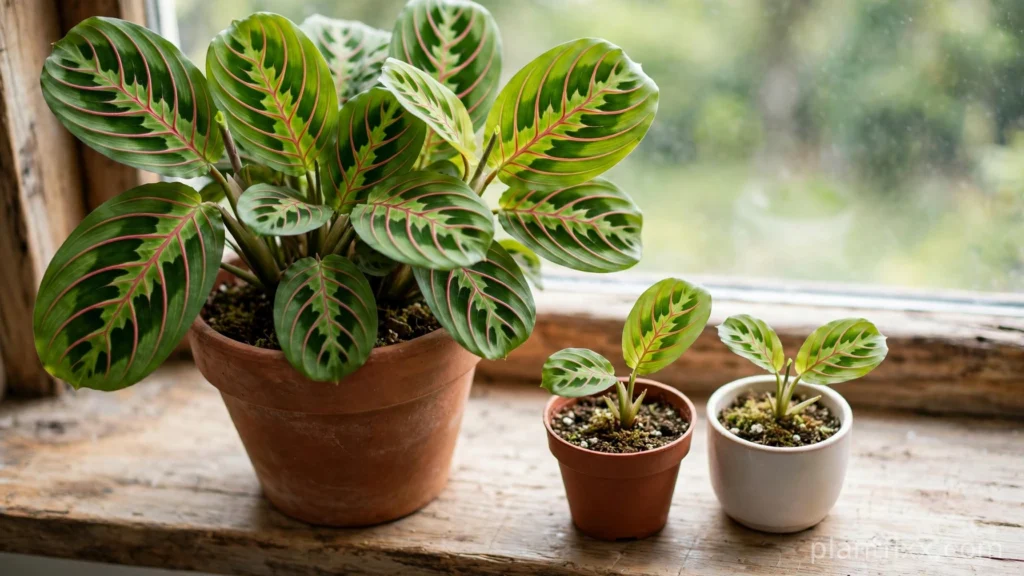
Prayer plant propagation gives you two working routes, and both start from how a Maranta grows. Divide a crowded plant at repotting time, or cut a trailing stem below a node and root that cutting in water or soil.
Division hands you a rooted plant on the same day. A stem cutting takes longer, about 2 to 4 weeks to root in water, but it costs the mother plant almost nothing and can fill gaps in her own pot.
This guide walks through both methods step by step, the readiness checks that stop most failures, a shelf sized propagation station, and first month aftercare.
Why a Prayer Plant Roots at Its Nodes: The Mechanism Behind Both Methods
A prayer plant stem is jointed. At each joint sits a node, a swollen ring where a leaf stalk leaves the stem. Inside it sits meristem tissue, cells that can change job and build roots when the stem is cut.
No node means no meristem, and no roots. A single leaf in a jar has no node, so it can stay green for weeks but will never root.
Division uses a different structure. Maranta spreads by rhizomes that add crowns, and each crown is a growing point with leaves and roots. The North Carolina Extension Gardener Plant Toolbox profile of Maranta leuconeura lists the method as rhizomatous division.
A good division needs roots plus a crown, together. Roots without a crown have no growing point. A crown with few roots cannot drink fast enough for its leaves.
One contrast sentence keeps this article in its lane. Its Calathea relatives, covered in our complete calathea plant care guide, spread by rhizome only and do not root from stem nodes, so Calathea propagation is division only and gets its own guide.
Maranta also differs from a peace lily, which has crowns and no rootable stems, as our peace lily propagation guide shows. Maranta gives you both options.
When to Propagate a Prayer Plant, and When to Wait
Spring is the start point extension sources agree on, when growth restarts and roots form fastest. The RHS prayer plant Fascinator page lists division in spring, or basal softwood cuttings with bottom heat in spring.
Early summer still works for cuttings. Wait in midwinter, when cold and low light stretch rooting out and divisions sit in cool damp mix, where rot starts.
Also wait if the plant is stressed, with yellowing, a soft base or pests. Fix the cause first using our complete prayer plant care guide.
What You Need Before You Start
- Clean sharp scissors or a small knife, wiped with rubbing alcohol
- Small pots with drainage holes, one per new plant
- Fresh potting mix with perlite for air
- A clear glass jar for water rooting, washed clean
- Room temperature distilled, rain or filtered water
- A clear plastic bag with air holes, or a clear storage box, for the humidity tent
Rooting hormone is optional. Nodes root readily in warm humid conditions without it.
Is Your Plant Ready? A Short Check Before You Cut
For division, look for a full pot with several crowns and stems rising from more than one point. A plant with one crown has nothing to spare yet.
For cuttings, pick trailing stems with a healthy node and sound leaves. Avoid yellowing stems or webbing underneath. Water the mother plant the day before division, so roots bend instead of snapping.
Method 1: Division at Repotting, Step by Step
Step 1: Tip the Plant Out and Look at the Root Ball
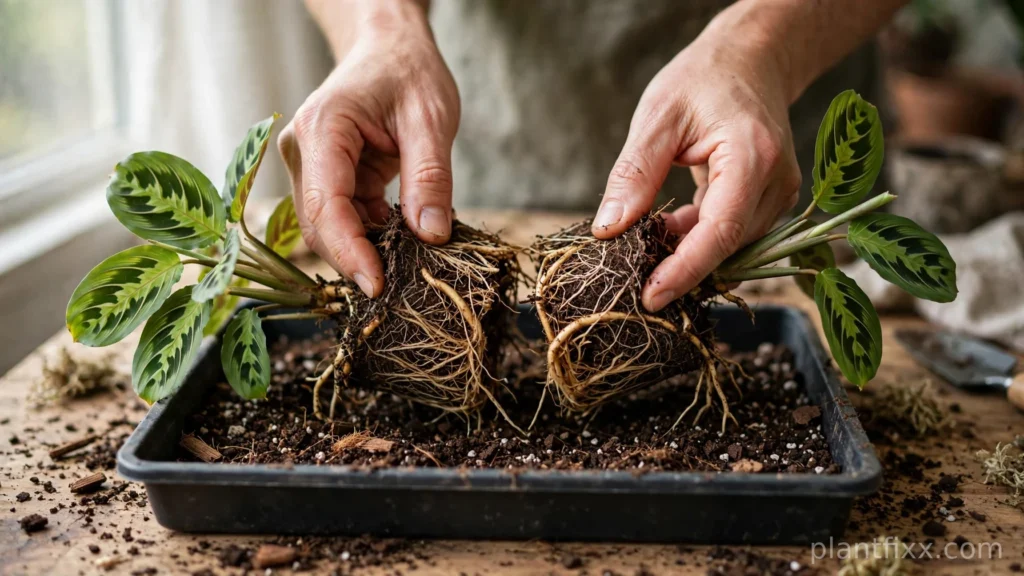
Ease the pot off sideways on a tray, support the stems, and shake loose mix away until the crowns and rhizomes show clearly.
Step 2: Find the Natural Split Lines
Each crown usually has its own leaf group and root bundle, linked by a short rhizome. Decide where the plant wants to split before you pull anything.
Step 3: Tease Apart by Hand, Cut Only What Resists
Tease the roots apart slowly, untangling rather than tearing. Where a thick rhizome will not yield, make one clean cut with your disinfected blade.
Step 4: Check Every Piece Before It Gets a Pot
Check each piece for roots plus a crown, together. Strong roots with two or three stems make a plant. A weak piece goes back with a bigger one.
Step 5: Pot at the Same Depth in a Snug Pot
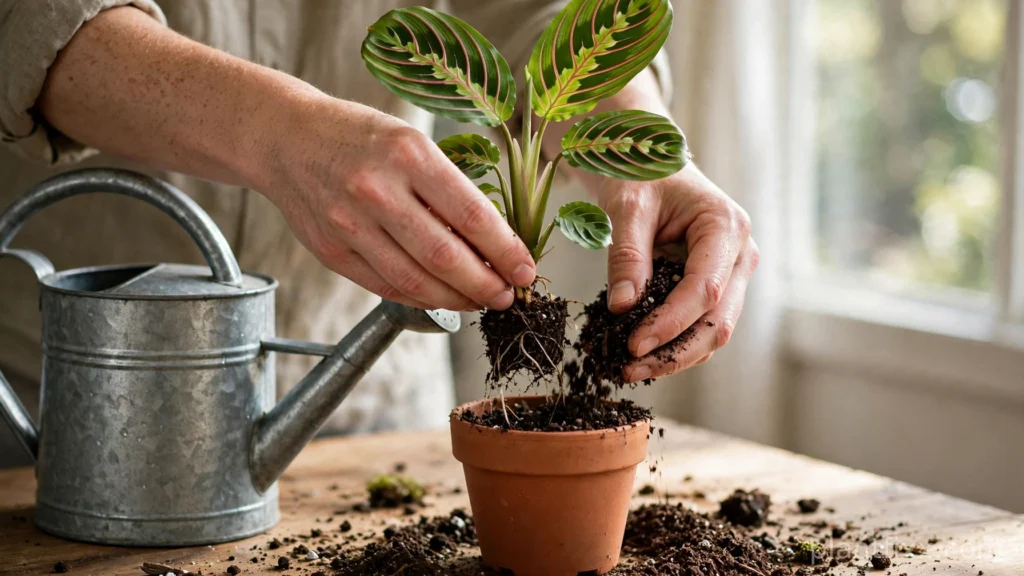
Set each division on fresh mix at its old depth, crown at the surface and never buried. Fill around the roots, firm gently, and pick a pot that hugs the root ball.
Step 6: Water In and Rest the Plant
Water slowly until it drains from the base. Place pots in bright indirect light, out of direct sun, under the humidity tent below for the first week.
Method 2: Stem Cuttings Rooted in Water, Step by Step
Step 1: Choose a Trailing Stem With a Clear Node
Pick a healthy trailing stem with a swollen node and sound leaves above it. One node and two or three leaves make a good cutting.
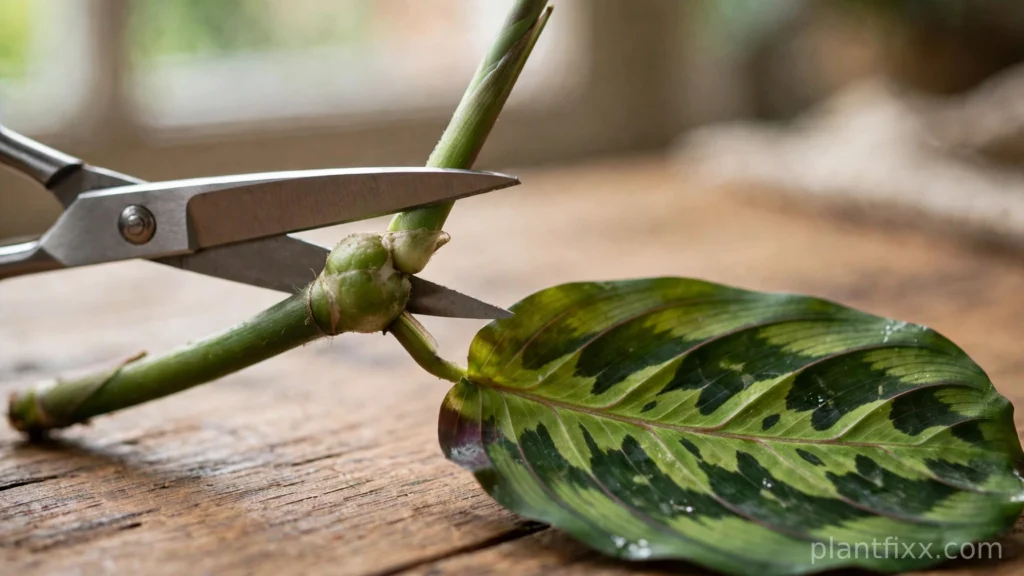
Step 2: Cut Just Below the Node
Cut about a quarter inch below the node in one firm snip. Remove any leaf that would sit under water, because submerged leaves rot and foul the jar.
Step 3: Set the Node Under Water, Leaves Above It
Stand the cutting in room temperature soft water with the node fully submerged and every leaf dry above the rim.
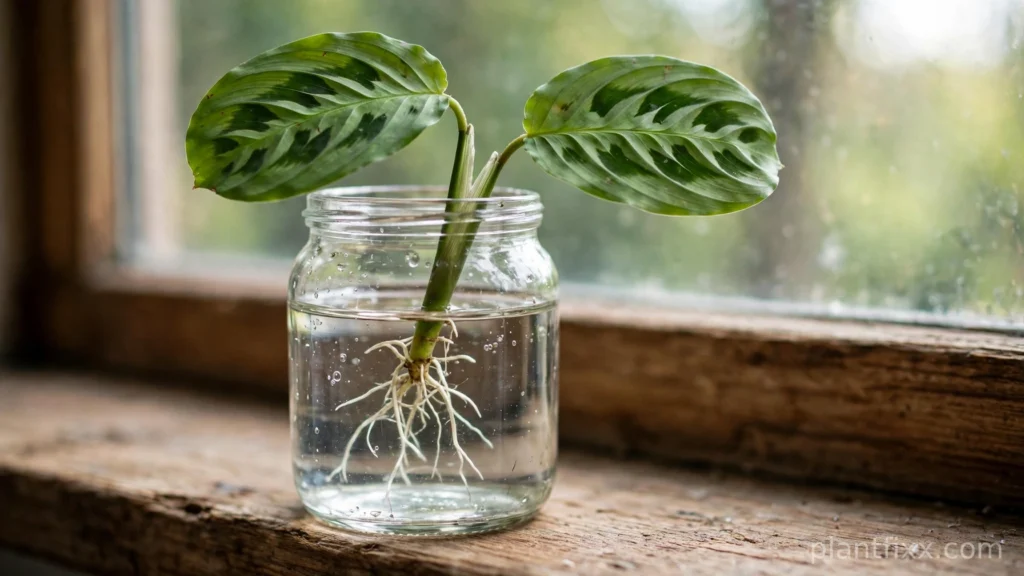
Step 4: Place the Jar and Change the Water
Put the jar in bright indirect light and change the water every few days. Stale water loses oxygen and grows the slime that rots nodes.
Step 5: Pot On at 1 to 2 Inches of Root
First roots usually show within a couple of weeks, and most cuttings are ready in about 2 to 4 weeks. Pot on when roots reach 1 to 2 inches and branch.
Do not leave a rooted cutting in its jar for months. The move to mix gets harder over time. Pot into damp mix and tent for a week.
Rooting Stem Cuttings Straight in Soil
Soil rooting skips the transfer step, so roots form as soil roots from the start. It suits cuttings for the mother pot.
- Fill a small pot with mix and perlite, watered evenly damp, not wet.
- Take the cutting as in the water method, cut just below a node.
- Push the node an inch into the mix and firm the mix around the stem.
- Cover the pot with the bag tent below, holes open for air.
- Keep the mix lightly moist in bright indirect light, lifting the tent daily.
- Test after three weeks with a gentle tug. Resistance means roots have formed.
You cannot watch roots form in soil. Judge by new leaf growth, because a fresh leaf means roots are working underneath.
A Small Space Propagation Station With a Humidity Tent
One bright shelf corner holds the whole station, the jar, soil pots and divisions. Pick steady warmth away from radiators and drafts, ideally near an east window.
In a dim home, give cuttings your brightest shelf, the same logic that puts Maranta among the best low light indoor plants for small spaces.
For the tent, slip a clear bag loosely over each pot, propped off the leaves with a chopstick, with small holes snipped in it. A clear storage box works for several pots.
Open the tent daily for a few minutes, because still saturated air grows mould. Remove it after one week for divisions, and once a cutting shows new growth.
Aftercare: The First Month, Week by Week
- Week 1: Mix lightly moist, tent on, bright indirect light. Early wilt is root disturbance, not failure.
- Week 2: Fresh water every few days for jar cuttings. Open the tent longer each day.
- Weeks 3 to 4: Pot on water cuttings at 1 to 2 inches of root. Watch for new leaves.
- Month 2 onward: Normal care, soft water, humidity above 50 percent. Feed a month after new growth.
Pot rooted cuttings back into bare spots in the mother pot to fix a leggy plant.
Signs Your Propagation Is Working
- White roots growing and branching from the node of a water cutting
- A soil cutting that resists a gentle tug and stands firm
- A division whose wilt peaks early, then lifts more each morning
- Leaves folding up at night again on a division
- A new leaf tube rising from a crown or cutting base
Signs It Has Failed, and What Can Still Be Saved
A cutting with a soft black stem at the waterline has rotted. Cut back to firm green tissue above the damage, keep a node on the piece, and restart it in clean water.
No roots after four weeks in warm bright conditions usually means no working node, or stale water. If the piece has no node, take a fresh cutting instead.
A division still wilted after a week, with a soft crown, has lost roots to rot. Trim black roots to firm tissue and repot in fresh barely damp mix.
Prayer Plant Propagation Methods Compared
| Method | What you start with | Time to a growing plant | Best for |
|---|---|---|---|
| Division | A crown with roots and leaves | Already a plant, new growth in a few weeks | A full plant at repotting |
| Stem cutting in water | A stem piece with a node | Roots in about 2 to 4 weeks | Watching roots form, filling gaps |
| Stem cutting in soil | A stem piece with a node | New leaves in about 3 to 4 weeks | No transfer step |
| Single leaf in water | A leaf with no node | Never roots | Nothing. No growing tissue |
Division carries the lowest risk, because each piece starts with roots attached. Cuttings ask for patience and clean water.
Is It Safe to Propagate a Prayer Plant Around Pets
Yes. Maranta leuconeura is non toxic to cats and dogs, so shelf cuttings are not a poisoning risk. Confirm any other plant first with our pet safe plant checker for cats and dogs.
Keep jars out of easy reach anyway. A cat that bats one off a shelf ends the propagation.
The Routine, in One Place
Divide a crowded plant in spring and give every piece roots plus a crown, or cut below a node and hold it in clean water or damp mix until roots form. Keep new plants warm, humid and out of direct sun for a month.
Judge new plants by new growth, not by first week wilt. Start small, then scale up next spring.
Can you propagate a prayer plant from a leaf cutting?
No. A leaf has no node and no meristem tissue, so it cannot build roots. Take a stem piece with at least one node instead.
How long do prayer plant cuttings take to root in water?
First roots often show within the first couple of weeks. Most cuttings are ready to pot on in about 2 to 4 weeks, at 1 to 2 inches of branched root.
Do prayer plant cuttings need rooting hormone?
No. Nodes root readily in warm humid conditions without it. Hormone cannot rescue a cutting that has no node.
When is the best time to propagate a prayer plant?
Spring, at repotting for division and as new stems grow for cuttings. Early summer works for cuttings. Avoid midwinter.
Can I put prayer plant cuttings straight into soil?
Yes. Bury the node an inch deep in damp mix, tent the pot with a holed clear bag, and keep the mix lightly moist.
How many new plants can I get from dividing one prayer plant?
As many as the clump has healthy crowns, if each piece keeps roots and several stems. Two or three solid divisions beat five weak ones.
Why is my prayer plant cutting not rooting?
Check for a node first, then stale water, then a cold or dark spot. With a node, fresh water and bright light, most cuttings root in the normal window.