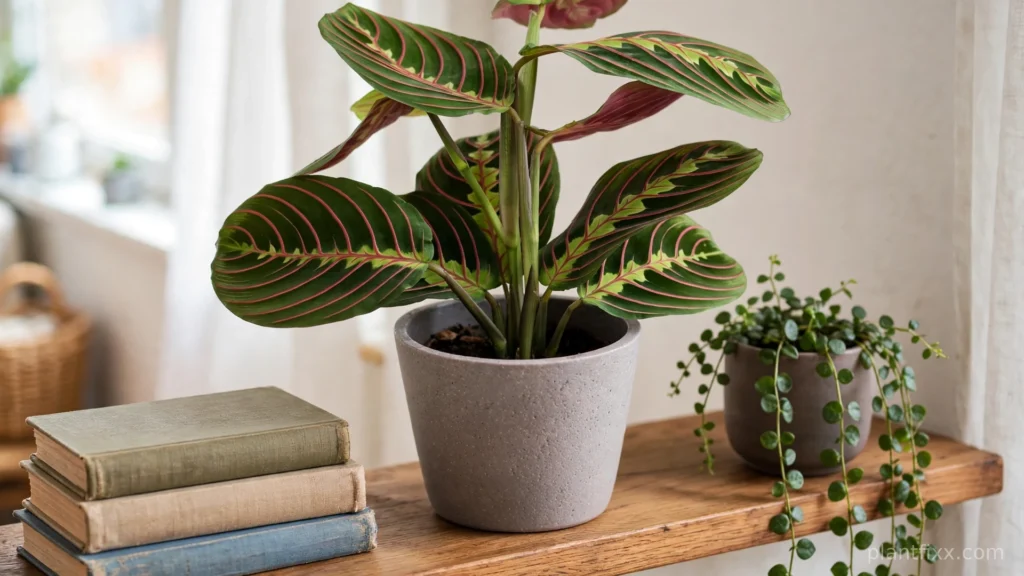
A prayer plant earns its name every evening. As the light fades, the leaves of Maranta leuconeura rise and fold together, and by morning they lie flat again. That daily movement is why prayer plant care feels different from caring for a plant that sits still.
Prayer plant care comes down to four habits: bright indirect light, soil that stays lightly moist, humidity above 50 percent, and soft water low in minerals. Meet those four and a Maranta rewards you with patterned leaves that fold every night. Miss one and the leaves tell you quickly, usually by curling.
This prayer plant care guide covers how to care for a prayer plant at home, including small apartments where space, dry air and tap water work against you: why the leaves fold, what the plant needs, the three problems behind most failures, and where the honest limits of maranta care sit.
Why Prayer Plant Leaves Fold at Night: The Nyctinasty Mechanism
Every leaf sits on a small swollen joint called a pulvinus. The pulvinus works like a hinge driven by water pressure. Cells on one side take in water and swell while cells on the other side shrink, and that pressure difference bends the leaf up or down.
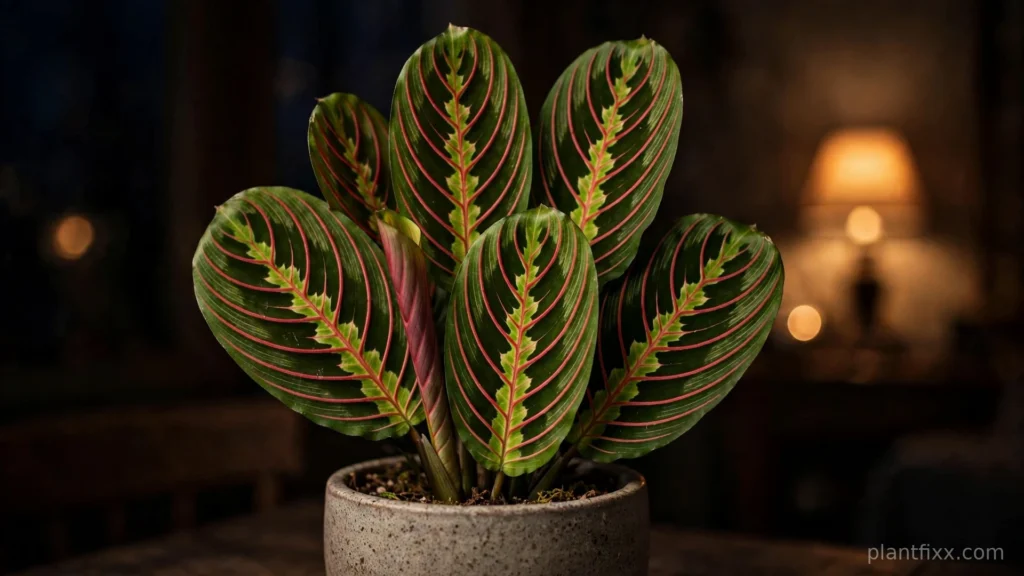
Ions, mainly potassium and chloride, moving in and out of the pulvinus cells control that pressure, and water follows the ions. The cycle runs on the plant’s internal circadian rhythm, a built in clock that also responds to light.
This movement is called nyctinasty. The North Carolina Extension Gardener Plant Toolbox profile of Maranta leuconeura describes leaves held parallel to the ground by day moving to a perpendicular prayer position at night. Why the plant folds is still debated, with shedding water off the leaves one proposed benefit.
Use the folding as a free health check. A plant that folds on time has its water, light and temperature close to right, and a plant that stays flat after dark is often stressed days before any leaf yellows. New leaves emerge as rolled tubes that unfurl over several days.
Prayer Plant Care at a Glance
| Need | What a prayer plant wants |
|---|---|
| Light | Bright indirect light. Tolerates low to medium light, but patterns fade. |
| Water | Soil lightly and evenly moist. Water when the top inch feels dry, then drain fully. |
| Water quality | Distilled, rain or filtered water. Tap water minerals and fluoride burn leaf edges. |
| Humidity | Above 50 percent. A humidifier, bathroom spot or grouped plants help. |
| Soil | 2 parts potting mix or coir, 1 part perlite, 1 part fine orchid bark. |
| Temperature | 65 to 80 degrees Fahrenheit. Keep above 60, away from drafts and vents. |
| Feeding | Half strength liquid fertilizer, monthly in spring and summer. None in winter. |
| Pot | Wide and shallow with drainage holes. One size up every 1 to 2 years. |
| Pet safety | Non-toxic to cats and dogs. |
What You Need Before You Start
- A wide, shallow pot with drainage holes. Prayer plant roots spread sideways, not deep.
- Potting mix, perlite and fine orchid bark for the soil recipe below.
- Distilled, rain or filtered water. One jug by the plant removes the daily decision.
- A balanced liquid houseplant fertilizer and clean scissors.
- Ten minutes twice a week. This plant needs regular checking more than products.
Prayer Plant Light Requirements
In the wild, Maranta grows on the Brazilian forest floor, where light arrives filtered through canopy. Reproduce that at home: bright, indirect light, no direct sun. An east facing window is the easiest placement, and a few feet back from a south or west window, or behind a sheer curtain, works the same way.
Direct sun is the one light error this plant does not forgive. It bleaches the pattern out of the leaves and can scorch pale patches into them within days. The red veins and silver bands you bought the plant for are what strong sun destroys first.
Too little light fails more slowly. A prayer plant tolerates low to medium light better than most patterned tropical plants, which is why it earns a place among the best low light indoor plants for small spaces. In dim corners, though, the stems stretch, new leaves come in smaller, and the pattern fades toward plain green.
If your only spot is dim, use the brightest shelf in that room and rotate the pot weekly.
How to Water a Prayer Plant
Prayer plant roots are shallow and fibrous, with no water reserve, so the soak and dry cycle that suits a ZZ plant or snake plant will damage a Maranta. The rule is even moisture: lightly moist at all times, never soggy and never bone dry.
Check the soil with a finger every few days and water when the top inch feels dry. Water until it runs from the drainage holes, then empty the saucer. Most homes land near once a week in the growing season, less in winter. Water by the soil check, not a fixed calendar day.
Water Quality: Why Tap Water Burns the Leaf Edges
Maranta leaves are sensitive to what tap water carries, especially fluoride and hardness salts. Extension guidance for this species flags leaf burn from high fluoride specifically. Water travels to the leaf tips and margins, evaporates there, and leaves its mineral load behind, so the edges accumulate salts until the tissue crisps.
Your options, from best to workable:
- Distilled water: no minerals at all, the most reliable fix for brown edges.
- Rainwater: soft and free where you can collect it.
- Filtered water: removes chlorine and part of the mineral load.
- Rested tap water: a jug left uncovered for 24 hours lets some chlorine gas off. It does not remove fluoride or chloramine.
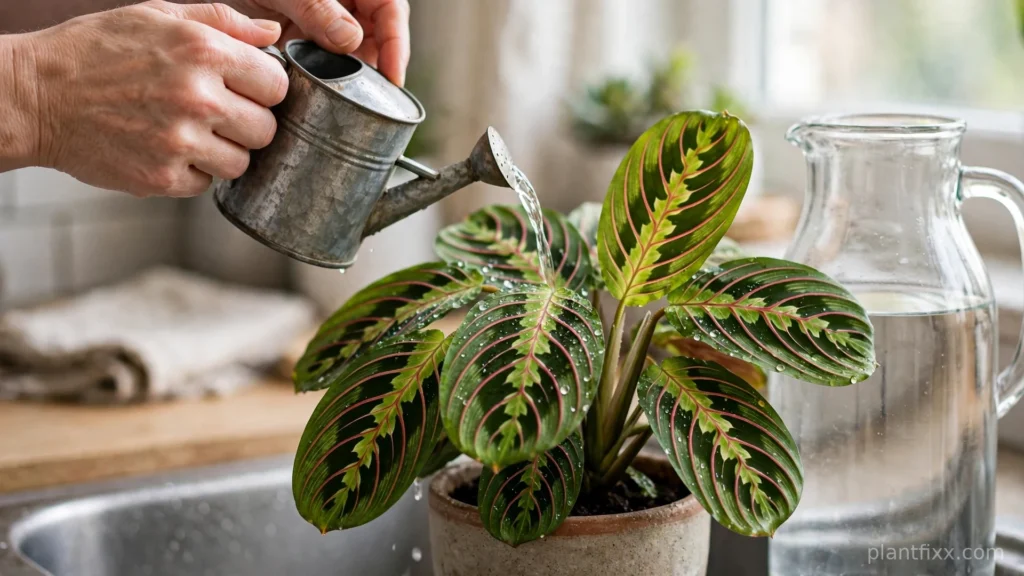
If you feed the plant or rely on tap water, flush the pot every 4 to 8 weeks: run plain water through the soil several times in a sink and let it drain.
Humidity: The Requirement That Decides Success
If one factor separates prayer plants that thrive from prayer plants that limp, it is humidity. It does best above 50 percent humidity, while heated rooms often sit well below that in winter. That gap is why so many Marantas look fine in October and ragged by February.
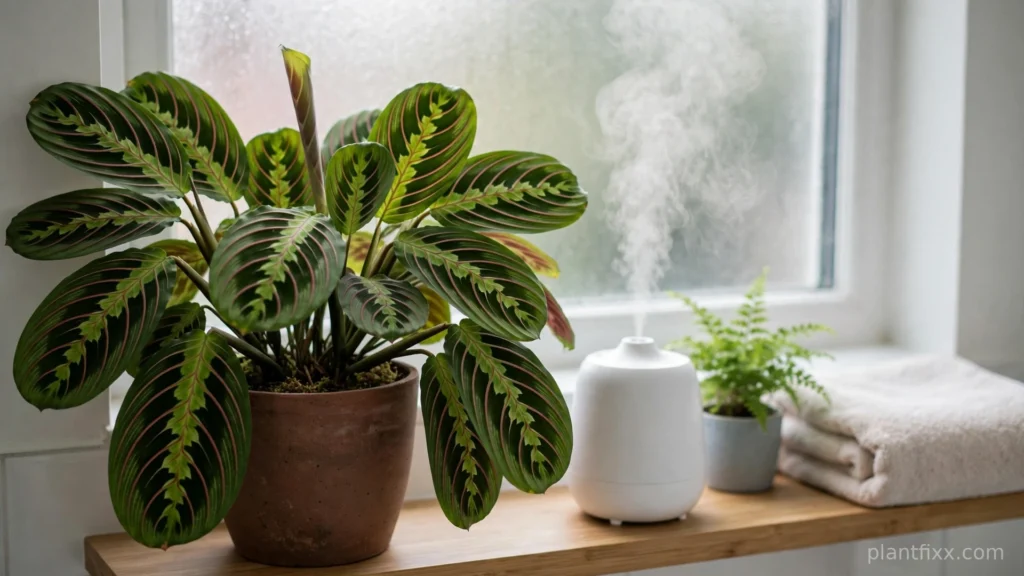
Methods ranked by how well they work:
- A small humidifier near the plant: the only method that holds humidity steady for hours.
- A bathroom spot: showers load the air daily, and a bright bathroom window is one of the best placements in a small home.
- Grouping plants together: a cluster holds a more humid pocket of air.
- A pebble tray: adds a little local humidity. Modest, but free.
- Misting: the weakest method. A spray raises humidity for minutes, and repeated wetting can mark the leaves, so mist in the morning if at all.
Keep the plant out of the path of radiators, heating vents and air conditioners, which strip moisture from the air around the leaves whatever the room average is.
Prayer Plant Soil and Potting
The right mix holds moisture and air at the same time: damp like a wrung out sponge, with grit running through it. Use the recipe in the table above, plus a handful of worm castings if you have them. A slightly acidic mix suits the plant.
Dense soil with no grit stays wet at the bottom and starves the shallow roots of air, setting up root rot.
The roots spread wide and shallow, so a wide pot suits the plant better than a tall narrow one, and drainage holes are not optional. Go up one size at a time: a small root system in a large pot sits in more wet soil than it can use.
Repot every 1 to 2 years in spring, or when roots circle the drainage holes. Do not repot a plant you brought home this week, because it needs to adjust to your light first. And do not repot a yellowing plant blind: check the roots first, since fresh airy mix is sometimes the fix itself.
Temperature and Placement in Small Spaces
Keep the plant between 65 and 80 degrees Fahrenheit, and above 60 at all times, since it has no frost tolerance. Sudden swings do more harm than a steady, slightly cool room, so avoid change rather than chasing a perfect number.
Avoid three spots: beside a door that opens to winter air, on a windowsill on cold nights, and in the blast path of a heater or air conditioner.
Maranta spreads and spills over a pot edge, so a shelf or hanging planter keeps the leaves in stable air and frees the windowsill for plants that need more light.
Feeding a Prayer Plant
Feed lightly, and only while the plant is growing. A balanced liquid fertilizer at half the label strength, once a month in spring and summer, covers its needs. Stop in autumn and winter, when unused salts sit in the soil.
Overfeeding shows up the same way hard tap water does, as brown leaf edges, because both problems are salt build up. If edges brown on a plant that gets distilled water, look at your feeding first, and skip a feed when in doubt.
How to Propagate a Prayer Plant: The Short Version
Division is the method extension guidance lists first. At a spring repot, lift the plant out and separate the rhizome and root ball into clumps by hand, keeping healthy roots and several leaves on each piece. Pot each clump in fresh mix, water it in, and hold the humidity up while it settles.
Expect a short sulk, then new growth within a few weeks.
Stem cuttings work because Maranta roots at its nodes, a trick its close relatives do not share. Cut a healthy stem just below a node, set it in water or a light moist mix, and keep it warm and humid. Roots usually form within a few weeks.
Potting rooted cuttings back into the mother pot is the fastest way to fill out a leggy plant. For step-by-step methods, see our prayer plant propagation guide.
Prayer Plant Varieties Worth Knowing
Almost every prayer plant sold is a form of one species, Maranta leuconeura, so the care in this guide applies to all of them. What changes is the pattern.
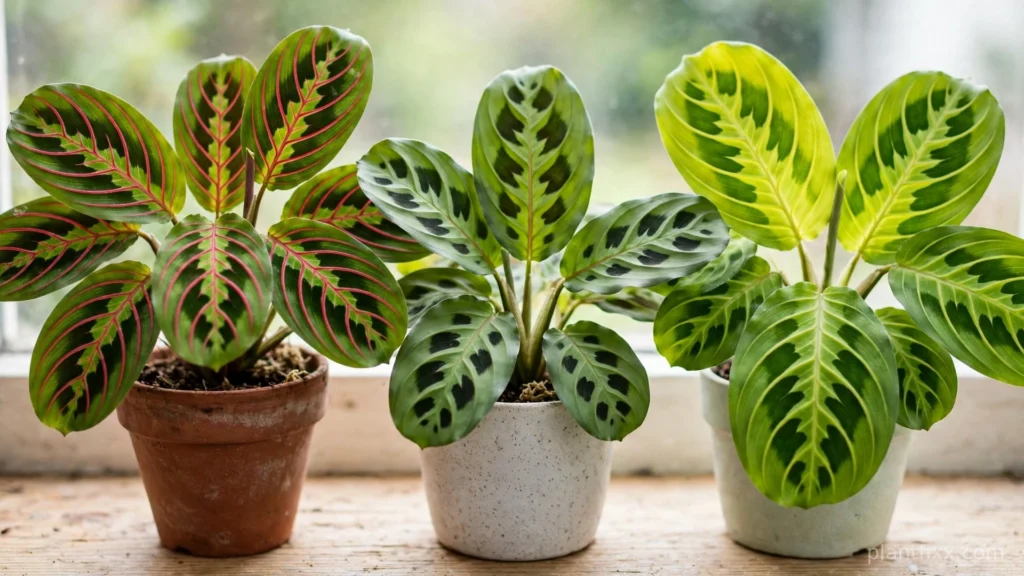
The red prayer plant, variety erythroneura, is the classic form: deep green leaves with a herringbone of red veins and a reddish purple underside. It is the most common, the most forgiving, and the best first prayer plant.
The rabbit’s foot form, variety kerchoveana, carries pairs of dark blotches along the midrib, like rabbit tracks, on a plainer green leaf that tolerates slightly lower light.
Lemon Lime types trade the red veins for bright chartreuse markings down the center of the leaf, and the pale foliage shows stress faster, so give them soft light and steady water.
One buying warning. Shops label several relatives as prayer plants, including Calathea, Stromanthe and Ctenanthe, because the whole family folds its leaves at night. They are close cousins, but not Maranta, and most are less forgiving of dry air and missed waterings.
Common Prayer Plant Problems, in the Order to Check Them
Work through problems in a fixed order: soil moisture, air, light, then water quality. Changing three things at once leaves you not knowing what fixed it.
For the full symptom-by-symptom troubleshooting, see our complete guide to prayer plant problems.
Leaves Curling Inward
Daytime curling is the plant protecting itself from moisture loss, and the most common cause is thirst. Check the soil first.
If it feels dry below the top inch, water thoroughly. If the soil is moist, look at the air: dry heated air pulls moisture from leaves faster than roots can replace it. Heat, direct sun and root damage from weeks of wet soil produce the same response.
Stressed leaves roll into a tube, unlike the flat upward fold of a healthy night posture. For the full causes and fixes, see our prayer plant leaves curling guide.
Yellow Leaves
One or two of the oldest leaves yellowing is normal aging. Several leaves yellowing at once, especially with soft stems, points to overwatering, the most common serious problem with this plant. Tip the plant out if you suspect it: healthy roots are pale and firm, rotting roots are brown and soft. Trim rot back to firm tissue and repot into fresh mix.
If you cannot tell whether your soil stayed too wet or dried out too far, compare your plant against our breakdown of overwatering versus underwatering signs before you change your routine. Yellowing with a faded pattern in a dark corner is a light problem: move the plant brighter instead of watering more. For the full causes and fixes, see our prayer plant yellow leaves guide.
Brown Tips and Crispy Edges
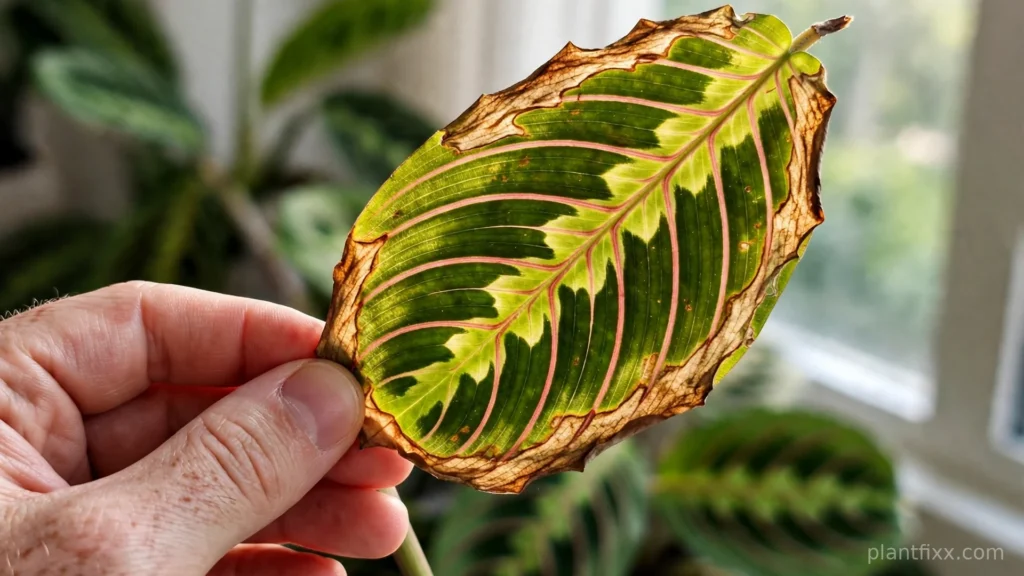
Brown edges are the signature complaint of this plant, and the cause usually sits in the water jug or the air, not your schedule. Fix it in order: distilled or rain water, higher humidity, a soil flush, and a check on feeding. Damaged edges will not turn green again, so trim them or leave them as a cosmetic flaw.
New leaves are your report card: clean edges on new growth mean the fix worked.
Leaves Not Folding at Night
A plant that used to fold and has stopped is giving early notice, usually because water or temperature has drifted off, or because bright room lights until midnight blur its light cycle. Restore the basics and give it a spot that goes dark in the evening.
Pests: Spider Mites and Mealybugs
Extension guidance lists no serious pest problems for this plant, with occasional spider mites and mealybugs. Spider mites favor dry air. Look for fine webbing and pale speckling on leaf undersides. Mealybugs show as white cottony clusters in the leaf joints.
Wipe leaves with a damp cloth, treat clusters with a cotton swab dipped in rubbing alcohol, and isolate the plant while you treat it.
Is a Prayer Plant Safe for Pets?
Yes. Maranta leuconeura is non-toxic to cats and dogs, one of the few boldly patterned tropical plants that is safe within pet reach. The trailing growth puts leaves right at cat height, and its lookalike relatives are not all as safe. You can confirm any plant before you buy it with our pet safe plant checker for cats and dogs.
Non-toxic does not mean salad. A pet that eats a lot of any houseplant can still get a mild stomach upset. A shelf or hanging planter protects the plant more than the pet. Prayer plant also belongs on any list of pet safe low light indoor plants, and it tolerates medium light too.
The Honest Limits: Who Should Skip a Prayer Plant
Prayer plant care is a routine of small regular checks, and no routine changes that. If you want a plant you water once a month and ignore between times, this is the wrong plant, and a snake plant or ZZ plant will suit you better.
If your home has dry winter air and you will not run a humidifier or use a bathroom spot, expect brown edges every winter.
Care also cannot reverse dead tissue: rotted roots do not recover, burned edges do not heal, and a plant reduced to a few damaged leaves may be cheaper to replace than to nurse.
Set against that, the plant asks for nothing expensive. Every requirement in this guide is a habit, not a purchase. Owners who fail with Maranta usually fail on one repeatable point, hard water or dry air, and both are fixable.
Conclusion
A prayer plant is a rhythm plant. It folds at night, drinks steadily, and reports problems in its leaves early enough for you to act.
Keep the light bright and indirect, the soil lightly moist with soft water, and the air above 50 percent humidity, and the plant does the rest. Start with the red vein form if you are new to the family, and place it where you will see it every evening.
For more patterned plants that will not harm a curious pet, browse our guide to pet safe indoor plants for cats and dogs.
Why does my prayer plant fold its leaves at night?
The movement is called nyctinasty. A hinge joint at the base of each leaf, the pulvinus, changes water pressure in its cells on a daily rhythm, lifting the leaves upright after dark and lowering them flat by morning. A plant that stops folding is often stressed.
How often should I water a prayer plant?
There is no fixed day count. Check the soil every few days and water when the top inch feels dry. Most homes land near once a week in the growing season, less in winter.
Why are my prayer plant leaves curling during the day?
Thirst is the most common cause, followed by dry air. If the soil feels dry, water thoroughly and the leaves should relax within hours. If the soil is moist, raise the humidity and check the plant is not in heat or direct sun.
Why does my prayer plant have brown tips?
Usually tap water: fluoride and dissolved salts build up and burn the edges, and dry air adds to the damage. Switch to distilled or rain water, flush the pot, and judge the fix by new leaves.
Is a prayer plant safe for cats and dogs?
Yes, Maranta leuconeura is non-toxic to cats and dogs. A pet that eats a large amount of any plant can still get a mild stomach upset, so a shelf or hanging planter protects the leaves.
Can a prayer plant live in low light?
It tolerates low to medium light. Growth slows, stems stretch, and the pattern fades toward green. Bright indirect light keeps the markings strong.
Why has my prayer plant stopped folding at night?
Usually a basic need has drifted off: water, temperature or a confused light cycle from bright room lights late into the evening. Restore the basics and give the plant a spot that goes dark at night.
How do I make my prayer plant fuller?
Trim long stems just above a node to push out side growth, and pot rooted cuttings back into the same pot to fill gaps.
Pingback: 10 Pet Safe Indoor Plants for Cats and Dogs (2026 Guide)
Pingback: Best Pet Safe Low Light Indoor Plants for Cats and Dogs
Pingback: Calathea Orbifolia Care: Light, Water, Humidity and Brown Edges
Pingback: Calathea Dottie Plant Care Guide: Dark Leaves, Pink Stripe, Light and Humidity
Pingback: Calathea Plant Care Guide: Light, Water, Humidity and Pet Safety
Pingback: 15 Best Low Light Indoor Plants for Small Spaces (2026)
Pingback: Is Calathea Toxic to Cats? The ASPCA Pet Safe Answer
Pingback: Prayer Plant Yellow Leaves: Causes by Pattern and Fixes
Pingback: Brown Tips on Prayer Plant: Causes and Fixes That Work
Pingback: Calathea Leaves Curling: Read the Curl Pattern and Fix It
Pingback: Calathea Light Requirements: How Much Light, Measured
Pingback: Calathea Propagation by Division: Why Cuttings Fail
Pingback: Calathea Orbifolia Care Guide: Light, Water, Humidity and Brown Edges
Pingback: Calathea Plant Leaves Curling: Read the Curl Pattern and Fix It