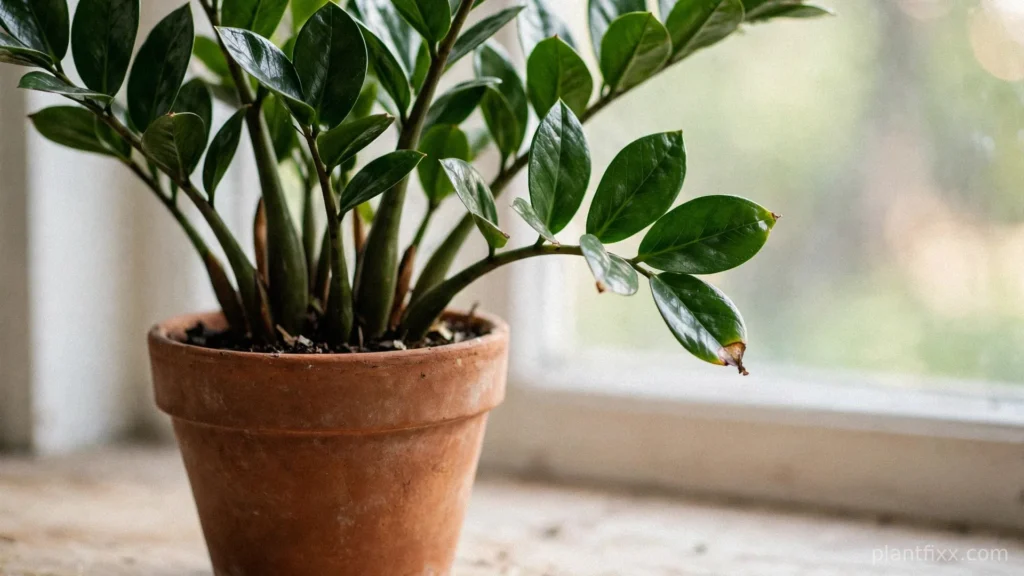
A ZZ plant rarely declines fast, so brown tips and black spots are easy to ignore for weeks. Do not. ZZ plant brown tips are among the most reported zz plant leaf problems, and they are the plant’s early warning system. By the time the marks look serious, the cause has usually been running for a month or more.
The mistake most owners make is treating every mark the same way. A crispy tip gets extra water even though the soil is already wet. A leaf with fungus spots gets fed. Guessing adds new damage on top of the old one, and the plant keeps browning while random fixes pile up.
This guide works in a different order. You will read the damage pattern first, match it to one cause, confirm it with a quick check, and then apply the matching fix. Brown tips, black spots on leaves, and brown spots on stems each get their own part, because on a ZZ plant they are three different problems.
Quick Answer
ZZ plant brown tips usually come from dry air, fluoride and salts in tap water, or long gaps between waterings, while black spots point to leaf spot disease, cold damage, or rot starting below the soil. Check the stems and the soil before you treat anything. Damaged tissue never turns green again, so judge every fix by the new leaves.
Why ZZ Plant Leaf Damage Shows Slowly and Never Reverses
A ZZ plant leaflet is thick, waxy and built to hold water. That toughness is why the plant survives neglect, but it also changes how damage behaves. Stress that would mark a thin-leaved plant in days can take weeks to show on a ZZ, because the leaflet spends its stored water first and only browns when the reserve runs out.
This lag matters for diagnosis. The brown tip you see today may trace back to the dry spell, the cold window or the strong feeding from last month, not to anything you did this week. Work through your recent care history, not just the last watering, when you match the pattern below.
The second rule is harder to accept. Dead tissue on a ZZ plant never recovers. A brown tip stays brown, a black spot stays black, and no product turns them green again. Treatment only stops the cause and protects the healthy leaves and the rhizomes below. The plant replaces damage with new growth, slowly, on its own schedule.
The rhizomes are the real stakes. Those thick underground stems store the water and energy for the whole plant. Leaf marks are cosmetic as long as the rhizomes stay firm and pale. Once rot reaches them, the problem stops being cosmetic, which is why the stem and soil checks in this guide come before any treatment.
What You Need Before You Start
Diagnosis needs almost no equipment. Gather clean, sharp scissors for trimming later, plus rubbing alcohol to wipe the blade between cuts. A phone flashlight or a basic magnifier helps you inspect leaf undersides and stem surfaces. Your finger or a wooden chopstick works as a moisture probe.
Take a dated photo of the worst leaves before you change anything. A ZZ plant moves so slowly that memory is unreliable, and a photo from two weeks earlier settles whether spots are spreading or standing still. Do the checks in this order: leaf pattern, stem feel, soil moisture, and rhizomes only if the first three point that way.
Read the Damage First: Tips, Edges, Spots and Patches
ZZ plant leaf damage is not one symptom. Where the mark sits and how it feels tells you most of the story. Look at three or four affected leaflets and the stems under them, then note which pattern matches yours.
Tips only: the last few millimeters of the leaflet turn brown and dry while the rest stays green and glossy. These are classic zz plant brown tips, and they point to dry air, mineral buildup from tap water, or watering gaps.
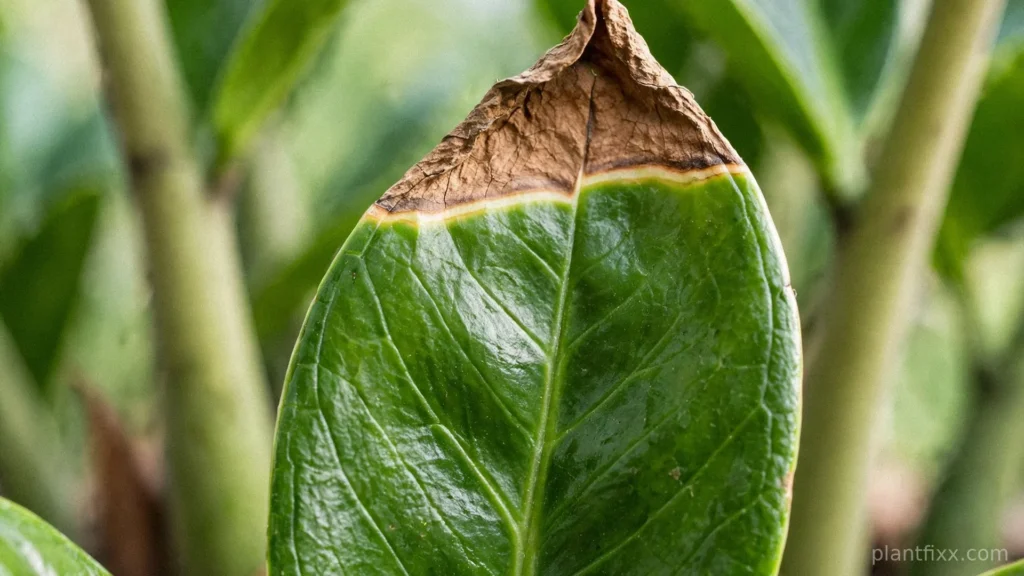
Edges: the brown starts at the tip and creeps along both margins of the leaflet. ZZ plant brown edges that spread inward usually mean the dryness or salt problem has been running longer, or the plant sits near a heat vent, a radiator or a cold draft.
Whole leaflets browning: when entire leaflets turn brown and drop, you are looking at zz plant brown leaves rather than tip damage. That pattern belongs to older leaflets finishing their life, to severe dry spells, or to stems in trouble below. Check the stem that carries them before blaming the air.
Spots in the middle of the leaflet: dark spots away from the edges are a different problem from tips. Round spots with defined edges suggest zz plant leaf spot disease. Pale bleached patches that turn papery are usually sun scorch. Soft black patches that appeared after a cold night point to cold damage.
Soft patches near the base: if brown or black areas feel soft instead of dry, and they sit low on the leaflets or close to the stem, water is the problem, not dryness. That pattern connects to the stem section below, and it outranks every other cause on this page.
| What you see | Most likely cause | Confirm it by |
|---|---|---|
| Dry brown tips only, rest of leaflet glossy | Dry air or tap water minerals | White crust on the soil surface or pot rim |
| Crispy tips and edges, leaflets feel thin | Underwatering | Soil dry through the pot, rhizomes slightly wrinkled |
| Round dark spots with defined edges on leaflets | Fungal leaf spot disease | Spots on several leaflets, worse after wet weather or misting |
| Water-soaked dark lesions with yellow halos | Bacterial leaf spot | Lesions look oily and spread fast in warmth |
| Black patches after a cold night near glass | Cold damage | Damage only on the side facing the window or door |
| Brown or black spots on stems, soft base | Stem and rhizome rot starting | Stem feels soft, soil stays wet, sour smell |
| Spots clustered near sticky residue or visible insects | Pest damage (minor cause) | Scale bumps or cottony mealybugs on stems and undersides |
Work through the zz plant brown tips causes below in the order your table result suggests. The right zz plant brown tips fix is always the one that matches your confirmed cause, and changing one thing at a time tells you within a few weeks whether you picked correctly.
ZZ Plant Brown Tips: The Four Causes and Their Fixes
Brown tips are the mildest problem in this guide and the most common. They are a supply problem at the far end of the leaflet. Water and whatever it carries travel from the rhizome, up the stem, and out to the tip, and the tip is where shortfalls and mineral loads show first.
Cause 1: Underwatering and Long Dry Gaps
A ZZ plant tolerates drought better than almost any houseplant, which is exactly why this cause gets missed. The plant spends the water stored in its rhizomes and stems first, so the soil can be dry for weeks before a single tip browns. When the reserve finally runs low, the far ends of the leaflets dry out, and you get zz plant crispy leaves that feel thin and papery at the tips and edges.
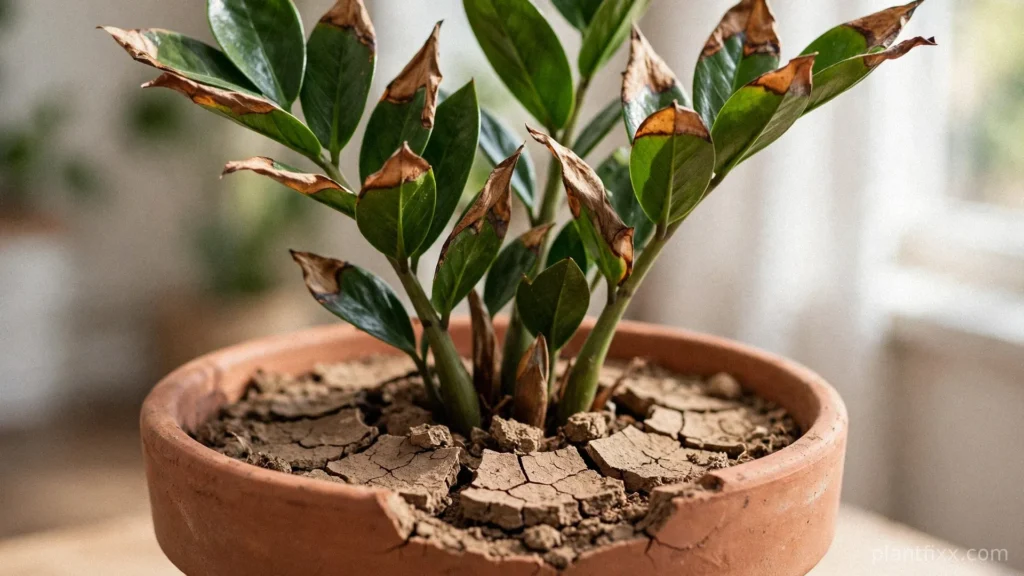
ZZ plant brown tips underwatering cases confirm themselves in the pot. The soil is dry all the way down, the pot feels light, and the rhizomes may look slightly wrinkled at the surface. The fix is one deep watering until it drains from the bottom, then a return to checking the soil before every watering instead of watering by calendar. Our zz plant underwatering and drooping guide covers the recovery routine for a plant that has gone far past thirsty.
Do not overcorrect. A ZZ plant that browned from one long dry gap does not need weekly watering from now on. It needs the dry spell to stop repeating. Constant wet soil trades a cosmetic tip problem for the rot problem covered later in this guide.
Cause 2: Low Humidity and Dry Indoor Air
The zz plant brown tips humidity pattern is slow and mild. Only the far tips dry out, the rest of each leaflet stays thick and glossy, and the soil checks come back normal. It shows up most in winter, when heating runs for months and indoor air turns very dry, and on plants sitting in the path of vents, radiators or air conditioners.
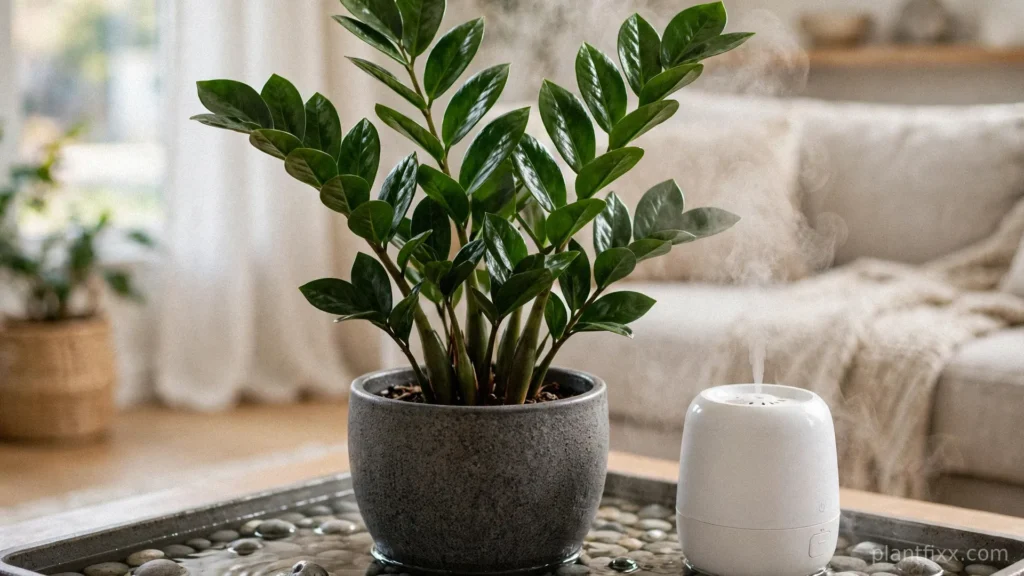
ZZ plants handle average room humidity well, but heated winter air can sit far below what the leaflets tolerate for months at a time. Raising the moisture around the plant works better than misting, because mist wets the leaf surface for minutes and, on a plant prone to leaf spot, wet leaflets are an invitation you do not need. Group plants together, set the pot on a pebble tray, or run a small humidifier in the room. Moving the plant out of the direct airflow path often stops new tips within weeks.
Cause 3: Tap Water, Fluoride and Mineral Salts
Tap water is the cause most owners never suspect, because the plant looks fine for months before the tips start to go. Municipal water carries fluoride, chlorine and dissolved salts. The plant draws that water up, the water exits at the leaflet tips, and the minerals stay behind. Day after day the concentration at the tip climbs until the tissue burns.
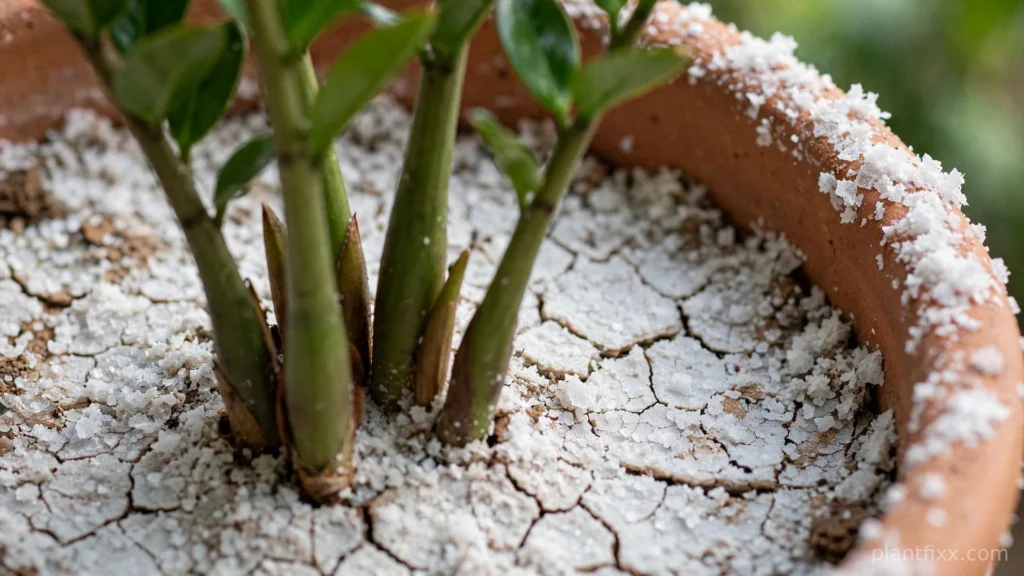
The telltale sign is a white or pale crust on the soil surface, around the drainage holes or on the rim of a terracotta pot. If you see that crust on a plant with clean watering habits, you are likely looking at zz plant brown tips tap water damage. Growers group this pattern under zz plant brown tips fluoride damage, because fluoride does not evaporate from standing water the way chlorine does. Leaving water out overnight removes chlorine gas only. The fluoride stays.
The fix has two parts. Switch this plant to distilled water, collected rainwater, or filtered water, and flush the soil by running water slowly through the pot for a minute or two so built-up salts drain out. Guidance on fluoride sensitivity in houseplants, including the tip burn it causes, is covered in the gardenbotany guide to ZZ plant pests and diseases. Avoid softened water, since softeners swap minerals for sodium salts and can make the burn worse.
Cause 4: Fertilizer Burn
Fertilizer causes the same burn as tap water salts, only faster. ZZ plants are light feeders, and full-strength feeding pushes salt levels up quickly in a pot that dries slowly. The pattern mimics salt damage: brown tips and margins, sometimes with a pale line between the brown edge and the green tissue, appearing in the weeks after a feeding.
Flush the pot the same way as for tap water buildup, then feed at half strength or less, only in spring and summer while the plant is actively growing, and always into soil that is already moist. Feeding a dry pot concentrates the solution around the rhizomes and burns them directly. A steady, light schedule is laid out in our zz plant light, soil and fertilizer guide, which also covers how much light the plant needs to use the feed you give it.
Never try to fix brown tips by feeding more. Salt browning is damage, not hunger. Pale, slow growth on a plant that has not been fed in years is a different diagnosis, and it does not come with burned tips.
ZZ Plant Black Spots on Leaves: Disease, Cold, or Something Else
ZZ plant black spots worry owners more than brown tips, and rightly so. Brown tips are a supply problem. Black spots mean tissue is dying in patches, and some of the causes spread. Most zz plant black spots causes fall into three groups: leaf spot disease, cold damage, and rot working up from below. The spots themselves tell you which group you are in, if you read them before reaching for a treatment.
Fungal Leaf Spot Disease
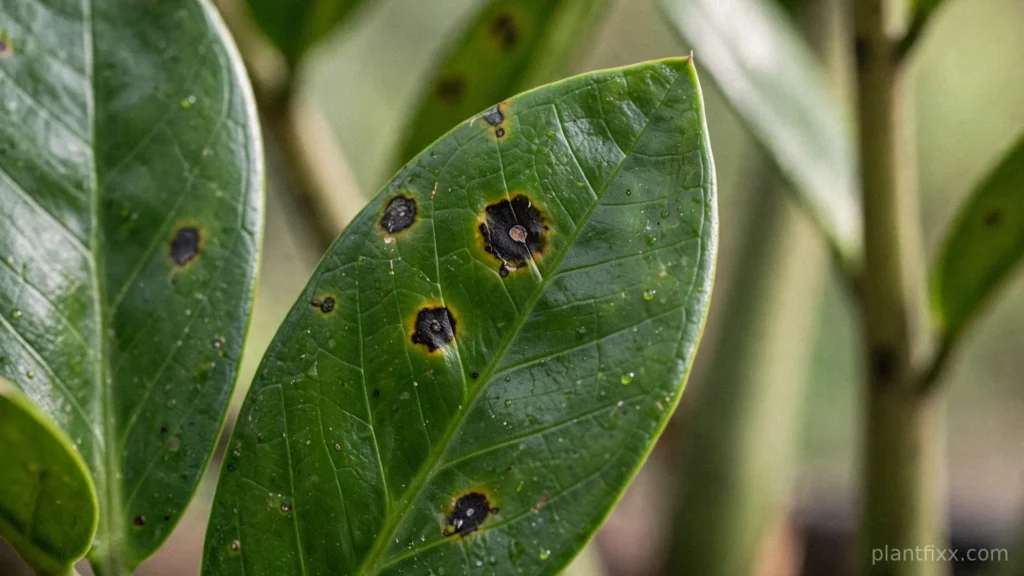
ZZ plant leaf spot disease from fungi shows as round or irregular dark spots with defined edges, sometimes ringed by a thin yellow halo. The spots sit on the leaflets, often on several at once, and they grow slowly outward. Fungal spores spread in water, so this pattern worsens when leaflets stay wet, when the plant is misted, or when crowded leaves block airflow.
Treat it by removing the worst affected leaflets with sterilized scissors, moving the plant where air moves around it, and watering the soil only, never the foliage. Bag and bin the removed leaves instead of composting them. If new spots keep appearing on clean leaves after two or three weeks of dry foliage, a household copper or sulfur fungicide used exactly as its label directs is the next step. Overviews of black spot causes, including fungal leaf spot, are summarized in the PlantIn guide to black spots on ZZ plants.
Bacterial Leaf Spot
Bacterial leaf spot looks wetter than the fungal kind. The lesions look water-soaked or slightly oily, they feel soft, and yellow halos are common. It spreads faster in warm, humid rooms and through splashed water. There is no reliable home cure for bacterial infections inside leaf tissue, so the treatment is removal and hygiene: cut out affected leaflets well into healthy tissue, sterilize the blade between cuts, keep the foliage dry, and isolate the plant from its neighbours until no new lesions appear for several weeks.
Cold Damage
Black patches that appear within days of a cold night are usually not a disease at all. ZZ plant tissue suffers below about 50°F (10°C), and leaflets pressed against cold window glass or sitting in a draft from a door can blacken in patches while the rest of the plant stays healthy. The patches feel soft at first, then dry out papery.
Cold damage does not spread from leaf to leaf, which is how you separate it from disease. Move the plant away from the glass and the draft, and simply wait. Trim the blackened leaflets once you can see the full extent of the damage, because partly damaged leaflets sometimes hold more green tissue than the first look suggests.
When Black Spots Are Not the Real Problem
One pattern should change your plan entirely. If black spots arrive together with yellowing leaflets, stems that feel soft at the base, or soil that stays wet and smells sour, the spots are a symptom, not the disease. The real problem is below the soil, and spraying the leaves will not touch it. Go to the stem section next before you treat anything.
ZZ Plant Brown Spots on Stems: The Warning Sign to Check First
ZZ plant brown spots on stems get ignored because they look like small blemishes on an otherwise sturdy plant. Treat them as the most important marks in this guide. A healthy ZZ stem is firm, smooth and evenly green. Spots that are dark, sunken or spreading on a stem often mean the tissue inside is starting to rot, fed by rhizomes sitting in wet soil.
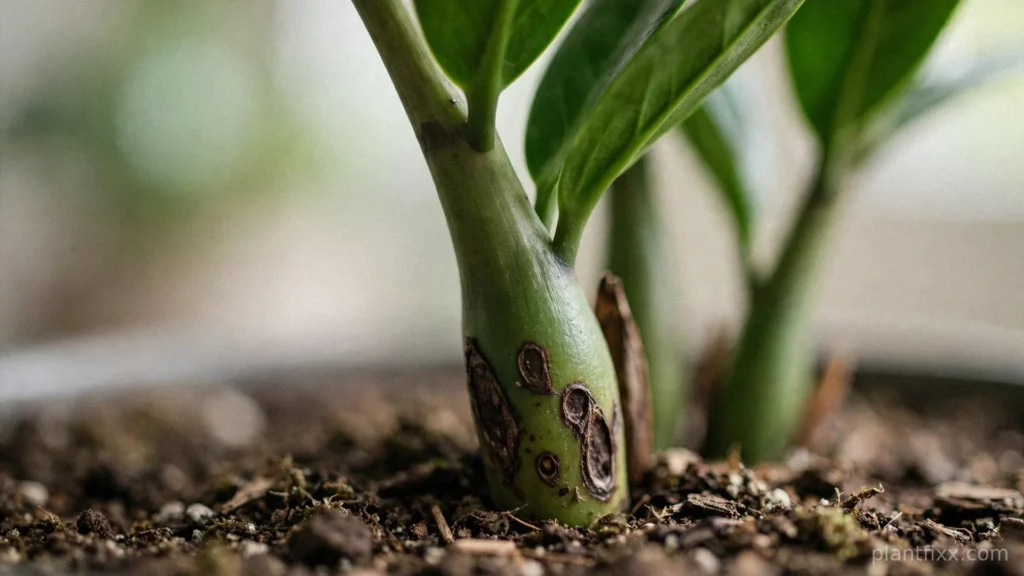
Start with the feel test. Press the stem gently along its length, especially near the base. A firm stem with a dry, flat brown mark is often old physical damage, a knock or a scrape that scarred over, and it needs nothing but watching. A stem that feels soft, spongy or hollow under a spot is rotting from the inside, and that finding outranks every leaf symptom on the plant.
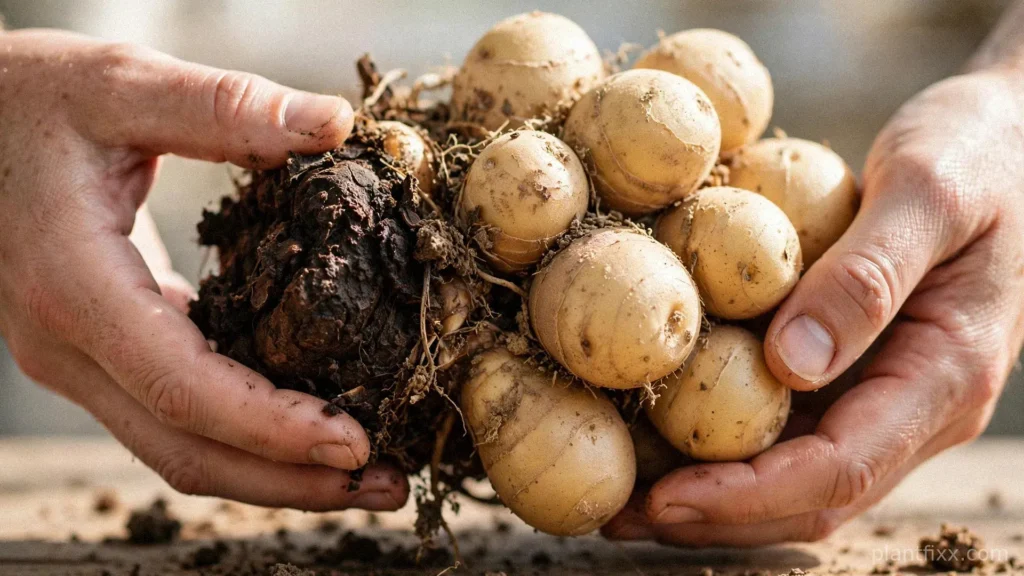
If any stem feels soft, unpot the plant and check the rhizomes the same day. Healthy rhizomes are firm and pale tan. Rotting rhizomes are dark brown or black, soft to the touch, and they smell sour. Cut away every soft section back to firm tissue with a sterilized blade, let the cuts dry for a day, and repot into fresh, dry, free-draining mix. The full rescue, including watering holds after repotting, is covered step by step in our zz plant root rot and overwatering guide.
Do not wait for leaf symptoms to confirm stem rot. By the time leaflets yellow and drop, the rot has usually taken a large share of the rhizome. A plant caught at the stem-spot stage often keeps most of its root system and recovers. A plant caught at the collapse stage may keep only a cutting.
Pest Spots vs Leaf Spot Disease: Telling Them Apart
Pests appear in almost every list of zz plant leaf problems, so here is the honest version. Pests are a minor cause of spots on ZZ plants. The thick, waxy leaflets resist most insects, and a healthy ZZ can sit beside an infested plant for months without picking anything up. When pests do appear, it is usually scale or mealybugs on a plant already stressed by another problem.
Pest damage has fingerprints that disease does not. Scale shows as small brown bumps fixed along stems and leaflet undersides, and the bumps scrape off with a fingernail. Mealybugs show as white cottony clusters in the joints. Both leave sticky residue called honeydew on the leaves below them, and that residue can grow a thin black coating of sooty mold. The mold wipes off with a damp cloth. Disease spots do not wipe off, because the damage is inside the tissue.
Use these checks to separate the two. Spots that cluster where insects are feeding, with stickiness nearby, point to pests. Spots that spread across clean leaflets with defined edges and halos, with no insects and no residue anywhere, point to leaf spot disease. Treat pests by wiping them off with a cotton bud dipped in rubbing alcohol, repeating weekly until none return. Treating a fungal problem with pest spray, or a pest problem with fungicide, wastes weeks while the real cause continues.
How to Trim Brown Tips on a ZZ Plant
Trimming is cosmetic. It fixes nothing, but it tidies the plant and makes new damage easy to spot. Trim only after you have identified the cause and started the real fix, so fresh browning afterward tells you the fix is not working yet.
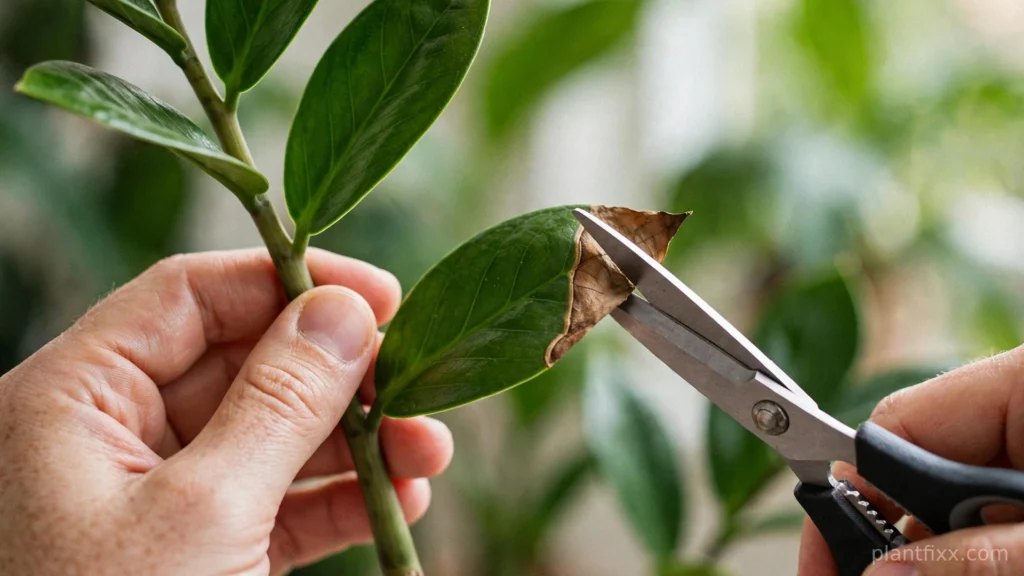
Use clean, sharp scissors. Follow the natural oval curve of the leaflet tip rather than cutting straight across, so the leaflet keeps its shape. Leave a thin line of brown tissue, about a millimeter, between the cut and the green part. Cutting into healthy green tissue opens a fresh edge that usually dries and browns again within days, which leaves the leaflet looking worse than before.
If a whole leaflet is more than half brown or black, remove the leaflet at its base instead of trimming. If a stem carries mostly dead leaflets and feels soft, remove the whole stem at the rhizome. Never strip many leaflets at once from a stressed plant, since the remaining green leaflets are what feed its recovery.
Signs the Fix Is Working
Judge by new growth and by spread, not by the damaged leaflets, which will never change. The working signs are these: no new spots appear on clean leaflets over three to four weeks, existing spots stop growing, stems stay firm along their whole length, and new shoots eventually open fully green. On a slow plant like the ZZ, a quiet month with no new damage is a genuine result.
Signs It Is Getting Worse
Act again if spots keep appearing on leaflets that were clean when you made your change, if halos widen week by week in your comparison photos, or if any stem starts to feel soft. Browning that jumps to many leaflets in a few days, especially with wilting or a sour smell from the pot, means stop and check the rhizomes that day, because rot moves faster than any surface disease on this plant.
Whole leaflets yellowing and dropping alongside the spots also change the picture. Yellowing is a colour problem with its own cause list, and our notes on why zz plant leaves turn yellow will help you separate it from the burn and spot patterns covered here.
ZZ Plant Brown Tips Prevention Routine
ZZ plant brown tips prevention is a short routine repeated on time. Water only when the soil has dried through the pot, and empty the saucer so the rhizomes never sit in runoff. Keep the foliage dry when you water, because most leaf spot infections start in water sitting on leaflets.
Flush the pot every two to three months if you use tap water, and feed lightly at half strength only while the plant is growing in spring and summer. Hold steady conditions: bright indirect light, room humidity in the middle range during heating season, and a spot away from cold glass, doors and vents. Wipe the leaflets with a damp cloth once a month, which clears dust and gives you a regular close look at the stems and undersides, where this guide’s serious problems start.
Fold these habits into the routine in our complete zz plant care guide, and leaf marks become rare. When one does appear, read it early. On a ZZ plant, the small mark you catch this week is the large problem you avoid next month.
Frequently Asked Questions
Should I cut the brown tips off my ZZ plant leaves?
Yes, trimming is safe once you have started fixing the cause. Cut along the natural curve of the leaflet and leave a thin line of brown tissue, because cutting into green tissue creates a new edge that often browns again.
Will brown tips or black spots on a ZZ plant turn green again?
No. Damaged ZZ tissue is dead and keeps its colour. The leaflet still works for the plant, so keep it unless most of it is damaged. Success shows up as clean new growth, not repaired old leaflets.
Are black spots on a ZZ plant always a disease?
No. Black patches can come from cold damage near a window, from sun scorch, or from rot starting below the soil. Disease spots have defined edges, sometimes halos, and spread across leaflets while conditions stay wet.
How can I tell leaf spot disease from rot on my ZZ plant?
Leaf spot disease stays on the leaflets, which stay firm, and the stems and soil check out normal. Rot announces itself through soft stems, wet sour soil and dark mushy rhizomes when you unpot the plant. Check the stems first, every time.
Does letting tap water sit overnight remove fluoride for a ZZ plant?
No. Standing removes chlorine, which escapes as a gas. Fluoride is a dissolved mineral and stays in the water. Use distilled, rainwater or filtered water for a plant with confirmed fluoride tip burn.
Can a ZZ plant recover from black spots?
Yes, as long as the rhizomes stay firm and the cause is removed. The spotted leaflets will not heal, but the plant stops producing new spots and replaces the damage with fresh stems over the following months.
Why are only the bottom leaves of my ZZ plant getting black spots?
Bottom leaflets sit closest to wet soil splash and the oldest tissue, and they get the least airflow, so leaf spot infections usually start there. Check the stems and rhizomes too, because bottom-up spotting can also be the first visible sign of rot.
Pingback: ZZ Plant Light Requirements, Soil Mix & Fertilizer Guide
Pingback: ZZ Plant Care Guide: Best Low-Light Apartment Plant (2026)
Pingback: ZZ Plant Underwatering: Signs, Causes and How to Revive It