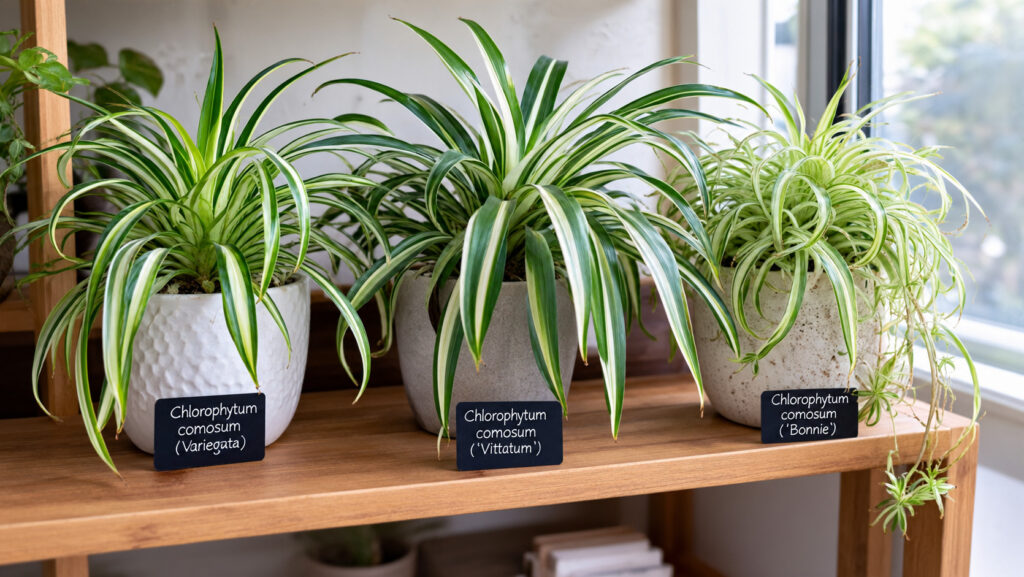
Spider plant varieties go well beyond the classic striped type most people picture, ranging from tightly curled forms to solid green leaves and even a wider-leafed cousin species sold under the same common name. Nearly all of them share the same forgiving care needs, so choosing between spider plant varieties comes down to appearance, mature size, and how much light your space actually offers rather than any real difference in difficulty.
Quick Answer
The most popular spider plant varieties for indoors are Vittatum, with a central white stripe, Variegatum, with white-edged leaves, Bonnie, with tightly curled foliage, and Zebra, with a wider yellow-green stripe. All grow well in bright, indirect light, though Bonnie’s compact, curled shape suits small spaces especially well.
What Makes a Variety Better Suited for Indoors
A spider plant variety works well indoors when it tolerates the light levels a typical home offers, stays a manageable size for the available space, and holds its variegation without needing unusually bright conditions. Compact, curly varieties like Bonnie suit small apartments and shelves better than a full-sized Vittatum, which spreads wider and produces longer, more dramatic arching leaves given room to grow. Solid green varieties tolerate lower light slightly better than heavily variegated ones, since less white tissue means more chlorophyll available for photosynthesis in dimmer conditions.
Vittatum (Classic Spider Plant)
Vittatum carries the classic look most people associate with spider plants: narrow, arching green leaves with a single white or pale yellow stripe running down the center. A mature Vittatum reaches twelve to eighteen inches tall with a similar spread, producing long stems of pups once established. This variety grows well in bright, indirect light and tolerates medium light reasonably well too, making it a flexible pick for most rooms. What to expect: fast, reliable growth and frequent pup production once the plant matures, though the central stripe can fade slightly in consistently low light.
Variegatum (Reverse Variegated)
Variegatum flips the classic pattern, with white or cream edges running along each leaf and a green center stripe instead. Mature size runs similar to Vittatum, typically twelve to eighteen inches, and this variety shares the same bright, indirect light preference. The wider white margins make Variegatum slightly more prone to leaf tip browning from tap water sensitivity, since white tissue often shows stress more visibly than solid green tissue. What to expect: a slightly showier look than Vittatum, with a bit more attention needed toward water quality to keep the white edges from browning.
Bonnie (Curly Spider Plant)
Bonnie stands out with tightly curled, spiraling leaves instead of the straight, arching form of other varieties, giving it a compact, textured appearance. Mature size stays smaller and denser than Vittatum, usually under twelve inches, making Bonnie a strong choice for small pots, narrow shelves, or desks with limited space. Light needs match other varieties, though Bonnie’s compact growth means it fills a small pot fully without needing much room to spread outward. What to expect: slower pup production compared to Vittatum, since the curled growth habit puts more energy into leaf density than trailing stems, and more limited availability compared to the classic striped types.
Zebra
Zebra features a wider, more yellow-green stripe than the crisp white of Vittatum, giving the leaves a softer, less contrasted look overall. Mature size runs close to Vittatum’s typical twelve to eighteen inches. This variety tolerates a slightly wider light range without losing its coloring, since the yellow-green stripe reads as less dramatic under lower light than a stark white one would. What to expect: a subtler, warmer-toned plant that reads less “classic spider plant” at a glance, which suits a home leaning toward a softer color palette.
Hawaiian Spider Plant
Sold under the spider plant name though botanically a related species, the Hawaiian spider plant features wider, more solid green leaves with a glossier texture than the narrow-leafed Chlorophytum comosum varieties. Mature size runs larger overall, often reaching eighteen to twenty-four inches with a fuller, denser habit. This variety tolerates lower light somewhat better than heavily variegated types, thanks to its higher chlorophyll content. What to expect: a bolder, more tropical look than classic spider plant varieties, though it takes up more visual and physical space once mature, so it suits a floor spot or larger shelf better than a small desk.
Solid Green Spider Plant
A less common but sometimes available solid green form skips variegation entirely, showing uniform deep green leaves without any white or yellow striping. Mature size and growth habit match Vittatum closely. This variety tolerates lower light better than any striped type, since it carries no reduced-chlorophyll white tissue at all. What to expect: the most shade-tolerant option of the group, though the plainer look appeals less to owners drawn to the classic striped appearance in the first place.
Spider Plant Varieties Compared
| Variety | Leaf Pattern | Mature Size | Best For |
| Vittatum | Green with white center stripe | 12–18 in | Classic look, flexible light |
| Variegatum | Green with white edges | 12–18 in | Showier look, watch water quality |
| Bonnie | Curled, compact | Under 12 in | Small spaces, desks, shelves |
| Zebra | Yellow-green stripe | 12–18 in | Softer color palette |
| Hawaiian | Wide, solid green, glossy | 18–24 in | Larger spaces, lower light |
| Solid Green | Uniform deep green | 12–18 in | Lowest light tolerance |
How to Choose Between Spider Plant Varieties
Start with the space available: a small desk or shelf favors Bonnie’s compact, curled form, while a larger room with floor space suits the fuller Hawaiian spider plant better. Next, consider the light in the room, since heavily variegated varieties like Variegatum hold their pattern best in bright, indirect light, while solid green or lightly striped types like Zebra tolerate dimmer spots with less fading. Finally, factor in maintenance tolerance: Variegatum’s white edges show tap water stress more readily, so a household using untreated tap water might get better results from a less variegated variety like Vittatum or solid green.
Different spider plant varieties can have slightly different appearances and growth habits, but they still need the right basic conditions. See our Spider Plant Care Guide for the essential indoor care requirements.
Final Takeaway
Spider plant varieties share the same forgiving core care needs, so the real decision comes down to size, light, and appearance rather than difficulty. Bonnie suits tight spaces, Hawaiian suits larger rooms with lower light, and Vittatum remains the reliable middle ground for most homes. Picking based on the space and light you actually have leads to a fuller, healthier plant than picking on looks alone.
FAQ
What is the most common spider plant variety? Vittatum, with its classic green leaves and white center stripe, ranks as the most widely available and commonly grown spider plant variety.
Which spider plant variety is best for low light? Solid green and Hawaiian spider plant varieties tolerate lower light better than heavily variegated types, since they carry more chlorophyll overall.
Is the curly spider plant a different species? No, Bonnie is a cultivar of Chlorophytum comosum, the same species as the classic striped spider plant, just bred for a compact, curled growth habit.
Do all spider plant varieties produce pups? Most do, though curled varieties like Bonnie tend to produce pups more slowly than classic varieties like Vittatum.
Which spider plant variety is best for small apartments? Bonnie’s compact, curled form suits small apartments, desks, and shelves best, since it stays under twelve inches at maturity.
Do different spider plant varieties need different care? Care stays largely the same across varieties, though heavily variegated types like Variegatum benefit from filtered water to reduce leaf tip browning.