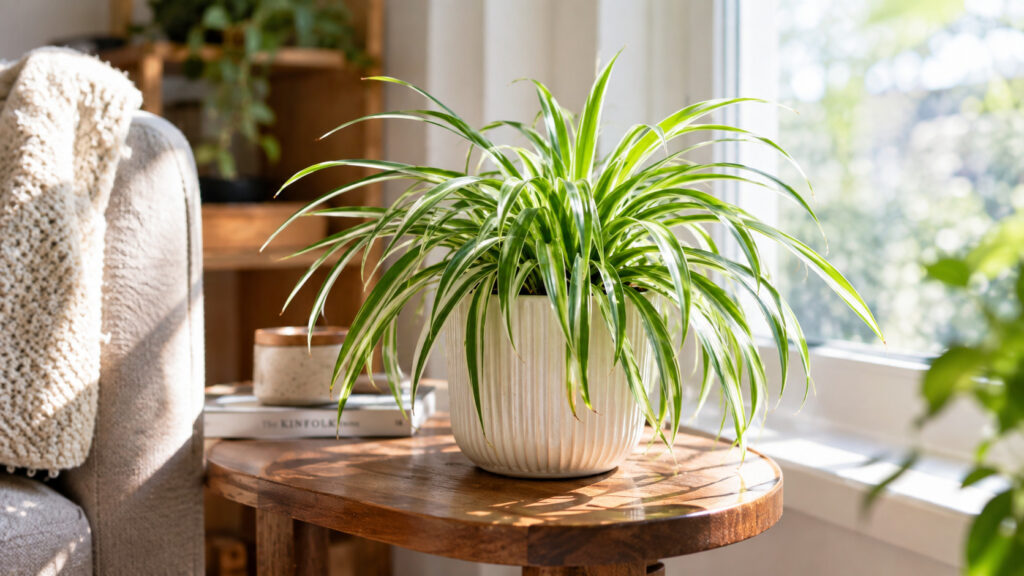
Finding the best light for spider plant growth becomes tricky the moment you move into an apartment with small windows or a north-facing view. Your spider plant will not die in low light, but it will stop producing the thick, striped leaves and baby plantlets it is known for.
This guide shows you where to place your spider plant, which windows work best, and when a grow light becomes worth adding. You will also learn how to read your plant’s leaves for signs of both too little and too much light.
Every recommendation here works for standard apartment setups, including small studios, shaded units, and rooms with only one usable window.
Quick Answer
The best light for a spider plant is bright, indirect light for several hours a day, ideally from an east or west-facing window. Your plant will survive in low light but will grow slower, produce fewer plantlets, and may lose its white or yellow striping over time.
Quick Take
Spider plants prefer bright indirect light but tolerate medium and low light better than most houseplants. In a low-light apartment, place your plant within 3 to 5 feet of the brightest window you have, avoiding direct afternoon sun that can scorch the leaves. If no window provides enough brightness, a full-spectrum LED grow light positioned 12 to 24 inches above the plant for part of the day is a reliable way to fill the gap.
One mistake many apartment plant owners make is pushing a spider plant into a dark corner because it has a reputation as a low-light plant. In practice, spider plants tolerate dim rooms without dying, but they only look full and vibrant when they get consistent bright, indirect light. Treating low-light tolerance as a light requirement is why so many apartment spider plants end up leggy and pale.
Why Light Matters for Spider Plant Growth?
Light drives photosynthesis, and photosynthesis controls how fast your spider plant grows, how thick its leaves become, and how many plantlets it sends out. A spider plant sitting in a dim corner is not dying. It is running on minimal energy.
You will notice the difference most in variegation. Variegated (white or cream) leaf tissue has less chlorophyll than solid green tissue, so it produces less energy for the plant. In low light, a spider plant often favors plain green growth because it photosynthesizes more efficiently, which is why the stripes can fade over time.
How Much Light Does a Spider Plant Actually Need?
A spider plant generally does best with several hours of bright, indirect light a day. Some growers cite a rough range of 6 to 8 hours as a helpful target, though the exact amount that works well depends on your window direction, the season, and how far the plant sits from the glass.
Direct sun should stay limited to early morning only. Midday or afternoon direct sun through unfiltered glass can scorch the leaf tips within a single afternoon.
Bright Indirect Light
This is light that reaches the plant after bouncing off walls, ceilings, or sheer curtains rather than hitting it straight from the sun. A spot a few feet back from a sunny window usually delivers this.
Medium Light
Medium light comes from a window a bit farther away, a room with an obstructed view, or a window that faces north. Your spider plant survives here but grows more slowly.
Low Light
Low light means the plant receives ambient brightness with no direct window view, such as a windowless hallway lit only by a nearby room. A spider plant tolerates this for a while but will not thrive long term.
For more on how light and watering work together, see how often to water a spider plant, since a plant in brighter light typically dries out and needs water sooner than the same plant in low light.
Best Window Placement for Low-Light Apartments
East-Facing Windows
East-facing windows give gentle morning sun and soft light for the rest of the day. This is usually the easiest placement in an apartment because the plant gets brightness without the scorch risk of afternoon sun.
West-Facing Windows
West-facing windows bring strong afternoon light. Keep your spider plant 2 to 3 feet back from the glass, or use a sheer curtain, so the leaves do not burn during the hottest part of the day.
South-Facing Windows
South-facing windows receive the most light of any direction. In a small apartment this can work well if you filter the light with a curtain or set the plant back from direct exposure.
North-Facing Windows
North-facing windows receive the least natural light and are the most common challenge in apartments. Your spider plant can survive here, but expect slower growth and fewer plantlets unless you add a grow light. If you’re furnishing a north-facing room, best plants for low-light apartments covers other options that share this same tolerance.
Window Direction Comparison for Spider Plants
| Window Direction | Light Level | Spider Plant Suitability | Placement Tip |
|---|---|---|---|
| East | Bright, gentle morning sun | Excellent | Place directly on the windowsill or nearby |
| West | Strong afternoon sun | Good, with filtering | Keep 2-3 feet back or use sheer curtains |
| South | Strongest overall light | Good, with filtering | Set back from direct glass exposure |
| North | Weakest natural light | Limited without help | Add a grow light for consistent growth |
How to Use a Grow Light for Spider Plants
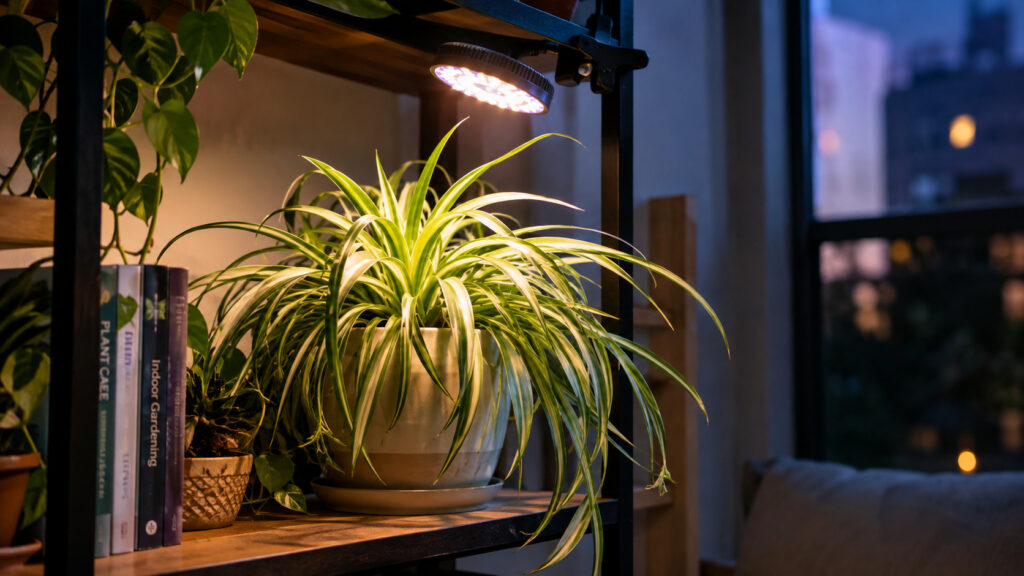
A grow light is a reliable way to close the gap in a low-light apartment, since it supplements the sun rather than replacing your window entirely. A full-spectrum LED grow light works well for spider plants because it covers the blue and red wavelengths the plant uses for leaf growth and overall energy.
Position the light 12 to 24 inches above the plant and run it for roughly 10 to 12 hours a day, loosely matching a natural daylight cycle. A basic clip-on or desk grow light is enough for a single plant, while a larger panel suits a shelf or windowsill with multiple plants.
Grow lights help most in north-facing rooms, basement apartments, windowless offices, or during winter months when daylight hours shrink.
Signs Your Spider Plant Is Not Getting Enough Light
Your spider plant tells you when the light is insufficient. Growth slows down and new leaves come in thin and pale. The white or cream stripes fade toward solid green, following the same variegation pattern explained earlier.
Plantfixx.com
Plantlet production also drops off. A spider plant that normally sends out multiple babies each season may stop producing them entirely in low light. Leaves can also start leaning or stretching toward the nearest light source, a sign the plant is reaching for brightness it is not getting where it sits.
Signs Your Spider Plant Is Getting Too Much Light
Too much light causes its own set of problems, usually the opposite of what low light produces. Leaves develop pale, bleached, or washed-out patches, most often on the side facing the window, as the direct sun breaks down chlorophyll faster than the plant can replace it.
Brown, crispy tips and edges are another common sign, though brown tips can also come from tap water minerals or low humidity, so check soil moisture and watering habits before assuming light is the only cause. For a full breakdown of these overlapping causes, see why is my spider plant getting brown tips.
Curling or drooping leaves during the brightest part of the day, even with adequate watering, often point to too much direct sun rather than a watering issue. Moving the plant back from the window or adding a sheer curtain usually resolves this within a few weeks.
Low-Light Apartment Placement Tips
Rotate your spider plant a quarter turn every 1 to 2 weeks so all sides receive even light and the plant grows evenly instead of leaning. Use mirrors near a dim window to bounce additional light onto the plant without adding hardware.
Move your spider plant seasonally if your apartment gets noticeably darker in winter. Shifting it a few feet closer to the window during shorter days helps keep growth steady year-round.
Move your spider plant seasonally if your apartment gets noticeably darker in winter. Shifting it a few feet closer to the window during shorter days helps keep growth steady year-round. For watering, soil, and feeding basics beyond light, check the full Spider Plant Care Guide.
FAQs
Can a spider plant survive with no natural light at all?
No, a spider plant needs some light source, either natural or artificial, to survive long term. A windowless room requires a grow light running for most of the day.
What is the best light for spider plant growth in a studio apartment?
An east-facing window with several hours of bright indirect light works well in a studio apartment. If no window provides this, a full-spectrum LED grow light can fill the gap.
Do spider plants do well under fluorescent office lighting?
Yes, spider plants tolerate standard fluorescent lighting reasonably well, which is why they are common in offices. Growth will still be slower than under natural bright indirect light.
How do I know if my spider plant is getting too much light?
Bleached, scorched, or brown-tipped leaves, especially on the side facing the window, signal too much direct sun. Move the plant back from the glass or add a sheer curtain to filter the light.
How far should a grow light be from a spider plant?
Keep a full-spectrum LED grow light 12 to 24 inches above the plant. Closer distances risk leaf burn, while farther distances weaken the light before it reaches the leaves.
Will low light kill my spider plant eventually?
Low light alone rarely kills a spider plant, since it is one of the more tolerant houseplants available. It weakens growth, fades variegation, and reduces plantlets, but the plant typically survives.
Is a north-facing window enough for a spider plant without a grow light?
A north-facing window alone often falls short of what a spider plant needs for full, vibrant growth. Pairing it with a grow light gives more consistent results in most apartments.
Conclusion
The best light for spider plant care in a low-light apartment combines an east or west-facing window with several hours of bright, indirect light whenever possible. When your apartment cannot provide that naturally, a full-spectrum LED grow light positioned 12 to 24 inches above the plant helps close the gap. Watch your plant’s leaves for signs of both too little and too much light, and adjust placement whenever growth starts to slow or leaves start to bleach.
Pingback: Spider Plant Watering: Full 2026 Guide
Pingback: Spider Plant Varieties: Best for Indoors (2026)