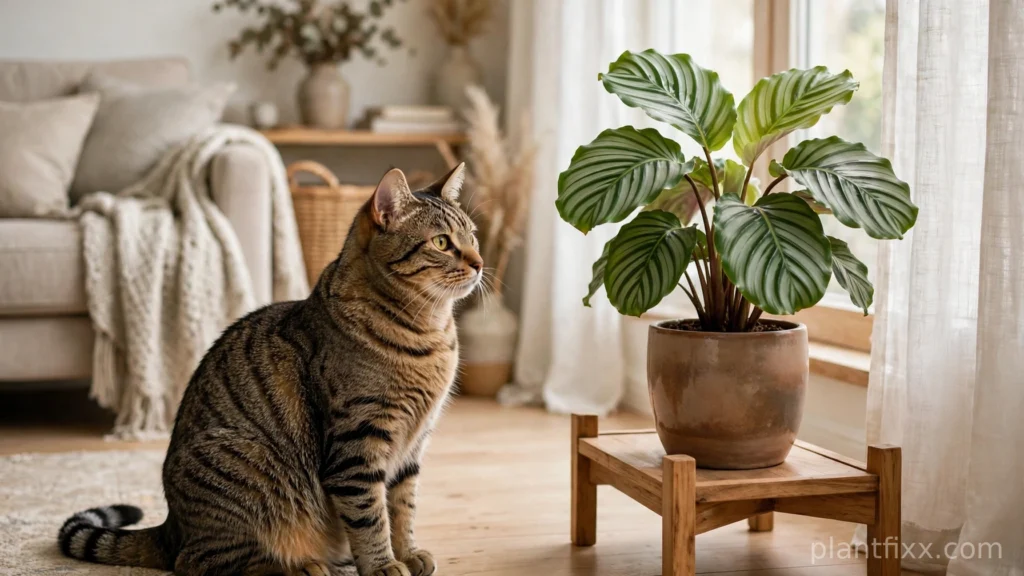
No, calathea is not toxic to cats. The ASPCA lists the whole genus as non-toxic to cats, dogs and horses, so a calathea plant on your shelf is a safe choice for a pet home.
That answer needs one honest limit. Non-toxic means there is no poison in the leaf, not that a cat can eat leaves without any effect at all.
This guide covers the question calathea toxic to cats in full: why the plant holds no toxin, what a chew actually does, the steps to take, and how to place the plant safely for a cat that chews everything it can reach in a small home.
The Direct Answer: What the ASPCA Listing Actually Says
The ASPCA plant list has a genus level entry headed Calathea. It gives the scientific name as Calathea spp. and the family as Marantaceae, the prayer plant family.
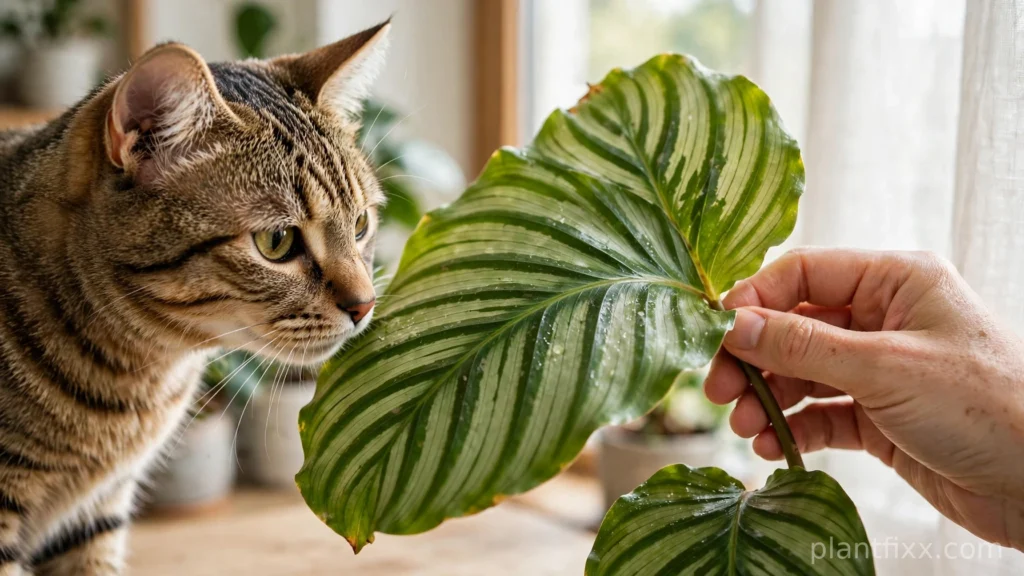
The entry states the plant is non-toxic to dogs, non-toxic to cats and non-toxic to horses. You can read the listing yourself on the ASPCA calathea plant page.
Many calathea varieties now carry the botanical genus name Goeppertia on shop labels. The ASPCA list still files them under Calathea, so search the older name when you check.
| Question | Answer from the ASPCA listing |
|---|---|
| Toxic to cats | No, listed non-toxic to cats |
| Toxic to dogs | No, listed non-toxic to dogs |
| Toxic to horses | No, listed non-toxic to horses |
| Toxic principle named | None |
| Clinical signs named | None |
One list level warning still applies to every plant on that database. The ASPCA notes that eating any plant material may cause vomiting and stomach upset in dogs and cats.
Before you buy any new plant, run its name through our pet safe plant checker for cats and dogs. The checker saves you from trusting a shop label that may use the wrong name.
Why Calathea Has No Poison to Give
A plant harms a pet through a specific compound, in a specific tissue, by a specific route. Calathea has none of the usual compounds behind houseplant poisoning.
Its leaves hold no insoluble calcium oxalate crystals, no alkaloids of concern and no cardiac glycosides. That short list covers the compounds behind most houseplant poisonings in cats.
How Calcium Oxalate Plants Hurt a Mouth
Pothos, philodendron, dieffenbachia and ZZ plant store needle shaped crystals called raphides inside their cells. The crystals are made of calcium oxalate and sit packed in bundles.
When a cat bites a leaf, the broken cells fire those needles into the tongue, lips and gums. The injury is mechanical, a burst of tiny punctures, and it starts in the first bite.
The mouth burns at once, so most cats spit the leaf out and drool heavily. Pain, not a spreading poison, is the whole event, and it fades as the mouth heals.
Why Calathea Sits Outside That Group
Calathea tissue holds no raphide bundles, so a bite delivers leaf fibre and sap, not needles. There is nothing in the leaf that can puncture tissue or enter the blood as a toxin.
That is why the ASPCA entry can cover the whole genus at once. The safety rests on an absence shared by the group, not on a low dose of something harmful.
Non-Toxic Does Not Mean Edible: The Fibre Problem
Cats are obligate carnivores, built to digest meat, not leaf fibre. A stomach full of chewed leaf is a load their gut handles poorly, whatever plant the leaf came from.
The fibre passes through largely undigested. On the way, it can irritate the stomach lining, speed the gut up, and come back up or out the other end.
Sprays and feeds sit outside the listing too. A new plant can carry leaf shine or pesticide residue from the shop, and fertiliser in the soil is a separate exposure.
What Actually Happens If Your Cat Chews a Calathea
After a larger chew, a cat may vomit once or twice in the hours after. Loose stool can follow within a day as the fibre moves through.
The normal pattern is short. Appetite and behaviour return as the plant material clears, and most cats look like themselves again by the next day.
Signs That Fit a Normal Mild Response
- One or two bouts of vomiting, with leaf pieces visible
- Loose stool or one mild bout of diarrhoea
- Brief drooling or lip licking after the chew
- Reduced appetite for a few hours
- Quiet behaviour and extra sleep for part of the day
Watch the pattern, not a single sign. A mild response peaks early and fades, so a cat that keeps improving needs rest and water, not panic.
What to Do Step by Step If Your Cat Ate Calathea
Step one is to move the plant out of reach and clear any leaf pieces from your cat’s mouth with a soft cloth. Do this first, before you search for anything.
Step two is to note what happened while you still know it. Write down the plant name, how much leaf is missing, the time, and any signs you can see.
Step three is to offer fresh water and let your cat rest in a quiet room. Do not give milk, oil or home remedies, and do not make your cat vomit.
Step four is to watch for a few hours and note any new signs with their times.
This short routine covers a known safe plant only. For an unknown or toxic plant, follow our full guide on what to do if your cat eats a toxic plant and call for advice at once.
When It Is Not Just the Calathea: Signs That Need a Vet Promptly
Some signs do not fit a fibre upset, and they change the call. Vomiting that repeats for hours, or a cat that cannot keep water down, needs a vet the same day. Blood in vomit or stool needs the same response.
Swelling of the face, mouth or throat is never a wait and see sign. Trouble breathing, collapse, tremors or seizures mean an emergency visit now, not a phone queue.
One common cause is a mistaken plant. If signs run hard, the chewed plant may not be a calathea at all, and a photo of the plant helps the vet rule that out.
You can also call the ASPCA Animal Poison Control Center on (888) 426-4435. It runs 24 hours a day, 365 days a year, and a consultation fee may apply.
This article gives general information only and is not a substitute for a vet. If your cat seems unwell after chewing any plant, call your vet, even if the plant is listed here as safe.
Dogs and Horses: The Same Listing, Briefly
The same ASPCA entry lists calathea as non-toxic to dogs. A dog that chews the leaves faces the same fibre problem as a cat, and no poison.
Dogs tend to eat more leaf in one go, so vomiting and loose stool are the likely cost. The response is the same watch, water and vet call if signs persist.
Horses appear on the entry as non-toxic too. That line matters to stable yards with houseplants in offices and tack rooms, and it rests on the same absence of toxic compounds.
Does the Answer Change by Variety
No. Because the ASPCA entry is written at genus level, the answer holds across the varieties sold for homes, under either the Calathea or the Goeppertia label.
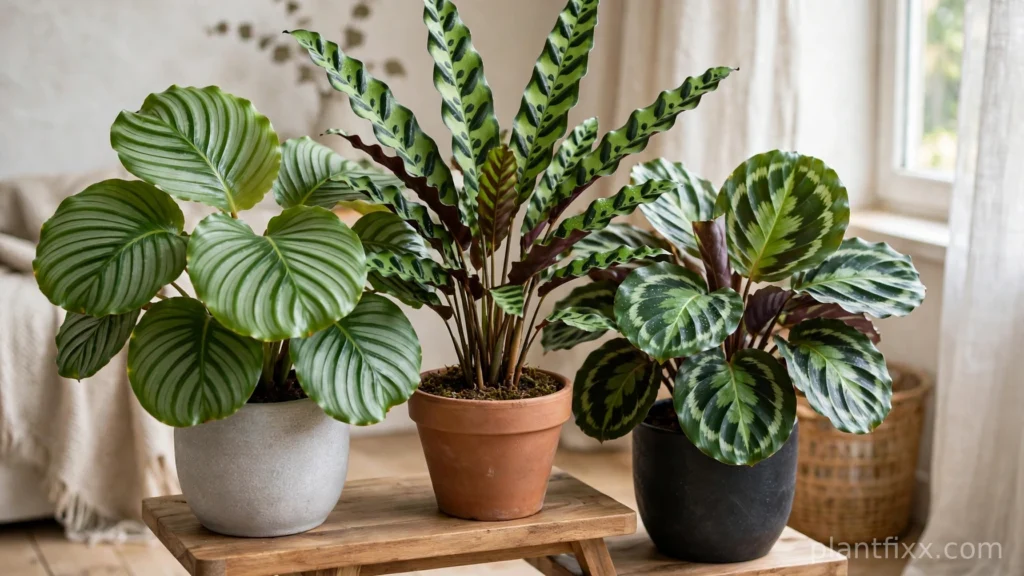
| Variety sold for homes | Toxic to cats | Note |
|---|---|---|
| Orbifolia | No | Large silver striped leaves, same genus listing |
| Lancifolia, rattlesnake plant | No | Named on separate ASPCA entries, also non-toxic |
| Medallion | No | Round feathered leaves, same genus listing |
| Dottie | No | Dark leaves with a pink stripe, same genus listing |
| White fusion | No | White centre stripe, same genus listing |
| Makoyana, peacock plant | No | See the common name warning in the next section |
Lookalikes and Confusion Risks: The Part That Actually Causes Harm
More pet harm comes from wrong names than from safe plants. Common names repeat across unrelated plants, and shop labels shorten or guess them, so check the botanical name before you relax.
Safe Plants Often Confused With Calathea
Its close family is good news. Maranta, sold as prayer plant, and ctenanthe and stromanthe share the folded leaf habit and the patterned foliage, and they are also listed as non-toxic.
Our prayer plant care guide covers the true Maranta group, which folds its leaves up at night the same way your calathea does.
Two common names need care. Peacock plant can mean a calathea type, and it can also mean an unrelated ginger plant, while zebra plant is used for several different plants.
Real Toxic Plants to Keep Apart
The plants to keep apart from a calathea shelf are the ones with a compound calathea lacks. Grouping them together in one display is how a safe plant gets blamed for a toxic neighbour.
| Plant | Why it is a real risk | Keep it |
|---|---|---|
| Pothos and philodendron | Calcium oxalate raphides, painful mouth injury | Out of chew reach, or out of the home |
| ZZ plant | Calcium oxalate crystals in leaves, stems and rhizome | On a spot no pet can reach |
| Peace lily | Calcium oxalate crystals, mouth and throat irritation | Away from cats, despite the gentle name |
| True lilies | Kidney failure in cats, even from pollen or vase water | Out of a cat home entirely |
| Snake plant | Saponins, nausea, vomiting and diarrhoea | Out of chew reach |
Safe Placement for Leaf Chewers in a Small Home
Judge a shelf by the jump line, not by its height alone. A cat launches from sofas, tables and windowsills, so a plant beside a launch point is a plant within reach.
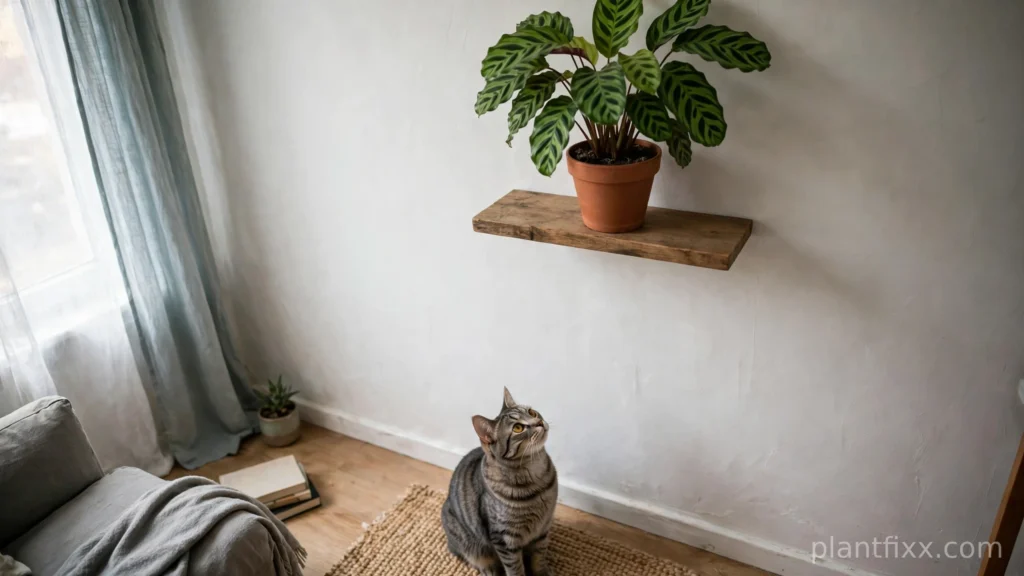
Pick up dropped and trimmed leaves the same day. Old leaves on the floor are the easiest chew in the house, and they are the one owners forget.
For low light corners, our list of pet safe low light indoor plants pairs calathea with other non-toxic plants that tolerate the same dim spots in small flats.
Give the Chewing Somewhere Better to Go
A pot of cat grass near the plant gives the chewing habit a legal target. Wheatgrass, oat grass and barley grass are grown to be eaten, and cats take to them fast.
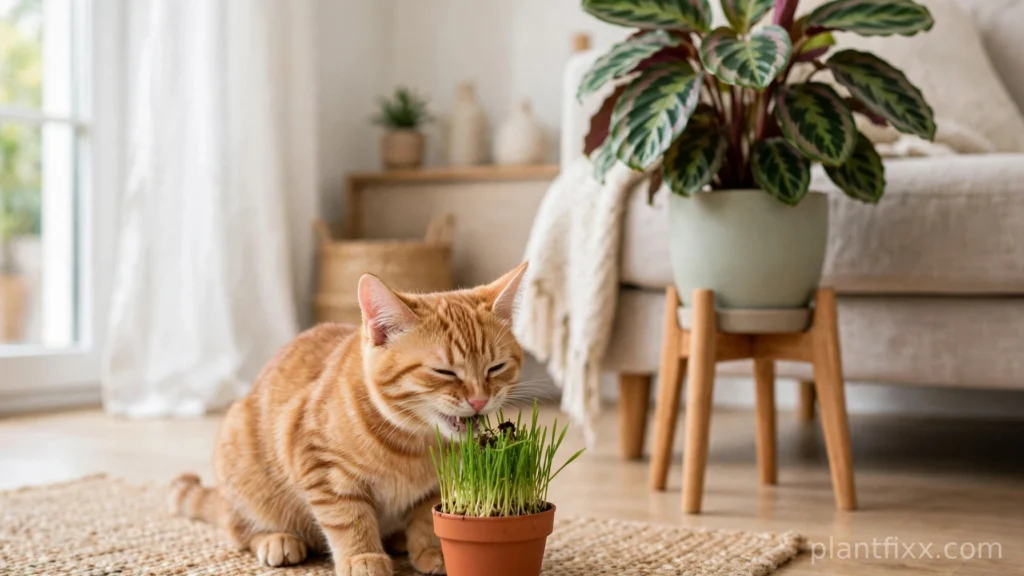
Skip deterrent sprays as your main plan. Taste sprays fade, need repeat use, and do nothing for the soil digging or the knocked pot that placement solves at once.
Keeping the Plant Alive Next to a Cat
A stressed calathea drops leaves, and dropped leaves invite more chewing. Steady light, moisture and humidity keep the plant full and far less interesting, and the full routine sits in our complete calathea plant care guide.
One mistake many people make is moving the plant lower for watering and leaving it there, at exact chewing height, for days. Put it straight back up when you finish.
A Safe Plant, With One Honest Caveat
Calathea earns its place in pet homes on evidence, not on folklore. The ASPCA lists the whole genus as non-toxic to cats, dogs and horses, with no toxic principle named.
The caveat is small and worth keeping. A cat that eats a lot of leaf can still face a short stomach upset from fibre, and the plant will carry the bite marks for months.
For a wider shelf plan, browse our guide to pet safe indoor plants for cats and dogs. It groups safe plants by light, so a whole room can be built without a single risky pot.
Is calathea toxic to cats?
No. The ASPCA lists Calathea spp. as non-toxic to cats, dogs and horses, and names no toxic principle for the genus. A cat that eats a lot of leaf can still get a mild stomach upset from the fibre.
What happens if my cat eats a calathea leaf?
Most cats show nothing, or vomit once, pass loose stool, or eat less for a few hours. These fibre effects fade as the leaf passes, usually by the next day.
Are all calathea varieties safe for cats?
Yes, the listing is written for the whole genus, so it covers orbifolia, lancifolia, medallion, dottie and white fusion, under either label.
Is calathea toxic to dogs?
No. Dogs sit on the same ASPCA entry as cats, listed as non-toxic. A dog that eats a large amount can still vomit or pass loose stool from the leaf fibre.
Why do some sites call calathea mildly toxic?
They are describing the stomach upset that any eaten plant material can cause. The ASPCA makes the same point at list level, and it is an irritation effect, not a poison in the plant.
Can calathea kill a cat?
No poisoning route exists in this plant, since it holds no toxic compound for cats. Hard or lasting signs after a chew point to another cause, so treat them as a vet matter, not a calathea effect.
Should I stop my cat from chewing calathea if it is safe?
Yes, as a habit rather than an emergency. Repeated chewing upsets the stomach, spreads soil and ruins the leaves, so placement and a pot of cat grass are worth the small effort.
Pingback: 10 Pet Safe Indoor Plants for Cats and Dogs (2026 Guide)
Pingback: Calathea Plant Care Guide: Light, Water, Humidity and Pet Safety