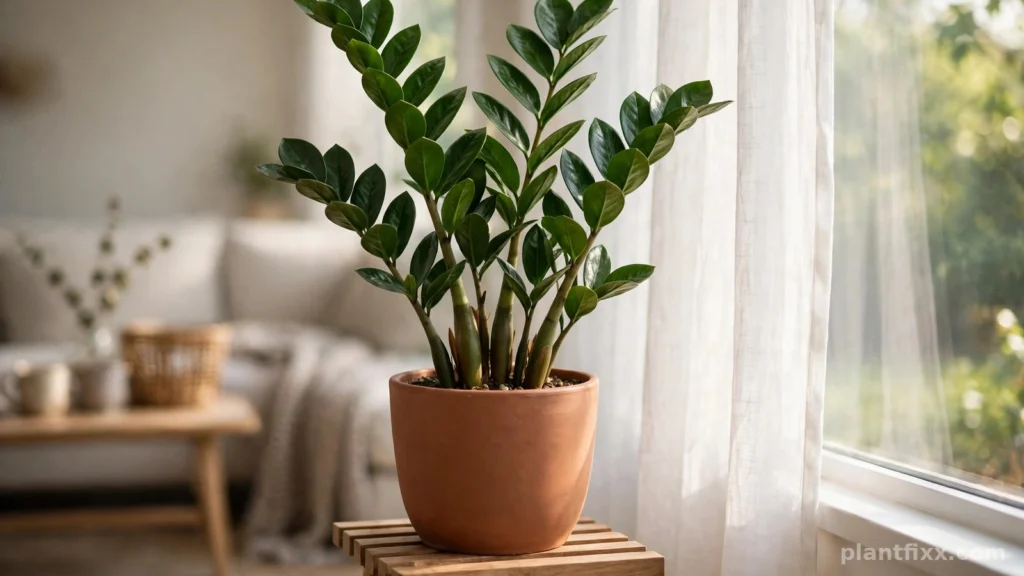
A ZZ plant forgives a lot, but it keeps score in three places: the light it gets, the soil around its rhizomes, and the food it is offered. Get the zz plant light requirements right and the other two get easier, because light controls how fast the soil dries and how much growth the plant can support.
Most guides treat these as separate topics. In practice they run as one system, and most ZZ plant problems trace back to a mismatch between them: bright light paired with a mix that stays wet, or a dim corner where the soil never dries and feeding only adds salt.
This guide covers all three together: how much light the plant needs and how to measure it, a soil recipe with ratios that drains fast enough for the rhizomes, and a feeding routine modest enough for a plant that stores its own supplies.
Quick Answer
A ZZ plant grows best in bright, indirect light, in a fast-draining mix of 2 parts potting soil, 1 part perlite and 1 part orchid bark, with a half-strength balanced feed once a month in spring and summer. It tolerates low light and average room humidity, but slow drainage and heavy feeding damage the rhizomes.
Why Light, Soil and Food Act as One System
The ZZ plant runs on its rhizomes, the thick white underground stems that store water and energy. Every care decision either protects those rhizomes or puts them under stress.
Light is the income. It refills the rhizome reserves through photosynthesis. In bright indirect light the plant earns more than it spends, pushes new stems, and uses water at a steady pace, so the soil dries on schedule.
Soil is where the reserves sit. A loose, airy mix lets water pass through and leaves air pockets around the rhizomes. A dense, wet mix does the opposite: water fills the air pockets, root and rhizome tissue suffocates, and rot starts in tissue you cannot see until stems yellow or turn soft.
Food is a small expense, not a salary. A ZZ plant grows slowly and draws on stored reserves, so it needs far less fertilizer than fast-growing houseplants. Feed it like a heavy feeder and the unused salts build up in the mix, burn root tips, and brown the leaf edges.
One mistake many people make shows how the three connect. A plant in a dim corner uses little water, so its soil stays wet for weeks. The owner sees no growth, assumes hunger, and feeds it. The plant cannot use the food, the salts concentrate in the wet mix, and the rhizomes take the damage. The fix was never food. It was light first, then drainage.
ZZ Plant Light Requirements: Surviving Is Not Thriving
The “low light plant” label is where most confusion starts. A ZZ plant tolerates low light better than almost any other houseplant, but tolerance is survival, not preference. Given the choice, it grows in bright, indirect light, and the difference shows in stem thickness, leaf size, and how often new spears appear.
Judge zz plant light needs by growth, not by survival. A plant that has held the same six stems for a year is surviving. A plant that pushes two or three new stems each growing season is getting the light it wants.
| Light level | Foot-candles | Lux (approx.) | Typical indoor spot | How a ZZ plant responds |
|---|---|---|---|---|
| Low light | 25 to 100 | 270 to 1,100 | Room away from windows, office with overhead lighting | Survives, growth slows or stops |
| Medium light | 100 to 300 | 1,100 to 3,200 | Middle of a bright room, close to a north window | Slow, steady growth |
| Bright indirect light | 300 to 800 | 3,200 to 8,600 | 2 to 4 feet from an east window, south window behind a sheer curtain | Best growth, compact stems, regular new spears |
| Direct sun | 800 and up, or a direct beam at any level | 8,600 and up | Unfiltered south or west windowsill | Scorch risk, bleached patches, crispy edges |
These bands are general indoor guidance, and the low end is the firm part: the University of Maryland Extension places ZZ plants in its low light band of 25 to 100 foot-candles, a range where the plant holds on but grows slowly. A free phone lux app gives a close enough reading for placement decisions. Hold the phone at leaf height, facing the window, and take the reading at midday.
ZZ Plant Best Light: Bright and Indirect
The zz plant best light is bright, indirect light: a room lit well enough to read in comfortably, while no direct sunbeam lands on the leaves. In most homes that means 2 to 4 feet from an east or north window, or a few feet back from a south or west window behind a sheer curtain. Aim for 6 to 8 hours of that indirect brightness a day.
The shadow test checks it without any meter. On a bright day, hold your hand about a foot above the plant. A soft, blurred shadow means bright indirect light. A sharp, hard-edged shadow means direct sun is reaching the leaves. Almost no shadow means the spot counts as low light, whatever the room feels like to your eyes.
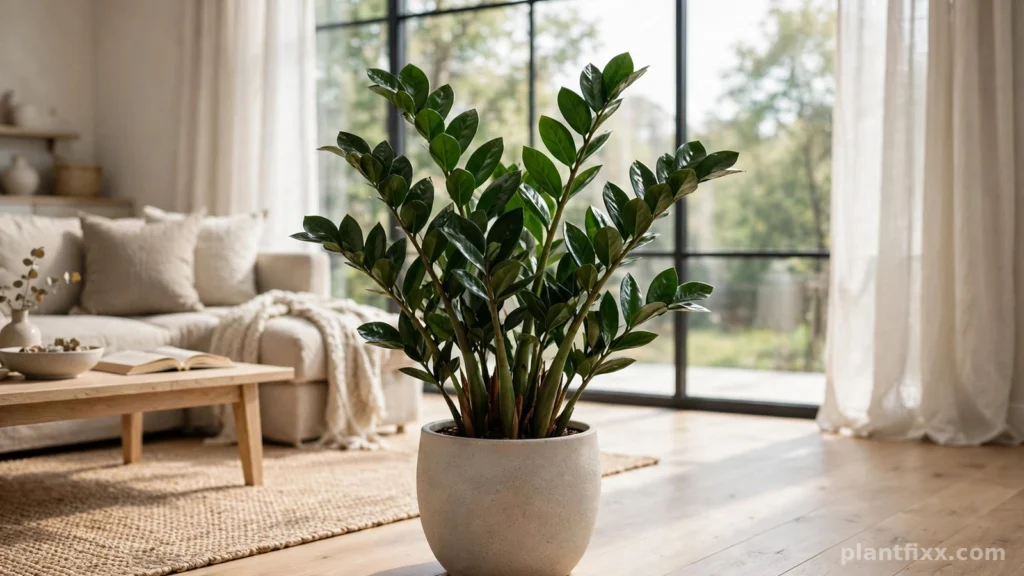
Rotate the pot a quarter turn every few weeks. Stems lean toward the light over time, and regular turning keeps the plant upright and even instead of lopsided.
ZZ Plant Low Light: What to Expect
A zz plant low light placement will not kill the plant. It will slow it down. New stems come less often, new leaflets stay smaller, and stems stretch taller with wider gaps between the leaves as the plant reaches for brightness. It still holds its green through all of that, which is why low light is central to our honest guide to zz plant benefits.
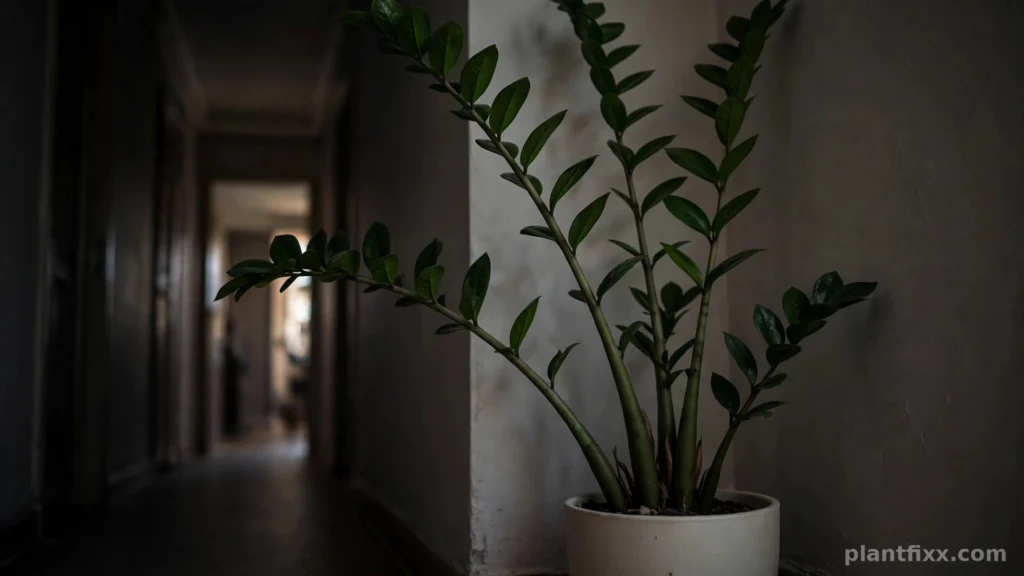
Two knock-on effects matter more than the slow growth. First, a plant in low light drinks slowly, so the same watering routine that was safe by a window can keep the mix wet for weeks in a corner. Water less often in dim spots and let the mix dry out fully between drinks. Second, do not feed a plant in low light to push growth. It cannot spend the food, and the salts will sit in the soil.
If the corner is the only option, choose the brightest version of it. Our guide to ZZ plant low-light spots ranks the usual rooms and corners by how much usable light they get.
Too Much Light: Scorch Signs
Direct sun, mainly through south and west windows in the afternoon, burns ZZ plant leaves. The signs are pale, bleached patches on the leaflets facing the glass, crispy brown edges, and foliage that fades from deep green to a washed-out yellow-green.
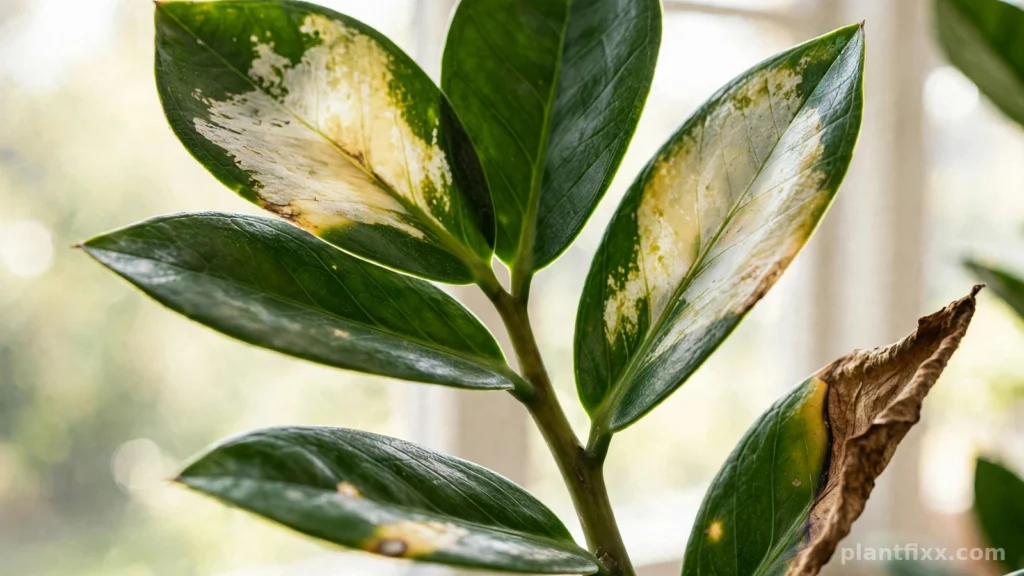
Scorched tissue does not recover. Move the plant back from the glass or add a sheer curtain, and leave damaged leaves in place until new growth replaces them, unless more than half of a leaf is dead. Morning sun through an east window is gentle enough for most ZZ plants. Afternoon sun is the one that burns.
ZZ Plant Grow Light: When a Window Is Not Enough
A zz plant grow light earns its place in windowless rooms, dark north-facing apartments, and winter months when daylight shrinks. The plant does not need high intensity. A full-spectrum LED in the 5000K to 6500K range, set 12 to 18 inches above the leaves, covers it.
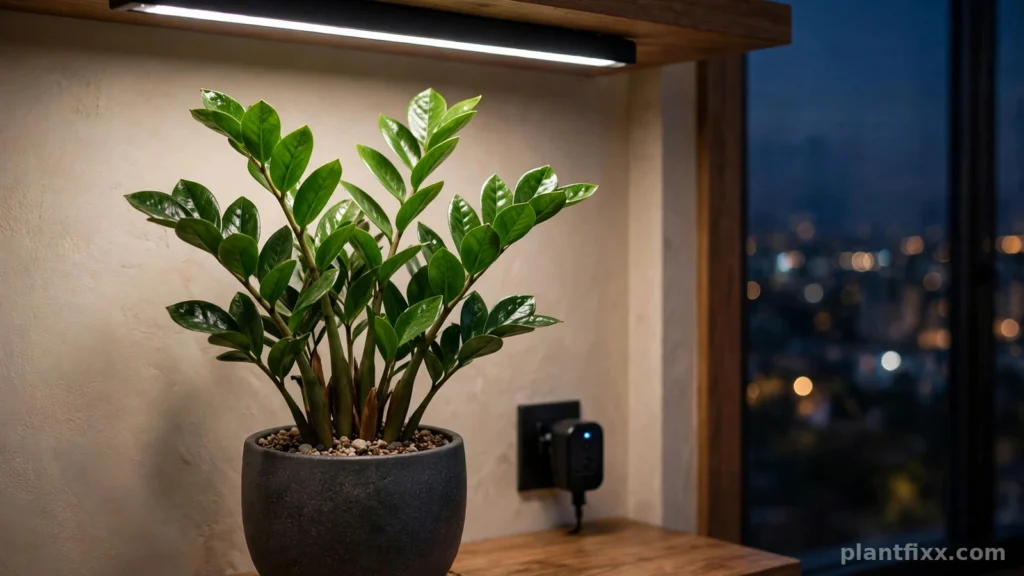
Run the light 8 to 12 hours a day on a timer, and keep at least 8 hours of darkness at night. Consistency beats intensity: a modest light on a steady schedule grows a better plant than a strong light switched on at random. Expect a plant under a grow light to drink slightly faster than one in a dim corner, and check the soil before watering rather than following the calendar.
What You Need Before You Start
- A phone with a free lux meter app, or a basic light meter. Optional, the shadow test works without one.
- Quality potting soil or a cactus and succulent mix as the base.
- Perlite or pumice, and medium orchid bark.
- A pot with drainage holes, only 1 to 2 inches wider than the rhizome mass.
- A balanced liquid fertilizer such as 10-10-10 or 20-20-20, plus a measuring cap or spoon.
- Plain water for the drainage test and for flushing salts out of the pot.
ZZ Plant Soil Mix: Built Around the Rhizome
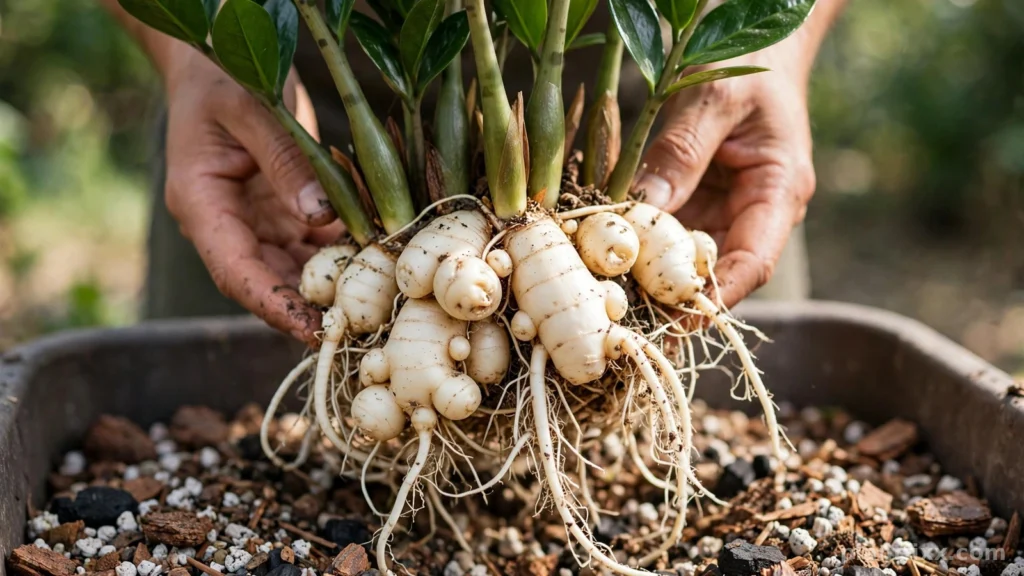
The roots of most houseplants forgive a heavy mix for a while. ZZ plant rhizomes do not. They are dense, water-filled tissue sitting in the wettest part of the pot, and a mix that holds water against them for weeks invites rot that stays hidden until a stem collapses.
So the best soil for zz plant roots is not the richest mix. It is the one that drains fastest while still holding enough moisture for the week or two between waterings. A good zz plant potting mix feels chunky and loose in the hand, with visible perlite and bark pieces, and water runs through it instead of pooling on top.
ZZ Plant Soil Recipe With Ratios
- 2 parts quality potting soil or cactus and succulent mix: the base, holds some moisture and structure.
- 1 part perlite or pumice: keeps air pockets open and speeds drainage.
- 1 part medium orchid bark: adds chunk and slows compaction over time.
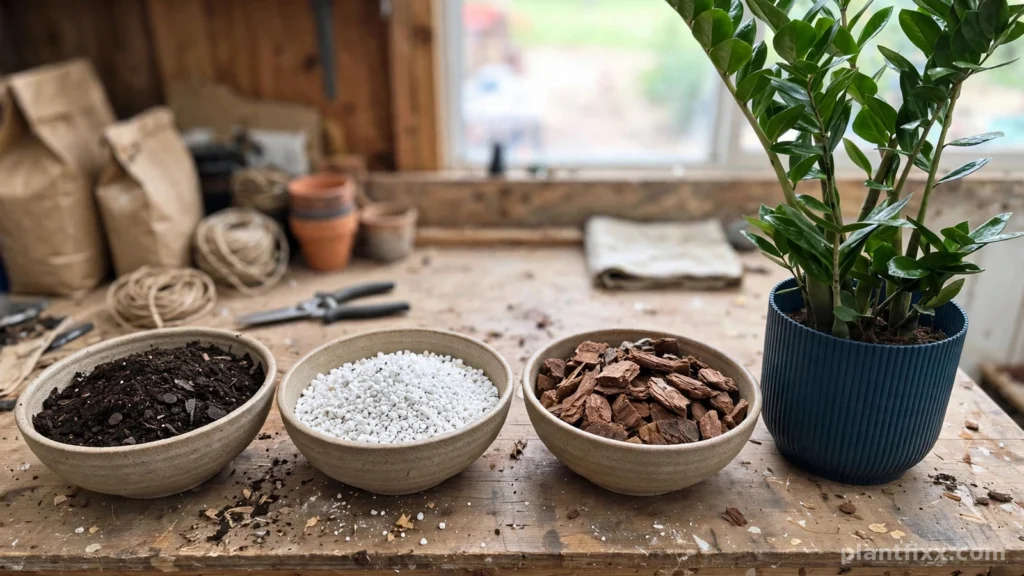
Mix the zz plant soil recipe in a bucket or tub, not in the pot, so the parts blend evenly. Two adjustments cover most homes. If your rooms run humid or you tend to water generously, shift to equal parts of all three for even faster drainage. If your home is hot and dry and the mix dries out within days, keep the recipe as written and let the base hold a little more moisture.
The shortcut version also works: a bagged cactus and succulent mix with extra perlite stirred in, at roughly 2 parts mix to 1 part perlite. Other soil guides land on the same shape, including the FullyGrows ZZ plant soil guide, which pairs two parts cactus mix with one part perlite. Skip garden soil and moisture-control mixes with water-retaining crystals, and avoid any bag that feels heavy and fine-textured. A slightly acidic to neutral pH, around 6.0 to 7.0, suits the plant, and most bagged mixes already sit in that range.
ZZ Plant Soil Drainage: Test Before You Trust It
Test zz plant soil drainage before the plant goes in. Fill the empty pot with mix, set it in a sink, and pour water through. Water should start leaving the drainage holes within seconds, and the surface should not stay flooded. If it pools, stir in more perlite and test again. See the best soil for a ZZ plant, with exact mix ratios and a drainage test.
The pot matters as much as the mix. Drainage holes are non-negotiable. Terracotta dries the mix faster and suits heavy-handed waterers. Plastic holds moisture longer and suits forgetful ones. Oversizing is the quiet mistake: extra soil with no roots in it stays wet for weeks, so choose a pot only 1 to 2 inches wider than the root and rhizome mass.
Drainage and watering are two halves of the same habit. Once the mix and pot are right, the rhythm is soak, drain, and wait until the mix dries again, which our guide to watering a ZZ plant breaks down by season and pot size.
Signs the Mix Is Working, and Signs It Is Not
Working signs: water drains freely at every watering, the mix dries through in one to three weeks depending on light, stems stay firm at the base, and new spears appear during the growing season.
Failure signs: the mix stays wet past three weeks, a sour smell comes from the pot, lower stems yellow or turn soft at the base, and fungus gnats gather at the soil surface. Treat those as a drainage problem first. Unpot the plant, check the rhizomes, cut away any soft brown tissue, and repot into a fresher, chunkier mix rather than adjusting the watering alone.
ZZ Plant Fertilizer: A Light Feeder With a Long Memory
Treat this section as a zz plant feeding guide built on one fact: the plant stores energy in its rhizomes and grows slowly, so it needs little food and notices every overdose. Underfeeding a ZZ plant rarely causes visible harm. Overfeeding is a common cause of brown leaf edges and damaged roots.
Choosing the Best Fertilizer for ZZ Plant Growth
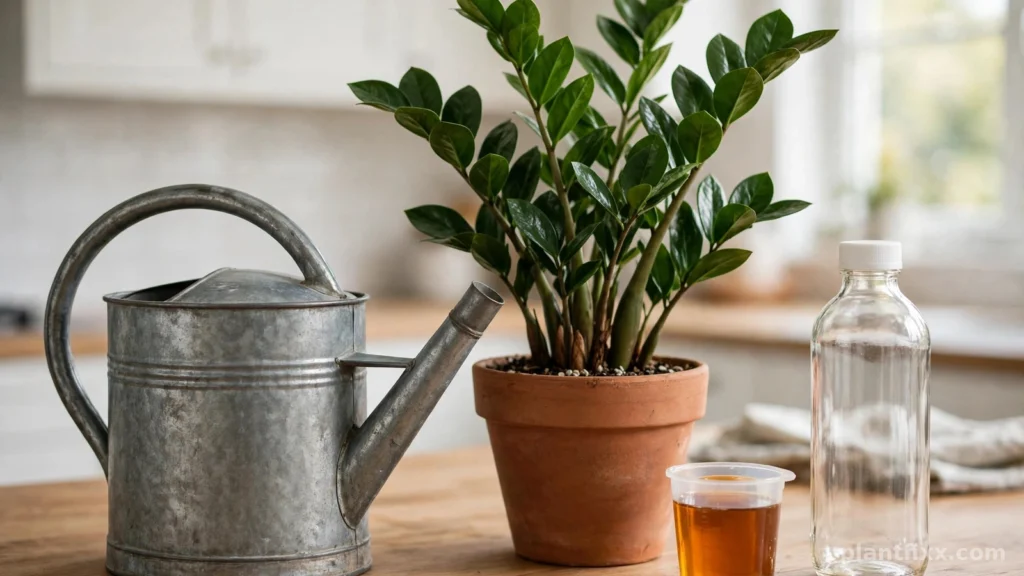
The best fertilizer for zz plant health is an ordinary balanced liquid feed, used weak. Balanced means the three numbers on the label are equal or close, so a 10-10-10 or a 20-20-20 both work.
Read the zz plant fertilizer NPK numbers as proportions, not power. Nitrogen drives leaf and stem growth, phosphorus supports roots and rhizomes, and potassium supports overall cell function. A slow-growing foliage plant uses all three in modest amounts, so a balanced ratio at half strength beats a strong specialty product at full strength. Slow-release pellets are a workable alternative: one light application in spring covers the season.
ZZ Plant Fertilizer Schedule by Season
| Season | What to do |
|---|---|
| Spring | Half-strength balanced feed once a month, starting when new stems appear. |
| Summer | Continue the monthly half-strength feed, always into moist soil. |
| Early fall | One final half-strength feed, then stop. |
| Late fall and winter | No fertilizer at all. Growth rests and unused salts build up. |
This zz plant fertilizer schedule sits at the modest end of the range care guides give, which runs from every 6 to 8 weeks down to twice a season. The TheLeafyCare ZZ plant care guide feeds every 6 to 8 weeks in spring and summer, and a plant in average light grows no faster on the monthly version. Pick the sparser schedule if your plant grows slowly. It will not fall behind.
Two rules protect the plant between feedings. Dilute to half the label strength, or quarter strength if you feed monthly through the whole season. And apply fertilizer only to soil that is already moist. Feeding a dry root ball concentrates salts around the roots and burns them. If your plant sits in low light or has pushed no new growth in months, skip feeding until it is growing again, because food cannot fix a light problem.
ZZ Plant Fertilizer Burn vs Nutrient Deficiency
Owners often feed a plant that is already burned, because zz plant fertilizer burn and early deficiency can both show up as unhappy leaves. Read the pattern before you act.
| Sign | Fertilizer burn | Nutrient deficiency |
|---|---|---|
| Leaf tips and edges | Brown and crispy, often with a white salt crust on the soil surface | Yellowing that starts on the oldest leaves, no crispy burn |
| Growth | Sudden decline in the weeks after a feeding | Slow growth, pale new leaves, smaller leaflets |
| Timing | Appears days to weeks after a feed | Builds over months or years in old, never-fed soil |
| Fix | Flush the pot with plain water, stop feeding for the season | One half-strength feed, then resume the light schedule |
A zz plant nutrient deficiency is rare and builds slowly, usually in a plant that has sat in the same soil for years without a single feed. Even then, light is the first suspect. If a plant has pushed no new stem through a whole growing season, work through the reasons a ZZ plant stops growing before reaching for fertilizer.
Burn is faster and follows feeding. Brown, crispy tips and edges in the weeks after a feed, sometimes with that white crust of salts on the surface, point to overdose. The fix is water, not more products: flush the pot with plain water several times over, let it drain fully, and stop feeding for the rest of the season. For the leaf-level damage pattern and how to trim it, see our guide to brown tips on ZZ plant leaves.
Humidity and Temperature: The Two Easy Ones
ZZ Plant Humidity Requirements
The zz plant humidity requirements are the lowest demands in this guide. Average household humidity, roughly 40 to 50 percent, suits the plant, and it tolerates the 30 percent or lower air of heated winter rooms without complaint. The thick, waxy leaflets lose water slowly by design.
Skip the humidifier and the misting bottle for this plant. Misting wets leaf surfaces for a few minutes and changes nothing in the air. If leaf edges brown in very dry air, check watering and fertilizer salts first. Both cause that pattern far more often than humidity does. Wiping dust off the leaves with a damp cloth once a month does more for the plant than misting, because clean leaves take in light better.
Temperature Tolerance
The zz plant temperature tolerance suits normal homes. Growth is best between 65 and 75°F (18 to 24°C). The plant shrugs off brief dips toward 50°F (10°C), but cold below about 45°F (7°C) can damage leaves and stems, and frost kills it outright.
Placement does the work. Keep the pot away from cold window glass in winter, exterior doors, air conditioning vents, and radiators, all of which swing leaf temperature faster than the room air changes. If the plant summers outdoors, keep it in full shade and bring it back inside before nights fall toward 50°F.
Frequently Asked Questions
Can a ZZ plant live in a room with no window?
Not on room light alone. It will coast on rhizome reserves for months, then decline. A full-spectrum grow light on a timer, 8 to 12 hours a day, makes a windowless room workable.
How many hours of light does a ZZ plant need?
Aim for 6 to 8 hours of indirect brightness a day near a window, or 8 to 12 hours under a grow light. Duration only counts when the intensity is high enough, which is why a dim room with the lights on all day still starves the plant.
Can I use regular potting soil for a ZZ plant?
Only after amending it. Straight from the bag, regular potting soil holds water too long around the rhizomes. Stir in perlite and orchid bark at the ratios in the recipe above, or start from a cactus and succulent mix.
How often should I fertilize a ZZ plant?
At most, a half-strength balanced feed once a month in spring and summer, and nothing from fall through winter. Many healthy ZZ plants get fed twice a season and grow the same. When in doubt, skip a feeding.
What NPK ratio is best for a ZZ plant?
A balanced one. A 10-10-10 or 20-20-20 liquid fertilizer at half strength covers what the plant uses. The dose matters far more than the exact ratio for a plant that grows this slowly.
Does a ZZ plant need a humidifier?
No. Average household humidity around 40 to 50 percent is enough, and the plant tolerates drier heated air in winter. Spend the effort on light and drainage instead.
Can fertilizer burn kill a ZZ plant?
A severe overdose can damage roots and rhizomes badly enough to kill stems, but caught early it is fixable. Flush the soil with plain water, stop feeding for the season, and the plant usually recovers as new growth replaces the burned leaves.
The Bottom Line
Light, soil, and food reward a ZZ plant in that order. Give it bright indirect light, a chunky mix that drains in seconds, and a weak feed a few times a year, and the plant settles into the slow, steady growth it is known for. When something looks off, check the light first, the drainage second, and the fertilizer last.
For the watering, repotting, and pruning routine that completes the picture, read our complete ZZ plant care guide.
Pingback: ZZ Plant Care Guide: Best Low-Light Apartment Plant (2026)
Pingback: ZZ Plant Benefits at Home: Real Perks and Honest Downsides
Pingback: Best Soil for ZZ Plant: 3 Exact Mix Recipes That Prevent Rot
Pingback: How Big Do ZZ Plants Get? Mature Height & Growth (2026)