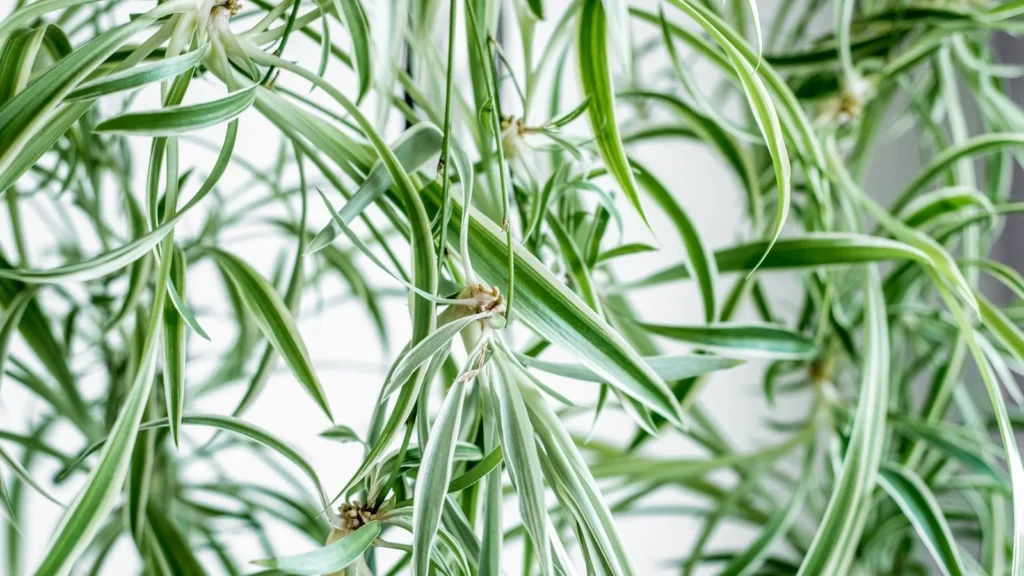
Small white flowers on long, arching stems mean your spider plant has reached maturity and started its reproductive stage. Spider plant flowers are normal, and they need no special care from you. Many owners miss them entirely because each bloom is small and short lived.
Spider plant flowers are a normal sign of a mature, healthy plant, and the blooms usually appear before baby plantlets form on the same stems.
This guide explains what the flowers look like, why they show up, and how to decide between leaving the stalks, cutting them, or rooting the plantlets that follow. You will also learn which conditions make flowering more likely, so you can support blooms without forcing them.
What Spider Plant Flowers Look Like
The flowers grow on stolons, the long, wiry stems that arc out from the center of the plant. Clemson Extension describes these stems on healthy plants, carrying many small white flowers along with miniature plantlets.
Each flower is small and star shaped, with six spreading white parts that botanists call tepals, since the petals and sepals look alike. NC State Extension describes the flowers in loose clusters called panicles, at about a quarter inch across.
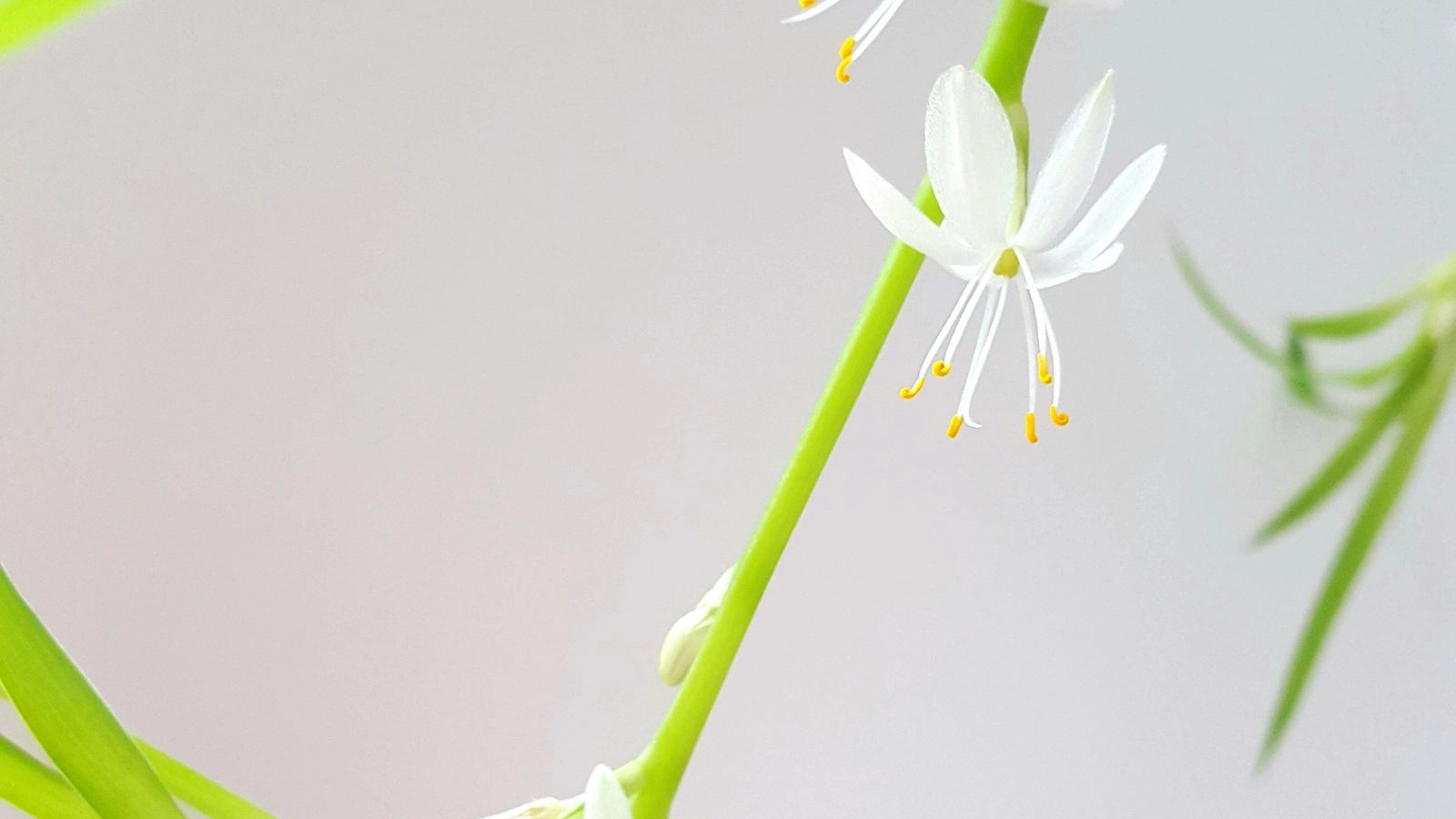
Look closer and you can see slender stamens with pale yellow tips at the center of each bloom. Missouri Botanical Garden describes the display as loose panicles of small, white, starry flowers.
Individual flowers do not last long, and fresh buds keep opening along the stem. One stalk can carry open blooms, fading flowers and young plantlets at the same time.
Why Spider Plants Flower
Flowering is how the plant reproduces, and it follows a set of conditions rather than a calendar date. A plant that never flowers is usually missing one of the triggers below.
The plant has reached maturity
A young plant puts its energy into leaves and thick, fleshy roots first. Flowering comes later, once the plant reaches a mature size, which grower references put at roughly a year of growth or more.
Steady basic care is what carries a young plant to that stage. The complete spider plant care guide covers the watering, light and potting routine that gets it there.
Day length and light send the signal
Day length is the trigger with the clearest extension backing. NC State Extension states that stolons and plantlets are light dependent and develop when the mother plant receives short days and long, uninterrupted nights, under 12 hours of light a day, for at least three weeks.
Light strength matters alongside day length. NC State lists medium light as the preference and notes that the plant tolerates shade but not direct sun, and a plant kept in dim light may grow leaves without ever producing stems.
Our guide to the best light for spider plant growth explains how to judge brightness at your window and where to place the pot.
A lamp left on beside the plant every evening can interrupt those long nights. If stems never appear, check the room lighting after dark before changing anything else.
A snug pot and light feeding help
Spider plants produce plantlets well when they sit slightly pot bound, according to University of Wisconsin Extension. Roots that fill the pot without severe crowding match the stage where stems and plantlets tend to appear.
Feeding works in the opposite direction from what you might expect. NC State Extension warns that over-fertilizing decreases plantlet formation, so heavy feeding can give you lush leaves and no stems at all.
The spider plant fertilizer guide shows a lighter feeding routine that avoids this problem while the plant is growing.
What Happens After the Flowers Fade
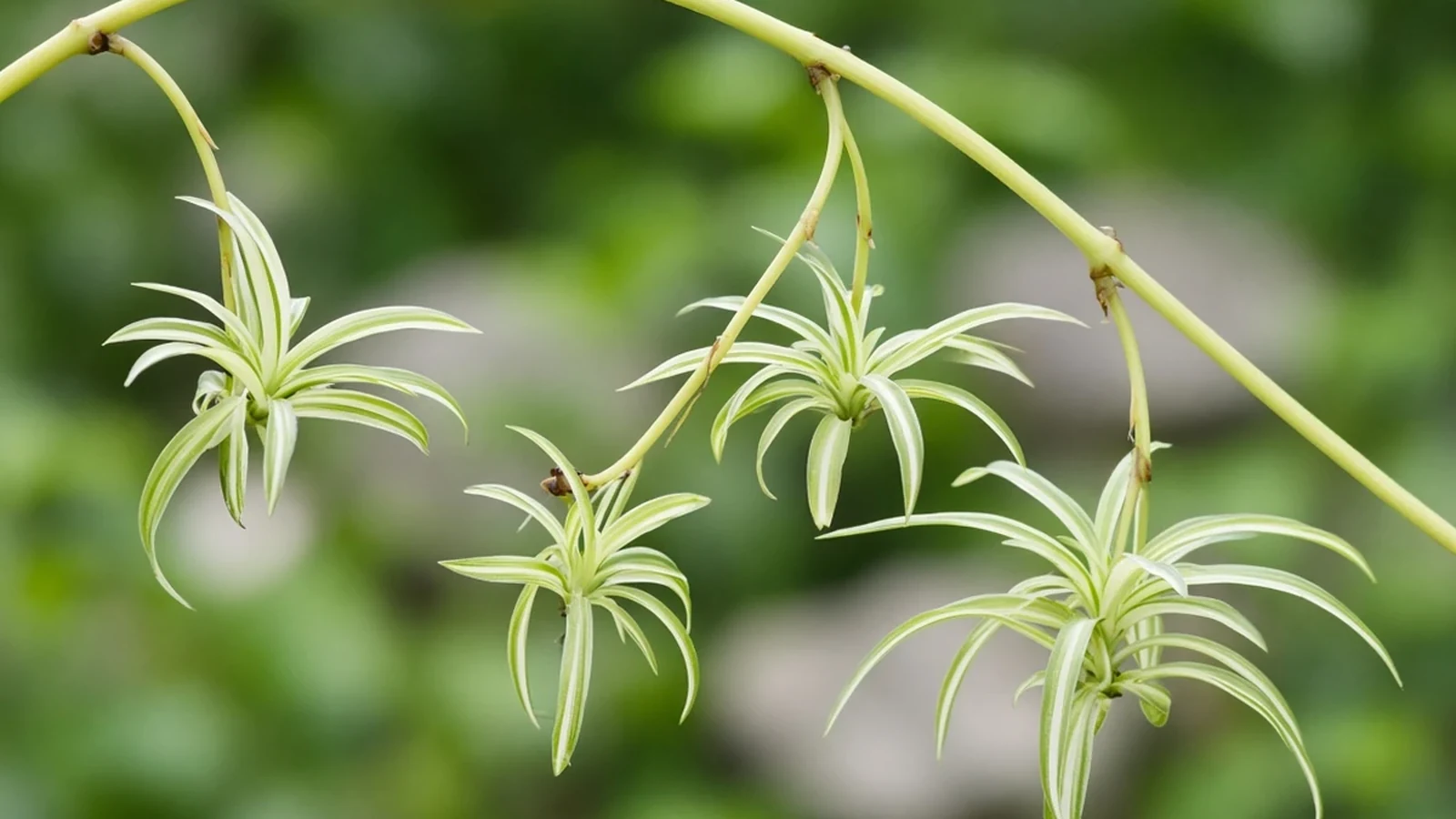
The flowers do not turn into babies. Flowers and plantlets share the same stem, and the plantlets form at the flowering nodes and at the stem ends after the blooms fade.
After flowering, more leaves grow at those points and build into a small rosette with its own strap shaped leaves. This miniature copy of the parent is the plantlet, also called a pup or spiderette.
The plantlet then grows short root nubs at its base while it still hangs from the stem. Clemson Extension notes that plantlets root when they touch soil, so a dangling pup that reaches a surface can start on its own.
Seed is the less common outcome indoors. A pollinated flower can form a leathery, three angled capsule holding small, flat, black seeds, but indoor plants rarely get the insect visits that pollination needs.
Should You Cut the Flower Stalks or Leave Them?
There is no required action here, and the right choice depends on what you want from the plant. Cutting a stalk early also removes the plantlets that would have formed on it, so decide before you reach for the scissors.
| Your goal | Stalk choice | What you get |
|---|---|---|
| New plants to pot up or share | Leave the stalk on | Plantlets form at the nodes after flowering |
| A full, cascading hanging basket | Leave the stalks on | Plantlets stay attached and fill out the display |
| A tidy plant with foliage only | Cut the stalk at its base | No plantlets, and the plant keeps growing leaves |
| A stalk is damaged or fully brown | Cut it off at the base | Dead growth is removed, and new stalks can follow |
The Royal Horticultural Society advises trimming back flowering spikes once they have finished if you do not need new plantlets. It advises leaving them in place when you want a fuller basket or babies to share.
If you cut, use clean scissors and take the stalk off where it leaves the crown. Avoid cutting into the leafy center, since new growth comes from that point.
How to Root the Plantlets That Follow
A plantlet is ready when it has a cluster of leaves and visible root nubs at its base. One with no roots can still work, but a rooted plantlet is the safer pick.
- Set a small pot of moist, free draining potting mix beside the parent plant.
- Lower the plantlet onto the surface of the mix while it stays attached to the stalk.
- Pin it in place with a bent paper clip so the base keeps contact with the mix.
- Keep the mix lightly moist while roots grow down into it.
- Cut the stalk between the parent and the plantlet once the new plant resists a gentle tug.
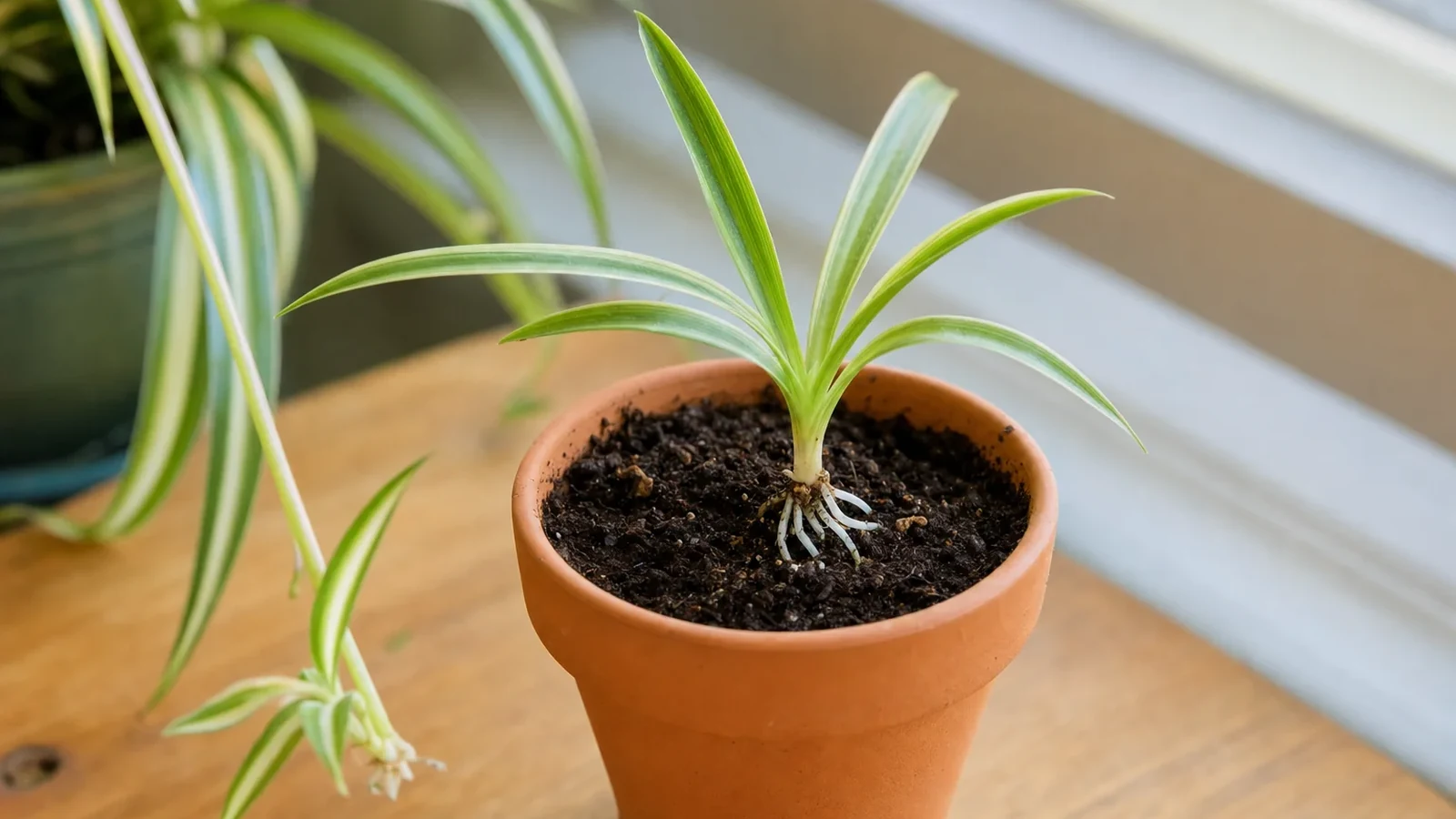
Detached plantlets with roots of their own can go straight into moist mix instead, a method Clemson Extension supports at any time of year. Keep new plants in medium to bright indirect light while they establish.
The spider plant pups guide covers water rooting, timing and aftercare in more detail once your plantlets are ready.
Flowers but No Babies: What to Check
Flowers with no plantlets afterward point to a short list of causes. Work through these checks before changing your whole routine.
- Interrupted nights: room lights or a lamp left on late keep the plant’s nights short or broken, and NC State ties plantlet formation to long, uninterrupted nights.
- Heavy feeding: over-fertilizing decreases plantlet formation, so ease off the fertilizer rather than adding more.
- An oversized pot: a plant in a much larger pot may spend its energy filling that space with roots, and stems can wait until the roots catch up.
- A slow producing cultivar: Wisconsin Extension notes that ‘Variegatum’ tends to form fewer plantlets than other types, so the plant itself may be the reason.
Check the spider plant varieties page if you are unsure which type you own, since expectations differ by cultivar.
How to Encourage Spider Plant Flowers
No routine can force a spider plant to flower, and a young or struggling plant should grow leaves first. On a mature plant, the conditions below match the triggers that extension sources describe, and they raise the chance of stems without stressing the plant.
- Keep the plant in medium to bright indirect light, out of direct sun.
- Let the plant keep long, dark nights, away from lamps that stay on late.
- Leave a healthy plant in its pot while the roots fill it, rather than moving it into a much bigger pot.
- Feed lightly and only during active growth, following the product label.
- Keep watering steady, letting the mix dry slightly at the surface between waterings.
If your plant grows well but stays flower free, patience is a valid step. Wisconsin Extension notes that indoor plants can produce stolons at any time of year, so a missed cycle says nothing about the next one.
Does Flowering Harm the Spider Plant?
Flowering is a normal stage of growth, not a warning sign. Clemson Extension describes the long, flower carrying stems as a feature of healthy plants, and the blooms ask little from the parent while they are open.
The stalks draw some energy, as any new growth does, but a plant in decent light with steady care keeps producing leaves at the same time. If the parent looks weak, check light, water and pot size before blaming the flowers.
One case calls for a different order. If the plant is already struggling, with yellowing leaves or a root zone that stays soggy, fix the care problem first, and remove the stalks only if you want growth focused back on leaves and roots.
Spider plant flowers mark the point where a foliage plant starts making copies of itself. Leave the stalks and you get plantlets to root and share, or cut them and you keep a clean pot of leaves, and the plant handles both choices well.
Start with the simplest step: leave the next stalk in place and watch a plantlet form at its end. For the full routine that keeps the parent plant strong through flowering and beyond, keep the complete spider plant care guide bookmarked.
Frequently Asked Questions
Do spider plant flowers turn into babies?
No. The flowers and the plantlets grow on the same stem. After a flower fades, leaves form at that node or at the stem end and build into a plantlet, while a pollinated flower forms a seed capsule instead.
Should I cut off the flower stalks on my spider plant?
Only if you do not want plantlets. Leave the stalks on for babies or a fuller basket, and trim a stalk at its base once it finishes, turns brown or gets damaged.
Do spider plant flowers harm the plant?
No. Flowering is a normal stage on a mature plant, and extension sources describe the flower carrying stems as a feature of healthy plants. A plant in steady care keeps growing leaves while it flowers.
Why is my spider plant flowering but not making babies?
Check the nights first, since plantlets form after short days and long, uninterrupted nights. Heavy feeding can also reduce plantlet formation, and some cultivars, such as ‘Variegatum’, produce fewer plantlets than others.
How can I get my spider plant to flower?
Give a mature plant medium to bright indirect light, long dark nights and light feeding, and avoid moving it into an oversized pot. These conditions match the known triggers, but they cannot force a young plant to flower.
Can a spider plant make seeds from its flowers?
Yes, if a flower is pollinated. The flower then forms a leathery, three angled capsule with small, flat, black seeds. Indoors this is uncommon, and plantlets remain the usual way new plants appear.