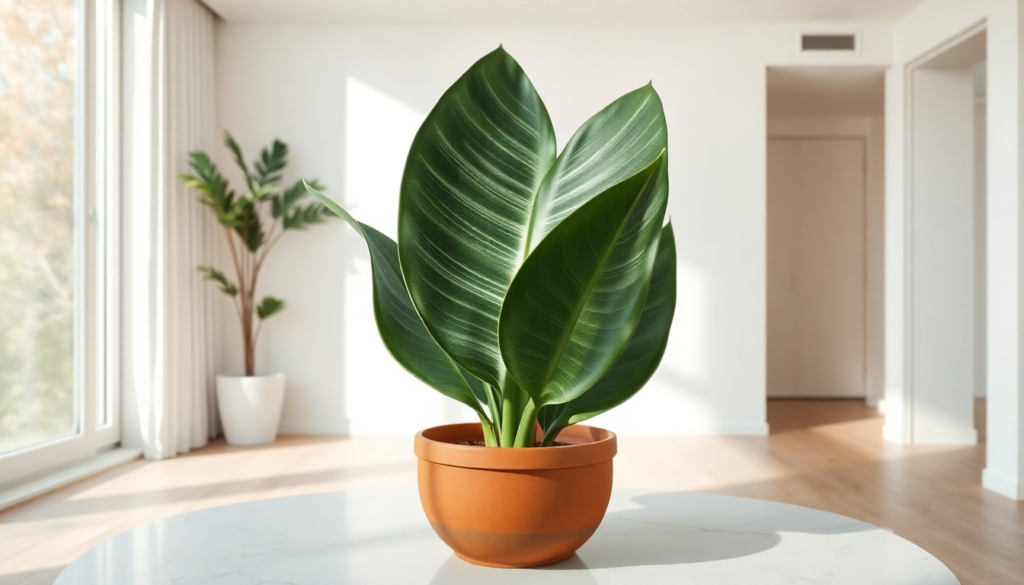
The whale fin snake plant stops people in their tracks. One massive, paddle-shaped leaf rising from a pot, deep green with faint silvery banding, looking almost too architectural to be a real plant. If you have just bought one or are considering it, you need care information that is specific to this variety because whale fin snake plant care differs from standard snake plant care in several important ways that most beginner guides skip over.
The whale fin snake plant (Dracaena masoniana, formerly Sansevieria masoniana) is not a typical snake plant. It grows differently, stores water differently, and fails from different causes. Understanding those differences before making your first care decisions is what keeps this plant alive and growing for years rather than months.
Quick Answer
Whale fin snake plant care requires watering only when soil is completely dry at 3 inches depth (every 3 to 6 weeks), bright indirect light from a south or west-facing window (250 to 300 foot-candles minimum), fast-draining mineral-rich soil, temperatures between 65 and 85 degrees Fahrenheit, and repotting every 3 to 5 years. Never mist, never fertilize in winter, and never water when the leaf feels firm and full.
Quick Take The whale fin snake plant thrives on neglect but only when that neglect is intentional and informed. Unlike common snake plants, it grows slowly, stores water in its thick paddle-shaped leaves rather than rhizomes, and suffers irreversibly from overwatering or low light. These plants can grow up to 3 to 6 feet tall, making them perfect for a tall statement in a low light corner. Whale fin snake plant care has three non-negotiables: infrequent deep watering only when bone dry, bright indirect light for at least 6 hours daily, and a porous mineral-rich soil that drains completely within 24 hours.
What Is the Whale Fin Snake Plant?
The whale fin snake plant, scientifically known as Sansevieria masoniana now reclassified as Dracaena masoniana, is commonly known as the whale fin snake plant, named for the single broad paddle-shaped leaf that resembles a whale’s fin breaking the surface of water. You will also see it referred to informally as the whale plant or simply the fin plant, both of which appear frequently in searches and on plant shop labels.
It is a close relative of the common snake plant but grows as a single dramatic leaf rather than the multi-leaf rosette most people associate with sansevierias. This single-leaf growth habit is the most distinctive feature that separates the whale fin from every other commonly available snake plant variety. While a standard Dracaena trifasciata produces a cluster of upright sword-like leaves, a whale fin produces one or two enormous paddle-shaped leaves per growing point, each capable of reaching 10 to 18 inches wide and 3 to 6 feet tall at full maturity.
Variegated versions are even rarer, featuring creamy borders or marbled patterns. The variegated whale fin, sometimes labeled as Sansevieria masoniana ‘Variegated’ or ‘Mason’s Congo Variegated’, carries cream or pale yellow margins along the leaf edges. These are significantly more expensive and harder to find than the standard variety and require even brighter light to maintain their variegation.
One mistake many beginners make is treating the whale fin exactly like a standard trifasciata and applying the same care habits. Unlike common snake plants, the whale fin stores water in its thick paddle-shaped leaves rather than rhizomes. This leaf-based storage system means the plant has different warning signals, a different overwatering timeline, and a different recovery process from the rhizome-based storage of trifasciata varieties.
Watering: The Most Critical Care Decision
Water only when the soil is completely dry, typically every 2 to 4 weeks. For most indoor environments, particularly in lower light or cooler temperatures, every 3 to 6 weeks is more accurate. The whale fin’s massive leaf stores enormous amounts of water relative to its pot size, which means it uses soil moisture more slowly than you expect from a plant this large.
Infrequent deep watering only when the soil is bone-dry 3 inches down is the core rule. Insert your finger or a wooden chopstick 3 inches into the soil before every watering. If you feel any moisture, wait. If completely dry and crumbly, water thoroughly until water flows from the drainage holes, then let it drain completely. Never leave the pot in standing water.
Our whale fin once started wrinkling along the center of the leaf, which surprised us because we thought wrinkling meant it needed more water. This is the most common whale fin diagnosis mistake. Leaf wrinkling in whale fin snake plants does not always mean underwatering. It also occurs from overwatering when root damage prevents water uptake despite adequate soil moisture, and from cold damage. Always check the soil before responding to wrinkling. If the soil is wet or damp and the leaf is wrinkling, you are overwatering, not underwatering. If the soil is bone dry and the leaf feels soft and thin rather than firm and full, then watering is the correct response.
In winter, extend your watering interval to every 6 to 10 weeks. Refer to the snake plant winter care guide for the complete seasonal adjustment schedule that applies to whale fin as well as standard trifasciata varieties.
Light: Where Whale Fin Differs From Standard Snake Plants
Whale fin snake plants require a minimum of 250 to 300 foot-candles of photosynthetically active radiation for 6 to 8 hours daily. That is equivalent to bright filtered light 3 to 5 feet from an unobstructed south-facing window, or 2 to 3 feet from a west-facing window with a sheer curtain.
This is meaningfully higher than the 100 to 150 foot-candle minimum that standard trifasciata varieties like Laurentii tolerate for basic growth. The whale fin’s single massive leaf needs sufficient light to power the photosynthetic activity that supports its enormous water storage capacity and slow but steady growth. In insufficient light, the consequences are specific and progressive.
New leaves emerge significantly narrower than mature ones, often under 4 inches wide versus the standard 6 to 9 inches. Leaf color fades from deep forest green to olive-gray with reduced silvery cross-banding. No new growth appears for 12 or more consecutive months even with correct watering. A whale fin that produces narrow, pale new leaves is telling you it needs more light immediately. Move it closer to a bright south or west-facing window, or add a full-spectrum LED grow light positioned 12 to 18 inches above the leaf and run it for 12 hours daily.
North-facing windows rarely exceed 50 foot-candles year-round. East windows peak at approximately 150 foot-candles in the morning only, which is insufficient for sustained whale fin growth. Unlike some standard trifasciata varieties that manage in north-facing windows, the whale fin needs south or west-facing exposure for reliable performance indoors.
Soil: A More Mineral-Rich Mix Than Standard Snake Plants
Repot only every 3 to 5 years in a porous mineral-rich mix: 40% coarse perlite or pumice, avoid fine-grade material, 30% terracotta grit, and 30% low-peat potting blend. This is a more aggressively draining mix than the standard snake plant formula because the whale fin’s leaf-based water storage means the soil needs to dry even faster than for rhizome-storing varieties.
The key distinction from standard snake plant soil is the addition of terracotta grit or coarse horticultural sand at a higher proportion. These inorganic materials create a mineral-rich growing medium that mimics the rocky, fast-draining substrate of the plant’s native West and Central African habitat. The soil must drain completely within 24 hours of watering. If you press a handful of the mix together and it holds its shape rather than crumbling apart, it is too water-retentive for a whale fin.
For beginners who prefer a shortcut, a pre-made cactus and succulent mix amended with 30 to 40% extra perlite or pumice produces acceptable results. Avoid any mix that contains wetting agents or moisture-retaining crystals since these work directly against the fast-draining conditions this plant requires. Refer to the best soil mix for snake plants guide for the complete recipe and amendment ratios, keeping in mind that whale fin benefits from a slightly more mineral-heavy blend than standard trifasciata.
Pot Size and Type
Snug pots work best for whale fin snake plants. The same one-to-two-inch larger rule that applies to standard snake plants applies here, but the whale fin’s single-leaf growth habit means its root system is often more contained than you expect given the plant’s dramatic above-ground size.
A wide, shallow pot suits the whale fin’s growth habit better than a tall, narrow container. The single leaf grows from a central base and the root system spreads laterally rather than deeply. An oversized pot holds wet soil that the limited root system cannot access, which creates the exact conditions that cause root rot in a plant that is already sensitive to overwatering.
Terracotta is the best pot material for whale fin snake plants because its porous walls wick excess moisture from the soil at a rate that helps compensate for beginner overwatering tendencies. For a plant this slow-growing and this expensive, the extra drying benefit of terracotta is a meaningful safety margin. Refer to the snake plant pot size guide for the complete sizing table and pot material comparison that applies directly to whale fin selection.
Temperature and Humidity
Whale fin snake plant prefers temperatures between 65 and 85 degrees Fahrenheit. It handles the low end of this range better than the high end in most indoor conditions. Below 55 degrees Fahrenheit, cellular damage begins and the leaf may develop water-soaked patches that later brown and scar permanently. Keep the plant away from cold windows in winter, exterior walls, and air conditioning vents.
Humidity requirements are minimal. The whale fin tolerates dry indoor air and irregular watering while maintaining a firm sculptural look. Its massive leaf stores enough water internally to buffer against low humidity conditions that stress thinner-leafed tropical plants. Never mist the leaf surface. Misting adds surface moisture that evaporates slowly in the whale fin’s lower-metabolism microclimate and promotes fungal surface infections without providing any hydration benefit to the plant.
Propagation: Slow But Possible
Propagation is slow but possible. Try leaf cuttings or divide pups when visible. Whale fin propagation is significantly slower and more complex than standard snake plant propagation for two reasons: the plant grows only one or two leaves per growing point, which means there are few leaves to spare for cuttings, and the slow growth rate of the species means even successful propagations take many months to produce a recognizable new plant.
Leaf cuttings from whale fin produce new plants but the process takes 3 to 6 months longer than standard trifasciata cuttings. Cut a section of healthy leaf at least 3 to 4 inches long, let the cut end callous for 48 hours, dust with cinnamon, and insert bottom-end-down in a 50/50 perlite and cactus mix. Keep barely moist and in bright indirect light. Do not expect results for 4 to 6 months. Pup separation is the faster and more reliable method when pups are available, which in a slow-growing whale fin may only happen every 2 to 3 years.
Variegated versions are even rarer. Leaf cuttings from variegated whale fins revert to solid green since the variegation pattern exists in the meristem tissue of the rhizome, not in the leaf cells. Use pup separation only to propagate variegated specimens. Refer to the how to propagate a snake plant guide for the complete pup separation process that applies to whale fin as well as trifasciata varieties.
Why Whale Fin Snake Plants Are Expensive
Its high price is due to extremely slow growth and limited propagation. Mature plants can reach 2 to 4 feet tall with leaves up to 12 to 18 inches wide. A whale fin that is 18 inches tall with a mature-width leaf represents approximately 3 to 5 years of growth from a propagated cutting. Nurseries cannot produce them quickly, which keeps supply limited and prices high relative to standard snake plants.
Variegated versions are even rarer, featuring creamy borders or marbled patterns, and command significantly higher prices precisely because they can only be reliably propagated through pup separation, which happens infrequently on a slow-growing plant. A variegated whale fin in a 6-inch pot commonly sells for 50 to 150 dollars or more depending on leaf size and condition, compared to 10 to 30 dollars for a standard whale fin of similar size.
Common Whale Fin Problems and Fixes
Leaf wrinkling is the most misdiagnosed whale fin symptom. Wrinkling along the center of the leaf can surprise beginners who assume it means the plant needs water. Check soil moisture first. Dry soil plus a thin, soft, wrinkled leaf means underwatering. Wet or damp soil plus wrinkling means root damage from overwatering is preventing water uptake even though moisture is present. The fix for the second scenario is not more water but rather root inspection and repotting if rot is found.
Brown leaf edges or tips develop from low humidity near heating vents, fluoride in tap water, or cold draft damage. Switch to filtered water, move the plant away from vents, and maintain stable temperatures above 55 degrees Fahrenheit. Brown patches on the leaf surface that appear suddenly and feel soft or translucent indicate cold damage from window glass contact or a cold draft, which is permanent but does not spread to healthy tissue once conditions improve.
Yellowing of the leaf, which is unusual since the whale fin typically has one leaf and losing it to yellowing is a serious event, indicates root rot from chronic overwatering. Unpot immediately, inspect the root system, remove all soft dark sections with sterilized scissors, and repot in completely dry fresh mineral-rich soil. Do not water for 10 to 14 days after repotting to allow the root system to stabilize.
No new leaf growth after 12 or more months indicates insufficient light as the primary cause in most cases. Move immediately to a brighter location and give the plant one full growing season in the new position before concluding there is a different problem.
Frequently Asked Questions
How do you care for a whale fin snake plant? Whale fin snake plant care requires watering only when soil is completely dry at 3 inches depth, typically every 3 to 6 weeks. Provide bright indirect light from a south or west-facing window at 250 to 300 foot-candles minimum for 6 to 8 hours daily. Use fast-draining mineral-rich soil with 40% perlite or pumice. Maintain temperatures between 65 and 85 degrees Fahrenheit. Repot every 3 to 5 years. Never mist and never fertilize in winter.
How often should you water a whale fin snake plant? Water every 3 to 6 weeks in spring and summer, and every 6 to 10 weeks in winter. Always check soil moisture at 3 inches depth before watering. The whale fin stores water in its thick leaf rather than rhizomes, which means it can go longer between waterings than most houseplants of its size. When in doubt, wait another week before checking again.
Why is my whale fin snake plant wrinkling? Wrinkling along the center of the leaf can surprise beginners who think it means the plant needs water. Check the soil first. Dry soil plus wrinkling means underwatering: water thoroughly. Wet soil plus wrinkling means root damage from overwatering is preventing water uptake: stop watering, unpot and inspect roots, treat any rot found, and repot in dry fresh soil. Cold damage also causes leaf wrinkling alongside soft water-soaked patches.
How much light does a whale fin snake plant need? Whale fin snake plants require a minimum of 250 to 300 foot-candles for 6 to 8 hours daily, equivalent to bright filtered light 3 to 5 feet from a south-facing window. North-facing windows rarely exceed 50 foot-candles and east windows peak at approximately 150 foot-candles in the morning only, both of which are insufficient for sustained whale fin growth.
Why is the whale fin snake plant so expensive? The whale fin snake plant’s high price is due to extremely slow growth and limited propagation options. A plant with a mature-width leaf of 8 to 12 inches represents 3 to 5 years of nursery growth. Variegated specimens cost even more because they can only be reliably propagated through pup separation, which happens infrequently on an already slow-growing plant.
Can you propagate a whale fin snake plant? Yes, through leaf cuttings or pup separation. Leaf cuttings take 4 to 6 months longer than standard snake plant cuttings to produce results. Pup separation is the faster and more reliable method when pups are available. Variegated whale fins must be propagated by pup separation only since leaf cuttings revert the variegation to solid green. The complete process is in the how to propagate a snake plant guide.