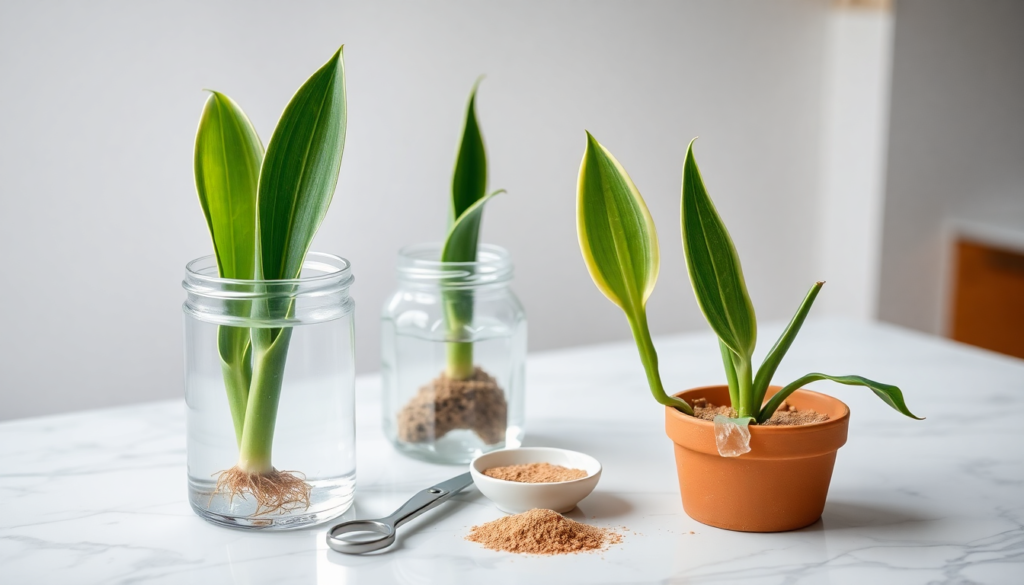
Snake plant propagation is one of the most rewarding things you do with this plant. One healthy Dracaena trifasciata becomes two, four, or ten plants within a single growing season, entirely for free. But snake plant propagation fails more often than it should, and almost always for the same small set of reasons: the cutting goes in upside down, the water goes stale, a variegated cutting reverts to solid green, or a pup gets separated before it has roots of its own.
This guide covers the three main snake plant propagation methods, leaf cuttings in water, leaf cuttings in soil, and division, with exact steps, the biology behind why each works, and the specific mistakes that kill cuttings before they ever root.
Quick Answer
The fastest snake plant propagation method is division or pup separation, which produces a new plant with existing roots in 2 to 4 weeks. Leaf cuttings in water or soil take 4 to 8 weeks to root and 3 to 5 months to produce a new pup. Division also preserves variegation in Laurentii and other patterned varieties. Leaf cuttings from variegated plants revert to solid green.
Quick Take Snake plant propagation works through three main methods: leaf cuttings in water, leaf cuttings in soil, and rhizome division. Division is faster, more reliable, and the only method that preserves variegation in chimeric varieties like Laurentii or Moonshine. Leaf cuttings work well for solid-colored varieties when you want to produce many new plants from a single leaf. The single most common mistake in leaf propagation is inserting the cutting upside down, which prevents root formation entirely regardless of other conditions.
Which Method Should You Use?
Before starting, use this decision rule to pick the right snake plant propagation method for your situation.
Use leaf cuttings in water or soil when your parent plant has no pups yet, when you want to produce several new plants from one leaf, or when your plant is a solid-colored variety without chimeric variegation. Leaf cuttings take longer but require nothing more than a healthy leaf, a jar or small pot, and patience.
Use division when the parent plant has produced pups or multiple clumps, when you want to preserve the gold margins of variegated cultivars like Laurentii, or when you want a fully established new plant in the shortest time possible. Division gives you a plant with existing roots that starts growing immediately rather than spending weeks developing roots from scratch.
The Biology of Snake Plant Leaf Propagation (Why Polarity Matters)
Every guide tells you to mark the bottom of each cutting. Few explain why it matters so much.
The reason polarity matters is biological: cells at the base of a snake plant leaf are primed to respond to auxin, the root-initiating hormone. Cells at the tip are not. Placing the tip end in the rooting medium asks tip cells to do a job they were not differentiated for. Roots either fail to form or form so slowly and weakly that the cutting rots before they establish. Getting polarity right is the single highest-leverage step in snake plant leaf propagation.
This is why marking the bottom of each cutting before you section the leaf is not optional. Once a leaf is cut into 3-inch sections, every piece looks identical. Without a mark, you insert half of them upside down and wonder why they never root.
Method 1: Leaf Cuttings in Water
Success rate: 70 to 80% Timeline: Roots in 4 to 8 weeks, pups in 3 to 5 months Variegation preserved: No
Select a healthy, mature leaf with no yellowing, soft spots, or pest damage. Avoid the youngest leaves at the center of the rosette, which root less reliably than older outer leaves. Cut close to the soil line with sterilized scissors or a clean sharp knife. Let the entire cut leaf rest on dry paper in a shaded spot for 24 to 48 hours before sectioning. This callusing step at the base reduces rot risk significantly when the cutting contacts water later.
Once calloused, cut the leaf into 3 to 4 inch sections. As you cut each section, immediately mark the bottom end with a small diagonal notch or a pen mark. Never skip this step. Place each section cut-end-down in a clean glass jar filled with room-temperature filtered water. Submerge only the bottom 1 inch. Submerging too much tissue is one of the most common mistakes, as it causes the cutting to rot before roots form. Position the jar in bright indirect light, 3 to 4 feet from a south-facing window or directly in front of an east-facing window. Change the water every 5 to 7 days without exception. Stale water loses oxygen, and roots need oxygen to develop. If the water turns cloudy or develops any odor before the weekly change, replace it immediately.
White root tips appear in 4 to 8 weeks depending on temperature and light. Warmer rooms at 70 to 80 degrees Fahrenheit root faster than cool rooms. Do not move cuttings to soil until roots reach at least 1 inch long, since shorter roots break during transplanting. When you move water-rooted cuttings to soil, use a very airy mix of 50% perlite and 50% cactus mix for the first 4 to 6 weeks. Water more frequently than you would for an established plant during this transition period since water-grown roots are fragile and need time to adjust to soil conditions.
Method 2: Leaf Cuttings in Soil
Success rate: 75 to 85% Timeline: Roots in 4 to 8 weeks, pups in 2 to 4 months Variegation preserved: No
Soil propagation produces stronger roots from the start because they develop directly in the medium they will live in permanently. There is no transition shock when you skip from water to soil.
Follow the same selection and callousing process as water propagation. Cut the healthy outer leaf near the soil line, let it air dry for 24 to 48 hours, then section into 3 to 4 inch pieces with each bottom end marked. Optionally dip the calloused cut end in powdered cinnamon, which acts as a natural antifungal, or in rooting hormone powder to accelerate root initiation. Fill a small pot with a 50/50 propagation mix of perlite and cactus mix. Moisten the mix lightly before inserting cuttings. Push each section bottom-end-down about 1 to 1.5 inches deep and press the mix gently around the base to keep it upright.
Water very lightly after inserting, just enough to settle the soil, then let the mix approach complete dryness before watering again. Rootless cuttings cannot absorb much water and wet soil around them is the primary cause of soil propagation failure. Place in bright indirect light at 65 to 80 degrees Fahrenheit. After 6 to 8 weeks, tug gently on the cutting. Resistance means roots have anchored. If it slides out with no resistance, return it to the soil and wait another 2 to 3 weeks. A small new leaf emerging from the soil beside the original cutting confirms successful propagation.
Method 3: Division and Pup Separation
Success rate: 90 to 95% Timeline: New growth in 2 to 4 weeks Variegation preserved: Yes
Division is simply separating a mature plant into sections, each with existing roots. You give each section independence rather than asking it to create roots from scratch. This is how snake plant propagation happens naturally in the wild.
Slide the mother plant out of its pot and brush away enough soil to clearly see the rhizomes, the thick orange-tan horizontal stems connecting sections of the plant. Each new section needs at least 3 leaves and a chunk of rhizome with roots attached. Cut cleanly through the rhizome at the division point using a sterilized knife. One decisive cut, not a sawing motion, produces a clean wound that heals faster. Dust cut rhizome ends with powdered cinnamon and let each section air dry for 2 to 4 hours before potting.
For pup separation specifically, a pup is ready when it stands at least 4 to 6 inches tall and has its own visible root system at the base. Separating a pup before it develops independent roots removes its only source of water and nutrients. Trace the rhizome connecting the pup to the mother plant and cut it close to the mother, leaving as much rhizome attached to the pup as possible.
Pot each division or pup in a container 1 to 2 inches larger than its root ball, using fresh fast-draining soil. Water lightly once after potting, then hold off for 7 to 10 days. The root system needs to settle before it can efficiently take up nutrients, so hold off on fertilizing for 4 to 6 weeks after division.
Variegation and Snake Plant Propagation: The Complete Rule
This is the most important fact about snake plant propagation for anyone growing patterned varieties.
Leaf cuttings from chimeric variegated varieties like Laurentii (yellow edges), Moonshine (silver), and Bantel’s Sensation (white stripes) revert to solid green in the new plants they produce. The variegation in these varieties exists only in the meristem tissue of the rhizome, not in the leaf cells. A cutting contains leaf cells only, and the new plant it grows produces solid green leaves regardless of how much care you take. This is why division is the only method that reliably preserves the gold margins of variegated cultivars like Laurentii.
For solid-colored varieties like Zeylanica, Black Coral, and standard trifasciata, leaf cuttings reproduce the parent’s appearance reliably since there is no chimeric variegation to lose.
Common Propagation Mistakes and Fixes
Cutting inserted upside down is the most common reason leaf propagation produces zero roots after 8 to 10 weeks. Mark each cutting’s bottom end as you section the leaf, before sections become indistinguishable from each other.
Water not changed weekly causes the propagation medium to become anaerobic. Roots need oxygen in the water to develop. Stale water smells bad and promotes bacterial rot at the cut end before any roots form.
Separating a pup too early removes its only nutrient source. A pup with no roots of its own declines rapidly after separation. Wait until the pup is at least 4 to 6 inches tall with visible independent roots before cutting the rhizome.
Moving water-rooted cuttings directly to standard potting mix causes transplant shock since water-grown roots are structurally fragile and adapted to an aquatic environment. Use a 50/50 perlite and cactus mix transition medium for the first 4 to 6 weeks and water slightly more often than normal.
Propagating from stressed or diseased leaves produces weak cuttings that rot before rooting. Always start snake plant propagation from firm, healthy outer leaves with no yellowing, spots, or soft sections.
Propagation Timeline by Method
| Method | Roots Form | First Pup or New Leaf | Fully Established |
| Water cuttings | 4 to 8 weeks | 3 to 5 months | 6 to 8 months |
| Soil cuttings | 4 to 8 weeks | 2 to 4 months | 5 to 7 months |
| Division | Already present | 2 to 4 weeks | 6 to 10 weeks |
| Pup separation | Already present | 1 to 3 weeks | 4 to 8 weeks |
Frequently Asked Questions
How do you propagate a snake plant? Snake plant propagation works through three main methods: leaf cuttings in water, leaf cuttings in soil, and rhizome division or pup separation. Water and soil cuttings take 4 to 8 weeks to root and 2 to 5 months to produce a new plant. Division produces a new plant with existing roots that shows new growth within 2 to 4 weeks.
How long does snake plant propagation take? Water cuttings root in 4 to 8 weeks and produce a recognizable new pup in 3 to 5 months. Soil cuttings follow a similar timeline. Division and pup separation are faster since existing roots are already present, with new leaf production starting in 1 to 4 weeks after potting.
Why is my snake plant propagation not rooting? The four most common reasons are the cutting inserted upside down, water not changed weekly, insufficient light, or propagation done during winter dormancy when metabolic activity is too slow. Mark the bottom of every cutting before sectioning the leaf, change water every 5 to 7 days, position in bright indirect light, and keep temperatures above 65 degrees Fahrenheit.
Does snake plant propagation preserve variegation? Only division and pup separation preserve variegation in chimeric varieties like Laurentii, Moonshine, and Bantel’s Sensation. Leaf cuttings from these varieties revert to solid green because the variegation exists only in the rhizome’s meristem tissue, not in leaf cells. Solid-colored varieties like Zeylanica and Black Coral reproduce their appearance through all propagation methods.
Can you propagate a snake plant in water? Yes. Place leaf sections cut-end-down with only the bottom 1 inch submerged in clean room-temperature water. Change water every 5 to 7 days. Place in bright indirect light. Roots appear in 4 to 8 weeks. Transfer to soil once roots reach 1 inch long using a perlite-heavy transition mix.
What is the fastest way to propagate a snake plant? Division or pup separation is the fastest snake plant propagation method because each new section already has an existing root system. New leaf production begins in 1 to 4 weeks compared to 2 to 5 months for leaf cuttings. Division also preserves variegation in patterned varieties, making it the best all-around method when the parent plant is large enough to divide.
Pingback: Snake Plant vs ZZ Plant: Key Differences & Winner (2026)