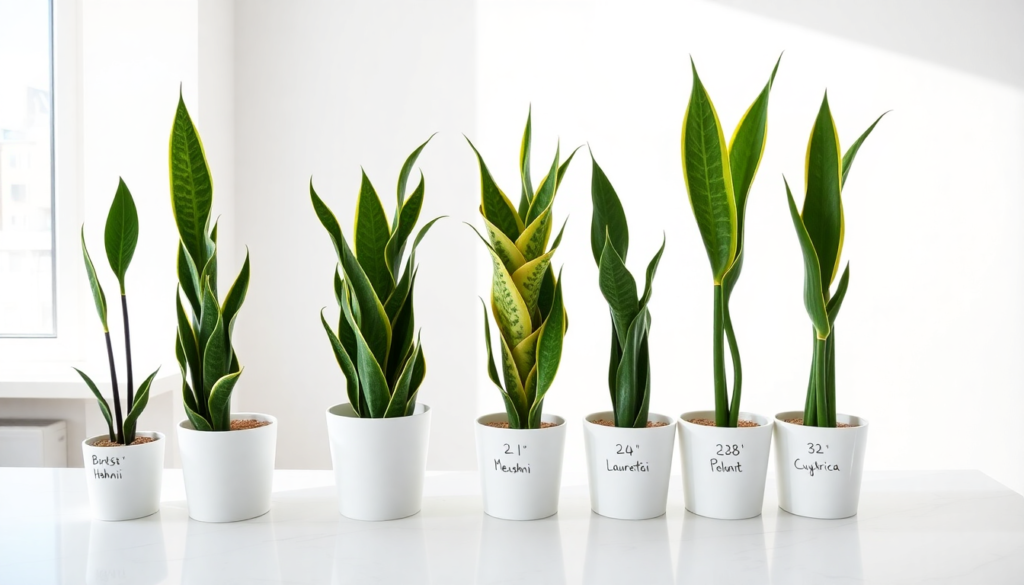
Snake plants have a reputation for being slow growers, and that reputation is partly deserved. Most varieties add only 2 to 4 inches per year under average indoor conditions. But that average hides real differences between varieties. Some snake plant varieties grow two to three times faster than others under the same conditions, and the fastest growing snake plant varieties respond dramatically to light, pot size, and seasonal care adjustments in ways that slower varieties do not.
If you want visible growth within a single season rather than waiting years for a plant to change size, choosing the right variety is the first decision that matters.
Quick Answer
The fastest growing snake plant varieties are Dracaena trifasciata (standard), Laurentii, Zeylanica, and Fernwood Mikado. Most snake plants add 2 to 4 inches per year under average indoor conditions, with upright varieties like Laurentii achieving moderate vertical growth when given optimal light and care. Compact varieties like Hahnii grow the slowest. Maximum growth happens in bright indirect light, spring through summer, with monthly feeding.
Quick Take All snake plants are slow to moderate growers compared to tropical houseplants. The fastest growing snake plant varieties are tall, upright Dracaena trifasciata cultivars with broad leaf surface area that allows more efficient photosynthesis. Snake plants have a medium growth rate and by making a few changes your plant can flourish. The low-maintenance, low-lighting advice that most guides give is the exact thing slowing your plant down. Bright indirect light, correct seasonal watering, and monthly spring and summer feeding push growth toward the upper end of each variety’s natural range.
Why Growth Rate Varies Between Varieties
The fastest growing snake plant varieties share two biological characteristics: large leaf surface area and tall, upright growth habits that direct energy toward vertical elongation rather than rosette spread.
In general snake plants grow slowly to moderately indoors. This varies as some species and varieties grow faster. If light levels are low then growth is slower. The core reason comes down to photosynthetic capacity. A tall, broad leaf like those on Laurentii or Zeylanica captures significantly more light per plant than the compact leaves of a Bird’s Nest Hahnii. More captured light means more energy for the Calvin cycle, which produces the glucose that drives cell division and new leaf production. Compact varieties with small leaf surface area simply generate less photosynthetic energy per day and have less to allocate toward growth.
D. angolensis (Cylindrica) stores water in its round, hollow spears so efficiently that it tolerates watering every 3 to 6 weeks in summer, even less frequently than standard snake plants. This water storage efficiency affects growth differently from leaf surface area. A plant optimizing water storage rather than light capture allocates cellular resources differently from one with flat, broad leaves oriented toward maximum light exposure.
One practical insight that most guides miss: growth rate is not fixed within a variety. The same Laurentii plant in a bright south-facing window produces two to three times more new growth per season than an identical specimen in a dim north-facing corner. Variety sets the ceiling. Care and environment determine where within that range the plant actually performs.
Variety-by-Variety Growth Rate Comparison
The table shows that most snake plants grow less than 4 inches annually, with dwarf types like Hahnii growing the slowest. Upright varieties such as Laurentii and Moonshine achieve moderate vertical growth when given optimal light and care. Maturity can take up to 8 years, emphasizing their slow but steady nature.
| Variety | Annual Growth (Indoor Average) | Max Indoor Height | Growth Habit | Speed Tier |
| Dracaena trifasciata (standard) | 4 to 6 inches | 3 to 4 feet | Upright cluster | Fastest |
| Laurentii | 4 to 6 inches | 3 to 4 feet | Upright cluster | Fastest |
| Zeylanica | 4 to 6 inches | 2.5 to 3 feet | Upright cluster | Fastest |
| Fernwood Mikado | 3 to 5 inches | 2 to 3 feet | Cylindrical cluster | Fast |
| Futura Robusta | 3 to 4 inches | 16 to 20 inches | Semi-compact upright | Moderate |
| Dracaena cylindrica | 2 to 4 inches | 4 to 6 feet | Upright fan | Moderate |
| Moonshine | 2 to 3 inches | Up to 2 feet | Compact upright | Slow to moderate |
| Twisted Sister | 2 to 3 inches | 12 to 15 inches | Spreading rosette | Slow |
| Whale Fin (masoniana) | 1 to 2 inches | 3 to 6 feet | Single leaf | Very slow |
| Bird’s Nest Hahnii | 1 to 2 inches | 6 to 10 inches | Compact rosette | Slowest |
The Fastest Growing Varieties in Detail
Dracaena trifasciata (Standard)
The standard Dracaena trifasciata, the original species from which most cultivars were selected, consistently produces the fastest growth of any commonly available snake plant when conditions are right. Its solid green leaves contain more chlorophyll per square inch than variegated cultivars, which means it converts light to energy more efficiently. In their natural environment these plants can grow up to 6 feet tall. Indoors with good bright indirect light, this variety regularly adds 4 to 6 inches per growing season and produces new pups more frequently than slower cultivars. If visible, rapid growth is your priority over decorative leaf pattern, the standard trifasciata delivers the best results.
Laurentii
Dracaena trifasciata ‘Laurentii’ is native to tropical West Africa from Nigeria to the Congo. Its long, rigid leaves grow from a basal rosette forming dense clumps that spread via creeping rhizomes. Laurentii matches the growth rate of standard trifasciata in good light despite its yellow margins slightly reducing total chlorophyll content. The leaves are tall, broad, and optimally shaped for light capture. It also produces pups reliably, which contributes to the visible size increase of the overall plant even when individual leaves are not growing dramatically. Laurentii is the fastest growing snake plant variety that also has strong decorative value, which is why it holds the top spot at most garden centers. Refer to the moonshine vs Laurentii snake plant guide for a direct comparison of how Laurentii’s growth rate compares to the slower Moonshine cultivar.
Zeylanica
Zeylanica (Dracaena zeylanica) is a separate species from trifasciata and one of the fastest growing snake plant options for indoor growers. Its upright leaves are long and blade-like reaching up to 2 to 4 feet, and its silver-green leaves with even horizontal stripes of darker green are stylish and adaptable. Zeylanica’s growth rate matches Laurentii in adequate light and it handles lower light conditions marginally better while maintaining its growth momentum. It also tolerates a wider range of watering schedules without the same root rot risk that stops growth in less drought-adapted varieties. Its banding pattern is preserved through leaf cuttings, which makes propagating a growing collection faster and easier than chimeric varieties.
Fernwood Mikado
The Sansevieria Fernwood Mikado has unique slim and dark green leaves and is considered a rare snake plant variety. Despite its rarity label at some retailers, Fernwood Mikado grows faster than its collector status might suggest. Its dark, slim cylindrical leaves cluster densely from a central rhizome and produce new growth points more readily than most cylindrical varieties. The deep green coloration means high chlorophyll density, which supports faster growth in adequate light. It stays under 3 feet, which makes it a good choice for growers who want visible fast growth in a compact form. Refer to the cylindrical snake plant care guide for the specific watering and rotation techniques that apply to Fernwood and other cylindrical varieties.
What Slows Snake Plant Growth Down
Understanding what limits growth is as useful as knowing which variety is fastest, because a slow-growing variety in optimal conditions often outpaces a fast-growing variety in poor ones.
Snake plants do not actually like being in a dim dark place and they will not grow without enough sun. While it is true that snake plants tolerate low light they don’t actually like being in a dim dark place. Insufficient light is the single most common growth limiter in indoor snake plants. A Laurentii in a north-facing dim room adds perhaps 1 to 2 inches per year. The same plant near a bright south or east-facing window adds 4 to 6 inches in the same period. The variety did not change. The light did.
Cold temperatures below 60 degrees Fahrenheit significantly slow growth even during the spring and summer growing season. Snake plants native to West and Central Africa have no evolved response to cold that maintains metabolic activity. Below 60 degrees Fahrenheit, cell division slows and root function reduces, both of which directly reduce growth rate. Keeping a snake plant in a room that drops below 60 degrees at night during the growing season cuts its growth rate substantially.
A root-bound pot stops growth entirely once roots fill the container completely, since the root system cannot expand to support new leaf production. Lack of growth is often due to insufficient light, overwatering, cold temperatures, or being root-bound. Ensure your plant gets bright indirect light, allow soil to dry between waterings, keep it warm, and consider repotting if roots are escaping the drainage holes. Check for roots emerging from drainage holes or circling the soil surface if a previously growing plant has stalled. Refer to the repot snake plant guide for the timing and technique that restores growth after a root-bound stall.
Overwatering reduces growth by damaging the root system. Roots sitting in wet soil lose their oxygen supply and their ability to absorb water and nutrients efficiently. A plant with compromised roots cannot maintain the cell turgor pressure needed for active growth. Following the snake plant watering schedule for each season prevents this growth limiter entirely.
How to Push Growth Toward the Upper End of Each Variety’s Range
These specific adjustments move any snake plant variety toward the top of its natural growth rate without changing what the variety is capable of.
Position the plant within 2 to 4 feet of a bright east or south-facing window during the growing season. This is the highest-impact single change available for most indoor growers. Place it in a location where it receives plenty of sunlight. You can even place it on a south-facing window to help it grow. A good rule of thumb is to put them somewhere where they can see the sky.
Fertilize once per month from April through September with a balanced liquid fertilizer at half strength. Nitrogen supports new leaf tissue development. Phosphorus supports root expansion. Potassium supports overall cellular function and stress resistance. Without any fertilizer input in depleted soil, the plant allocates its existing nutrient reserves to maintenance rather than growth.
Repot every 2 to 3 years before the root system becomes fully root-bound. A slightly snug pot is fine and even beneficial for snake plants. A completely root-bound pot stops growth. The transition between these two states is gradual, which is why proactive repotting on a regular schedule prevents the complete growth stall of a severely root-bound plant.
Maintain temperatures between 70 and 85 degrees Fahrenheit during the growing season. Snake plants actively grow faster in warmer indoor conditions within this range, which more closely approximates their West African origin environment.
Choosing the Right Variety for Your Growth Goals
The fastest growing snake plant is not always the right snake plant for every situation. These practical guidelines match variety to growth goal.
If you want maximum visible height gain in the shortest time, choose standard Dracaena trifasciata or Laurentii, place near a bright south-facing window, and fertilize monthly during spring and summer. These two varieties in optimal conditions produce the fastest measurable vertical growth of any commonly available snake plant.
If you want fast pup production for building a collection quickly, Zeylanica and standard trifasciata both produce offset plants reliably in good light. Pup production is a form of growth that adds visible plant mass even when individual leaves are growing slowly.
If you want a fast-growing plant that stays compact, Fernwood Mikado adds new cylindrical leaves at a meaningful rate while staying under 3 feet, which suits shelf and desk positions where a full-height Laurentii would be impractical.
If you want the appearance of rapid growth but your light conditions are limited, variegated compact varieties that produce dense clusters of leaves look fuller faster than tall varieties because their packing density changes the visual impression even when total leaf count per season is similar.
Frequently Asked Questions
What is the fastest growing snake plant? The fastest growing snake plant varieties are standard Dracaena trifasciata, Laurentii, and Zeylanica. All three add 4 to 6 inches per growing season in bright indirect light with monthly fertilizing during spring and summer. Compact varieties like Bird’s Nest Hahnii add only 1 to 2 inches per year and are the slowest growing commonly available snake plants.
How fast do snake plants grow indoors? Snake plants typically add 2 to 4 inches in height per year under average indoor conditions. Growth is fastest during spring and summer and slows significantly in winter. With optimal care including bright indirect light, monthly feeding, and correct watering, the fastest growing varieties reach the upper end of 4 to 6 inches per season.
What makes one snake plant variety grow faster than another? Leaf surface area is the primary factor. Tall, broad, upright leaves capture more light and generate more photosynthetic energy than compact rosette leaves or narrow cylindrical leaves. Chlorophyll density also matters: solid green varieties without variegation contain more chlorophyll per square inch than yellow or white-margined cultivars and convert light to energy more efficiently.
How can I make my snake plant grow faster? You can optimize growth by providing bright indirect light, watering appropriately, fertilizing lightly in spring and summer, and repotting every few years. Position the plant within 2 to 4 feet of a bright east or south-facing window, fertilize monthly at half strength from April through September, repot before the root system becomes fully root-bound, and maintain temperatures above 65 degrees Fahrenheit during the growing season.
Why has my snake plant stopped growing? The four most common causes of stopped growth are insufficient light, a root-bound pot, overwatering damage to the root system, and winter dormancy. Check light levels first since this is the most frequent cause. If the plant is in adequate light and has not been repotted in 3 or more years, check for a root-bound root ball by sliding the plant from its pot.
Do snake plants grow faster in bigger pots? Not necessarily. Snake plants grow better slightly root-bound and do not respond to oversized pots with faster growth. An oversized pot holds wet soil outside the root zone, which raises root rot risk and can actually slow or stop growth. Moving up one pot size when genuinely root-bound restores growth. Jumping several pot sizes does not accelerate it.