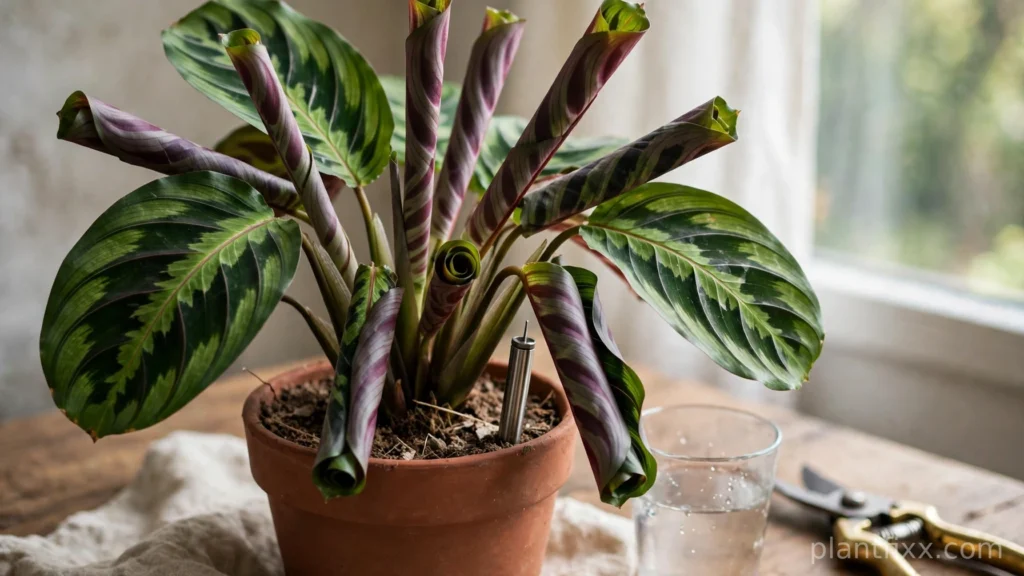
If prayer plant leaves curling is what you are seeing this morning, check the clock before you check the pot. Leaves that fold up after dark and open flat by morning are behaving normally. Leaves still rolled into tubes at midday are sending a stress signal.
Daytime curling usually means the leaf is losing water faster than the roots can replace it. Dry soil is the first cause to test, then dry air, strong light, cold drafts, salt build up and spider mites.
Work through the four checks in this guide in order. Most curled leaves relax once the real cause is fixed, and new growth tells you if the fix held.
For the wider picture, see our full guide to prayer plant problems and how to fix them.
The Night Fold Test: Normal Folding vs Stress Curling
Each Maranta leaf sits on a pulvinus, a small swollen joint where stalk meets blade. Cells there take up water and swell, or release water and soften. That pressure change lifts the leaf at night and lowers it by day.
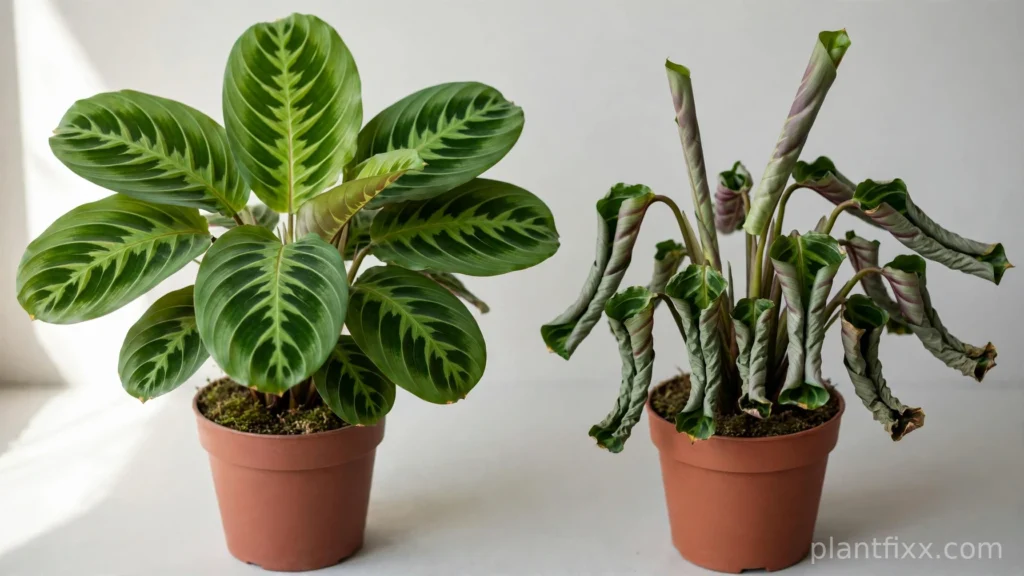
The North Carolina Extension Gardener Plant Toolbox profile of Maranta leuconeura puts it plainly: leaves sit parallel to the ground by day and move to an upright prayer position at night.
So judge curling at midday, never in the evening. A leaf that folded at dusk and opened by mid morning has passed. A leaf still rolled three hours after the room brightens has failed, and the cause is worth finding that day.
Close relatives share this rhythm, as the plants in our complete calathea plant care guide show. This guide stays with Maranta, though, because its curl patterns and fixes are its own.
One More Roll That Is Not a Problem
New leaves arrive as tight rolled tubes and open over several days. A single fresh tube among flat older leaves is growth, not stress. Do not peel it open, because the soft tissue tears easily.
Four Checks That Find the Cause, in Order
Run these checks in order, because each rules out a cause before the next. Changing water, light and position on one day leaves you unsure what worked.
| Curl pattern | Likely cause | First fix |
|---|---|---|
| Folded at night only, flat by morning | Normal night fold | None. Judge again at midday |
| Whole leaf in a tube, soil dry an inch down | Underwatering | Water until it drains, empty the saucer |
| Leaf curled, soil moist, dry air or a vent near | Low humidity | Humidifier nearby, move away from vents |
| Curl worst on window side, pattern faded | Too much direct light | Move back from glass or behind a sheer curtain |
| Curl after a cold night, near a door | Cold or drafts | Move to a warm, still spot |
| Curl with white crust on soil or pot rim | Salt build up | Flush with soft water, pause feeding |
| Curl with speckles on top, webbing below | Spider mites | Rinse undersides, treat, isolate |
| One new leaf rolled, older leaves flat | Normal new growth | Leave it alone for several days |
Check 1: Feel the Soil an Inch Down
Push a finger into the mix to the first knuckle. Dry at that depth points to thirst. Moist at that depth clears watering and sends you to the air and light checks.
Check 2: Read the Fold Timing
Look once in the evening and once at midday. Folding that reverses by morning is the pulvinus at normal work. Rolling that ignores the time of day is a leaf holding itself shut against water loss.
Check 3: Map the Curl Against the Window
Note which side curls most. Curling on the window side points at light, heat from glass or a cold draft there. Even curling across the plant points back at soil, air or roots.
Check 4: Turn the Leaf Over
Look under the worst leaf in bright light. Fine webbing, tiny moving specks or a dull dusty coating point to spider mites.
One contrast saves wasted work. A flat leaf that has only changed colour, or only browned at the tip, is a different problem from whole leaf curling.
What You Need Before You Start
- Room temperature water, ideally distilled, rain or filtered.
- A small hygrometer placed at leaf height.
- Clean scissors for dead leaves and damaged roots.
- Insecticidal soap, only if the underside check finds mites.
- Ten quiet minutes in daylight, at midday.
Why a Curled Leaf Is Protecting Itself
A flat leaf presents its full surface to the air, and water vapour leaves through it all day. Rolling inward shrinks the exposed area, shelters the underside, and slows that loss. The curl is a water saving move, not damage in itself.
The same move answers three shortages. Dry soil cuts supply at the roots, dry air raises loss at the leaf, and strong sun raises both temperature and loss. That is why one symptom needs four checks, not one automatic watering.
Turgor is the pressure behind the shape. Full leaf cells press outward and hold the blade flat. When water leaves faster than it arrives, pressure drops and the edges pull inward toward the midrib.
Fix Dry Soil First: The Underwatering Curl
Water slowly until it runs from the drainage holes, then empty the saucer. Fast pouring can run down one dry channel and leave half the root ball dry, so pour, pause, and pour again.
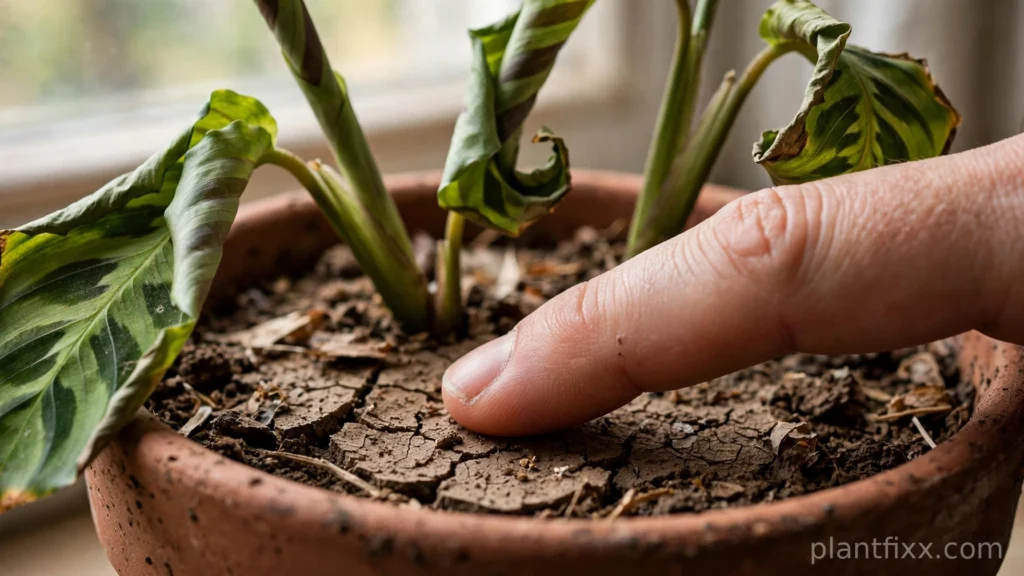
For a pot that has dried hard, set it in a basin of room temperature water for twenty to thirty minutes, then drain it fully. Then reset the habit: check every few days and water when the top inch feels dry.
Fix the Air Next: Low Humidity Curling With Moist Soil
This curl confuses owners most, because the watering is right and the leaves still roll. Heated winter air and air conditioning pull moisture from the blade faster than healthy roots can replace it.
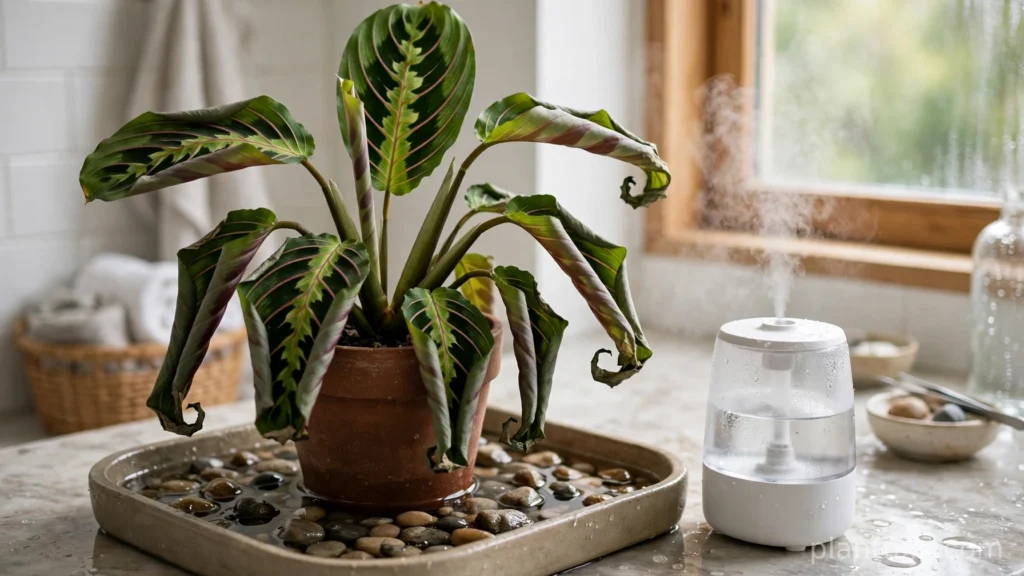
Aim to hold the air above 50 percent humidity at leaf height. The RHS prayer plant variety page pairs bright filtered light with high humidity and damp summer compost. A hygrometer beside the pot shows if your room meets that mark.
A small humidifier a few feet away is the one method that holds humidity for hours. A pebble tray and grouped plants add a smaller local lift, while misting lasts minutes only. Keep the plant out of the path of radiators, vents and air conditioners.
Fix Light, Cold and Drafts: The Placement Curl
Direct sun curls a Maranta leaf and fades its pattern. Extension guidance lists this species as intolerant of direct sunlight. Look for curling with washed out colour or pale patches, worst facing the glass.
Give bright light with no direct rays on the leaves. An east window, a spot a few feet back from a south or west window, or a sheer curtain all work. The plant also fits our list of best low light indoor plants for small spaces, with slower growth.
Keep the plant near 65 to 80 degrees Fahrenheit, away from glass on cold nights and doors that open to winter air. Use room temperature water while it recovers, because cold water adds a second shock.
Fix Salt Build Up: Overfeeding and Hard Water
Salts arrive slowly, through repeated feeding and mineral heavy tap water. Look for a white crust on the soil or pot rim beside the curling. Extension guidance notes that leaves of this species burn with high fluorides and over fertilization.
Those salts compete with roots for water in the soil, so a plant in moist mix can still take up too little. That is why salt curling survives a watering. The fix is removal.
Flush the pot in a sink, running soft water slowly through the mix several times, then drain fully. Pause feeding for a month. Restart at half strength, monthly in spring and summer only.
Check the Undersides: Spider Mites and Curling
Spider mites pierce leaf cells and drain them, so a fed on leaf loses pressure and distorts. The early sign is pale stippling on top, tiny light dots where cells have emptied. Webbing under the leaf means the colony is already settled.
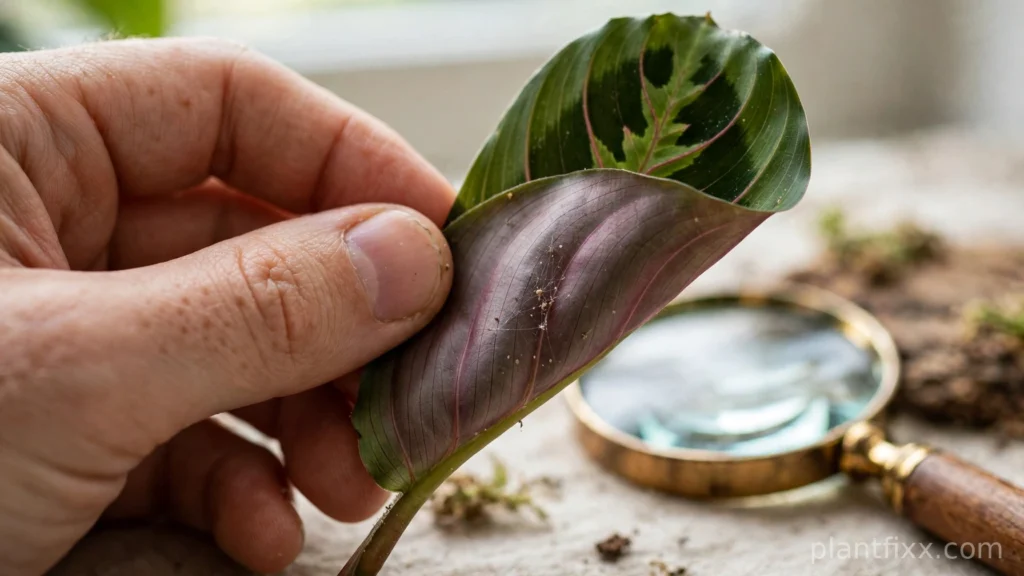
Confirm before you treat: tap a curled leaf over white paper and watch for specks that move. Then rinse both surfaces, follow with insecticidal soap as the label directs, repeat on the label interval, and isolate the plant.
Maranta leuconeura is non toxic to cats and dogs, but keep pets away from sprayed leaves until they dry. Confirm the plant any time with our pet safe plant checker for cats and dogs.
When the Soil Is Wet but the Leaves Still Curl
If the soil stays wet for days and the leaves still roll, suspect the roots. Roots in soggy mix lose the fine tips that absorb water, so the leaf curls from thirst in a heavy, wet pot.
Slide the plant out and read the roots. Healthy roots are pale and firm, while damaged roots are brown and soft. Trim back to firm tissue with clean scissors, repot into fresh airy mix, and water lightly.
Keep the humidity up while new root tips form, and do not feed yet. Feed adds salts to roots already struggling to take up plain water.
Recovery: What Uncurls, What Does Not, and How Long to Wait
A leaf curled by a short dry spell can relax the same day it is watered, often within hours. Curling held by dry air or light takes days of steady conditions. Judge progress at midday, on the same leaves.
Tissue that has gone crispy or dark will not flatten again. Leave a curled but living leaf in place, remove only fully dead leaves, and read new flat leaves as proof the fix worked.
Change one cause at a time and give it several days. A plant that gets water, a new window and a flush in one morning may recover, but you will not know which action mattered.
The Routine That Stops Curling Coming Back
Prevention is a short loop. Feel the soil twice a week, glance at the undersides when you water, and read the hygrometer when the heating runs. Those habits catch every cause here while it is still small.
Keep the basics steady with our complete prayer plant care guide, which covers light, soil, feeding and placement in full. Curling handled early rarely costs a leaf.
Why are my prayer plant leaves curling during the day?
Daylight curling is a water saving response, most often to dry soil. Feel the soil, check the humidity, read the light, then look under the leaves for mites. Fix the first cause that fails.
Is it normal for prayer plant leaves to fold at night?
Yes. The pulvinus changes water pressure on a daily rhythm and lifts the blade after dark. Folding that reverses by morning is healthy. Rolling that stays at midday is the stress signal.
Will curled prayer plant leaves uncurl?
Living leaves often flatten once the cause is fixed, within hours after watering or over several days for air and light. Crispy or dark leaves stay damaged, and new growth is the true measure.
How do I know if curling is from dry soil or dry air?
Feel the soil an inch down. Dry soil points to watering. Moist soil in a heated room points to the air, and a hygrometer reading under 50 percent at leaf height settles it.
Can too much light curl prayer plant leaves?
Yes. Direct sun raises leaf temperature and water loss, so the blade rolls. The clue is curling worst on the window side, with the pattern faded or bleached there.
Do spider mites make prayer plant leaves curl?
They can. Mites drain leaf cells, so the blade loses pressure and distorts. Look for pale stippling on top, webbing below, and moving specks over white paper.
Should I cut off curled prayer plant leaves?
Not while a leaf is green and firm, because it still feeds the plant during recovery. Cut only fully dead or crispy leaves, at the base of the stalk.
Pingback: Prayer Plant Problems: Symptom Guide, First Checks and Fixes