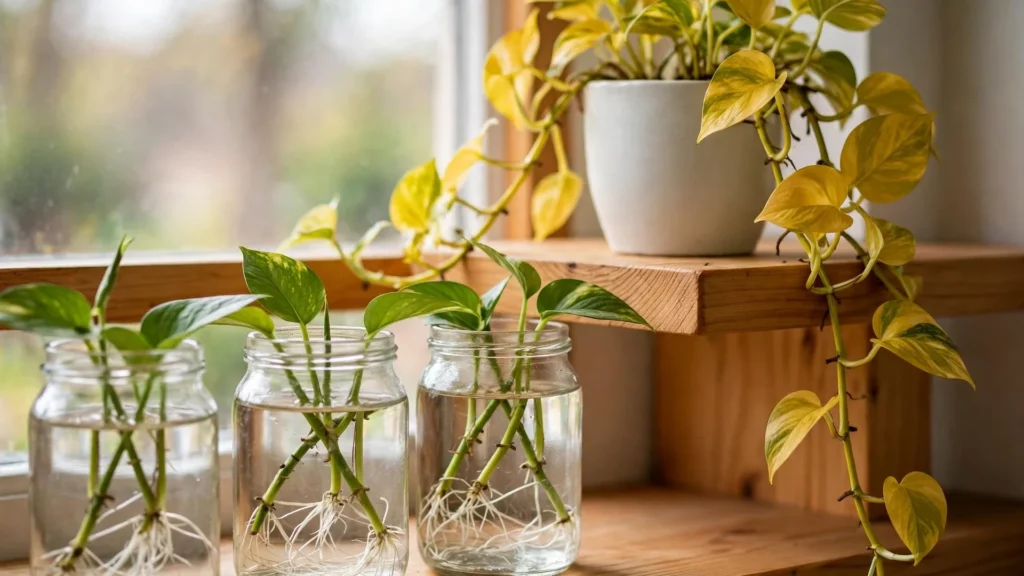
One healthy pothos can become ten. A single trailing vine holds everything needed to grow a new plant, and you need no special equipment to make it happen.
Propagation means cutting a vine in the right spot and giving it water or soil. Pothos roots from points along the stem called nodes, which is why this plant multiplies faster than almost any other houseplant.
Below are four methods: water, soil, layering, and division. Exact steps, realistic timelines, and how to tell whether a cutting is working or finished.
Quick Answer
To propagate pothos, cut a 4-6 inch stem just below a node, strip the lower leaves, and place the node in water or moist soil. Roots appear in 1-3 weeks in water. Move the cutting to soil once roots reach 2 inches, or start in soil for a plant that never needs transplanting.
Quick Take
Water propagation is fastest for beginners because you can watch the roots grow. Soil propagation skips transplant shock entirely. Layering roots a vine while it is still attached to the mother plant, so it rarely fails. Division only works on full, multi-stemmed plants but gives you an instant plant. Spring and early summer give the fastest rooting, though pothos roots year round indoors.
One mistake many people make
One mistake many people make is taking cuttings from a struggling plant. I have seen cuttings from a stressed, yellowing pothos sit in water for two months and grow nothing, while cuttings from a healthy vine in the same jar root in ten days. The parent plant’s health decides the result more than the method. Start with an actively growing plant, and your success rate jumps immediately.
Why pothos roots so easily
Pothos grows small brown bumps along its vines. Those are aerial roots, tiny pre-formed roots waiting for moisture. When you cut a vine just below a node, the point where a leaf joins the stem, those pre-formed roots activate on contact with water or damp soil.
That is the whole mechanism. No rooting hormone is required, though it can speed soil propagation. Nodes are the only part of the stem that can grow roots, so a cutting without a node will never root.
What you need before you start
Gather these before you cut:
- A healthy, actively growing pothos
- Clean, sharp scissors or pruning shears, wiped with rubbing alcohol
- A glass jar with room-temperature water, or a small pot with drainage holes and a light, airy potting mix
- Gloves. Pothos sap contains calcium oxalate, which irritates skin and is toxic to pets if chewed.
- Optional: rooting hormone powder for soil cuttings
Check the parent plant first. If the leaves are yellowing across the vine, fix that problem before you propagate. This guide explains each cause and its fix: Why Your Pothos Leaves Are Turning Yellow (And How to Fix Each Cause)
Method 1: propagate pothos in water (fastest for beginners)
Water propagation lets you watch every stage of root growth. It is the most forgiving method for a first try.
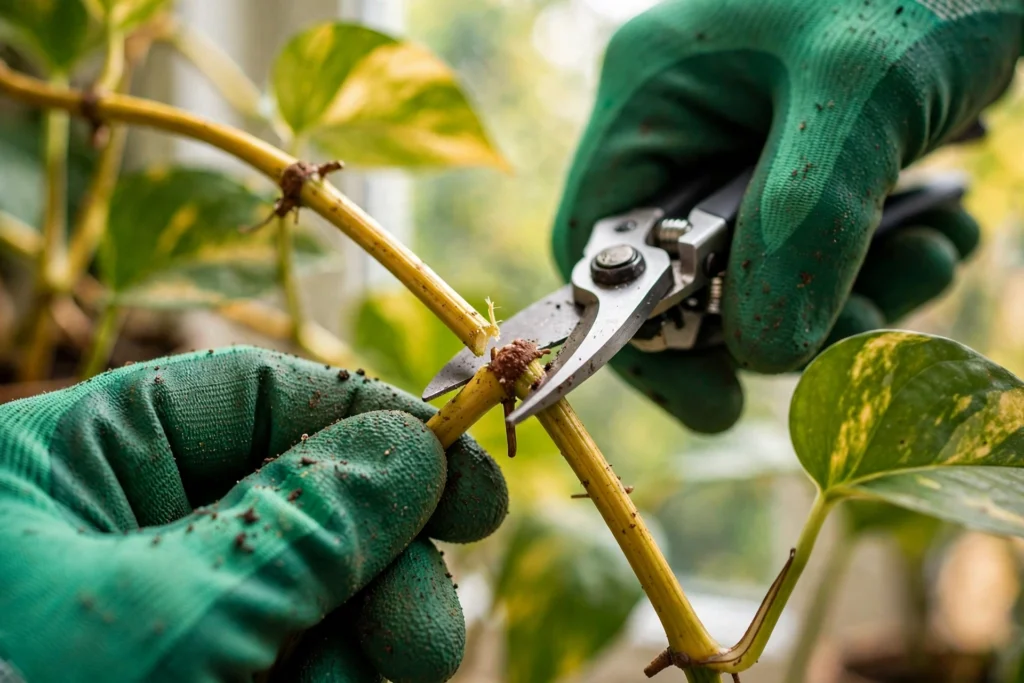
- Pick a healthy vine at least 6 inches long with 2-3 nodes, the small brown bumps where leaves meet the stem.
- Cut a quarter inch below a node with disinfected scissors.
- Remove any leaves that would sit below the waterline. Submerged leaves rot and foul the jar.
- Place the cutting in a jar of room-temperature water so every node sits underwater and all leaves stay dry.
- Put the jar in bright, indirect light, such as a shelf near a window.
- Change the water every 5-7 days to keep oxygen high and prevent rot.
- When roots reach 2-3 inches, usually in 3-4 weeks, move the cutting to soil.
One warning: water roots adapt to water. Plant them in soil once they reach 2-3 inches. Cuttings left in jars too long grow tangled water roots that transplant poorly.
Method 2: propagate pothos in soil (no transplant shock)
Soil propagation takes a little longer but gives you a finished plant in one step, with no water-to-soil transition to survive.
- Take the same 4-6 inch cutting with 2-3 nodes.
- Optional: dip the cut end in rooting hormone powder.
- Fill a small 3-4 inch pot with a light, well-draining potting mix.
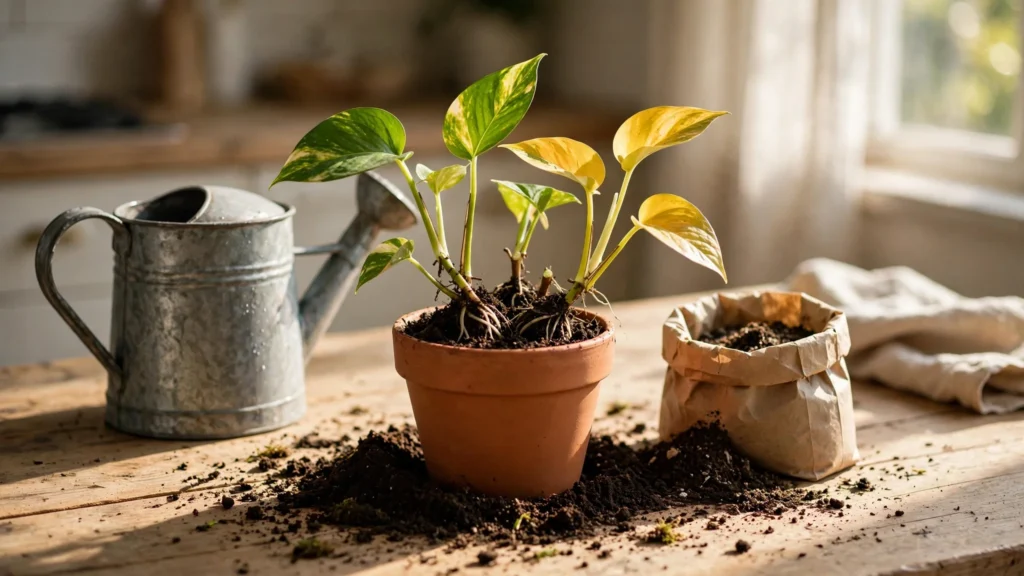
- Push the cutting about an inch deep so at least one node sits under the soil. Firm the soil gently around the stem.
- Water slowly until water drains from the bottom.
- Keep the soil lightly moist, not wet, for 3-4 weeks. A clear plastic bag over the pot raises humidity and speeds rooting. Air it out daily so mold cannot form.
- Tug gently after 3-4 weeks. Resistance means roots have formed.
Method 3: propagate pothos by layering (the fail-proof method)
Layering roots a vine while it stays attached to the mother plant. The vine keeps receiving water and nutrients the whole time, so this method almost never fails. Use it for cuttings you cannot afford to lose.
- Choose a long, healthy vine with aerial roots.
- Pin a section of the vine against the soil surface in the same or a neighboring pot, using a bent paperclip or a piece of wire. At least one node with aerial roots must touch the soil.
- Keep that spot lightly moist for 2-3 weeks.
- Once new leaves appear at the pinned node, cut the vine on the mother-plant side. You now have an independent plant.
Method 4: divide a full pothos (instant plant)
Division only works if your pothos is full with multiple stems. If yours is a single trailing vine, skip this method.
- Water the plant a day before so the root ball slides out easily.
- Slide the plant out of its pot and shake off loose soil.
- Look for natural separations in the root ball. Pull sections apart gently with your hands, and use a clean knife only where roots are tangled.
- Pot each section in its own container with fresh potting mix, stopping an inch below the rim.
- Water thoroughly and place in bright, indirect light.
Each section needs its own stems and roots. Do not divide one plant into more than three parts unless it is very large.
Which method should you use?
| Water | Soil | Layering | Division | |
|---|---|---|---|---|
| Roots form in | 1-3 weeks | 3-4 weeks | 2-3 weeks | Instant plant |
| Difficulty | Easiest | Medium | Easy | Medium |
| Transplant shock | Possible | None | None | Mild |
| Best for | Beginners who want to watch roots grow | One-step planting | Precious cuttings that must not fail | Overgrown pots |
Signs your cutting is working
- Tiny white roots push out from the nodes within 7-14 days in water.
- The cutting stays firm and green. Leaves hold their shape instead of wilting.
- A new leaf starts unfolding from the tip after 3-4 weeks.
- In soil, a gentle tug meets resistance after 3-4 weeks.
Signs it failed, and what to do
- The stem turns brown and mushy below the waterline. Remove it, change the water, and take a fresh cutting.
- The water smells bad. Dump it, rinse the cutting, refill with fresh water, and trim any slimy sections above the lowest healthy node.
- Leaves yellow within days. The cutting is too large for its energy reserves, or it sits in direct sun. Trim it to one or two leaves and move it to indirect light.
- No roots after 6 weeks. The cutting probably lacked a node. Start over with a section that has visible bumps.
What to do if growth stalls
A cutting that neither roots nor rots is usually missing one thing: warmth, light, or nutrients.
- Move the cutting to a warmer spot. Roots form fastest around 21-24°C.
- Increase humidity with a tray of pebbles and water, or cover soil cuttings with a plastic bag.
- Give water cuttings a brighter spot that still avoids direct sun.
- Add a drop of liquid fertilizer to the jar once roots appear. Plain water has no nutrients, so growth stops after rooting.
- Change stale water. A jar left two weeks without refresh is low on oxygen.
When not to propagate pothos
Timing and judgment matter as much as technique.
- The parent plant is stressed, yellowing, or fighting pests. Weak plants make weak cuttings.
- The only available vines are diseased or mushy. Never propagate from rotting stems.
- It is midwinter and your home is cold and drafty. Rooting slows below 18°C and rot risk rises.
- The cutting would be shorter than 3 inches with a single leaf and no node. It will not root.
Leggy vines make excellent cutting material, since each bare stretch of stem carries nodes. If your pothos grew long and sparse, here is how to handle the parent plant: Why Is My Pothos Leggy? (And How to Fix It)
How long does it take to propagate pothos?
Most cuttings show roots in 1-3 weeks in water and 3-4 weeks in soil. A transplant-ready new plant takes about 6 weeks from cutting to pot.
Can you propagate pothos in water permanently?
Yes. Pothos can live in water long term if you change the water weekly and add liquid fertilizer during the growing season.
Do you need rooting hormone for pothos?
No. Pothos carries natural rooting compounds at its nodes. Rooting hormone is optional and mainly speeds soil propagation.
Can you propagate pothos from a single leaf?
No. A leaf without a node cannot grow roots. You need a stem section with at least one node.
Can you propagate pothos without a node?
No. Nodes are the only part of the stem that can form roots. A stem piece with nodes can root even without leaves, but a node-less piece cannot.
How many cuttings per pot for a full plant?
Plant 4-6 cuttings in one 6-inch pot. Pothos rarely branches, so one cutting gives one vine. Several cuttings together create the full, lush look. This applies to every variety, from golden to marble queen:
When is the best time to propagate pothos?
Spring and early summer. Warmth and longer days speed rooting. Pothos roots year round indoors, just more slowly in winter.
Conclusion
One vine becomes a full pot. One full pot becomes gifts for friends. Use water when you want to watch the progress, soil when you want a hands-off route, layering when the cutting must not fail, and division when the pot is overflowing. Start with a healthy plant, keep the nodes wet, and check back in two weeks.
Once your cuttings are potted, the regular care routine takes over. Watering, light, and feeding for the plants you just made are all here: Pothos Care: The Complete Beginner Guide for Apartments
Pingback: Pothos Plant Varieties: 13 Types Compared for Your Home (2026)
Pingback: Is a Pothos Plant Toxic to Cats and Dogs? Symptoms First