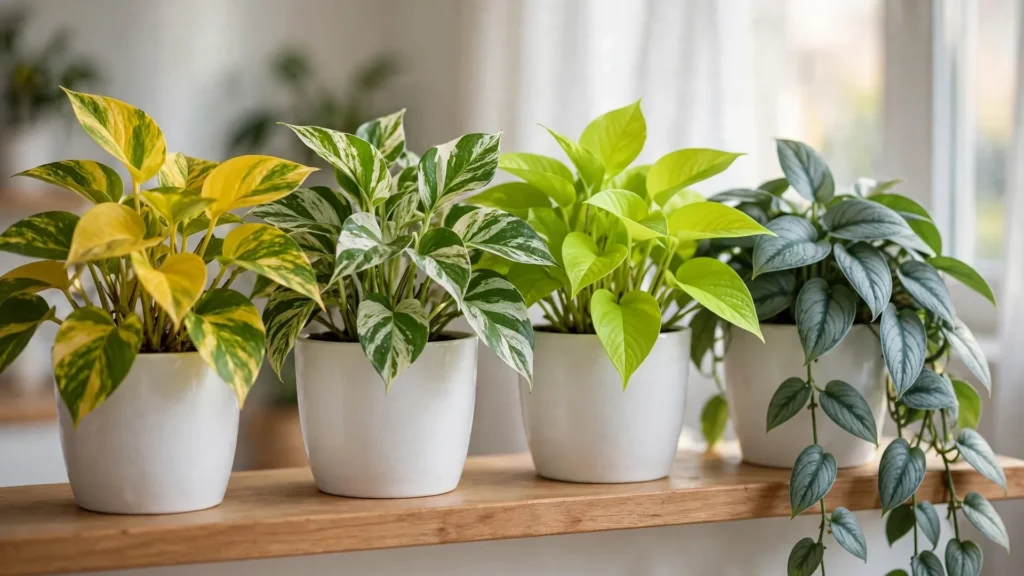
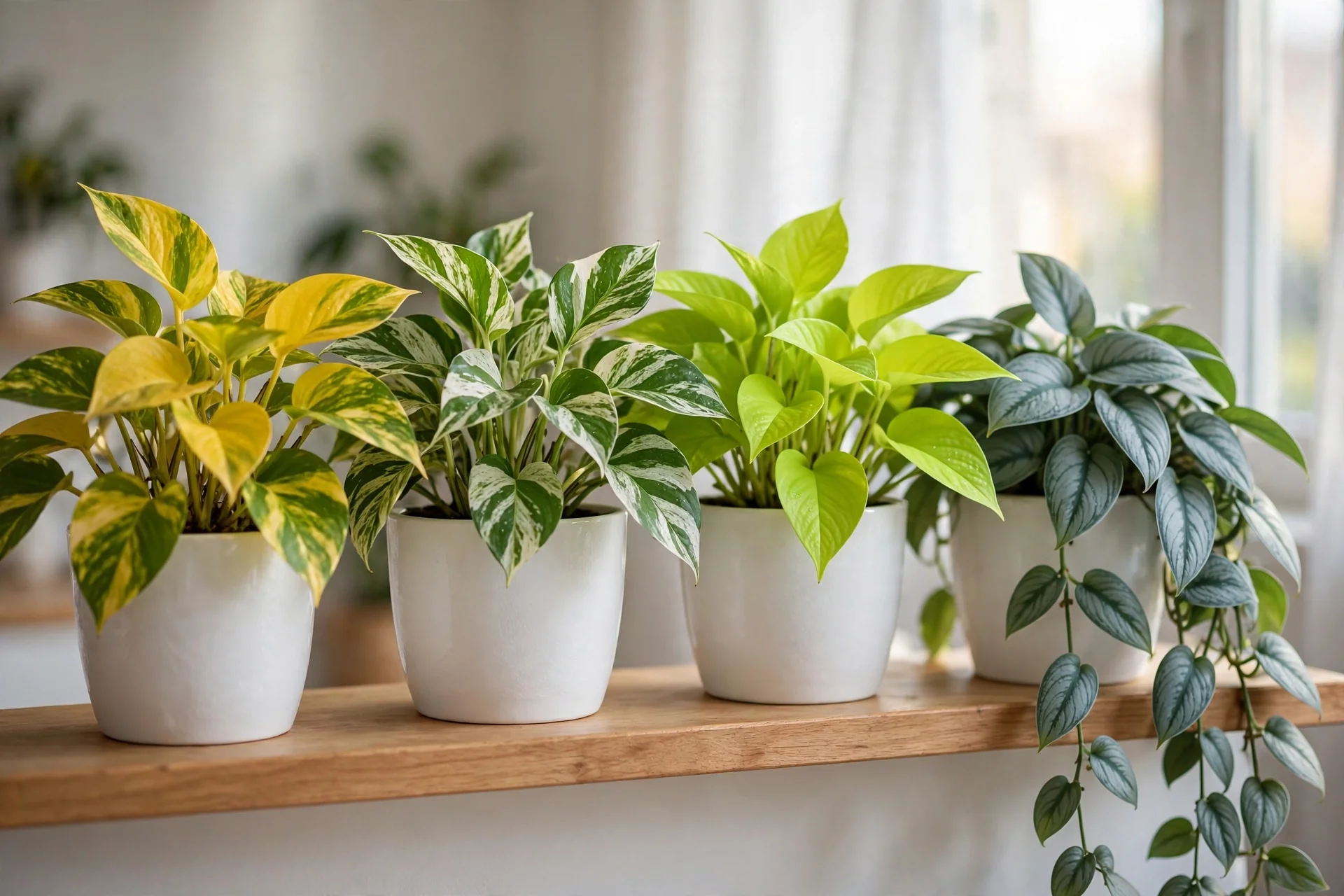
Walk into any plant shop and you will see a shelf of trailing green vines that look related but not quite the same. That shelf is the pothos family: more than a dozen distinct varieties behind one price tag, from the near-unbreakable golden pothos to the cebu blue, which can develop monstera-style splits when it climbs a moss pole.
The differences matter: a marble queen in a dark hallway slowly loses its white marbling, while a jade pothos in the same spot stays happy. This guide covers the 13 pothos varieties you will actually find for sale, shows you how to tell the lookalikes apart, and ends with straight picks for common apartment situations.
QUICK ANSWER: There are 13 pothos varieties worth knowing. Golden pothos is the toughest and fastest grower, jade handles the lowest light, marble queen and manjula carry the most striking white variegation, and cebu blue is the only common one that develops monstera-style leaf splits when mature. All share the same basic care. The real differences are light needs and growth speed.
QUICK TAKE: Golden, jade, and neon are the forgiving workhorses. Marble queen, manjula, N’Joy, pearls and jade, and glacier give you white variegation but need brighter light and grow slower. Global green and jessenia sit in the middle. Cebu blue and baltic blue are a different species that climbs and splits when mature. Satin pothos is not a true pothos. Read the white-pattern ID steps before paying extra for any “rare” label.
First, what actually counts as a pothos variety?
A variety occurs naturally, a cultivar is selected by growers, and a sport is a spontaneous mutation on one branch that a grower propagated. Nearly every pothos sold is a cultivar or sport of Epipremnum aureum, because pothos almost never flowers indoors, so nobody hybridizes it the way roses are hybridized.
Two impostors ride along: cebu blue and baltic blue are Epipremnum pinnatum, a close relative, and satin pothos is Scindapsus pictus, a different genus. Shops sell them all as pothos and the care is nearly identical, so this guide covers them while labeling them honestly. In practice, I have watched more people struggle with the label than the plant: a friend once paid collector prices for a “snow queen” that was simply a well-variegated marble queen under bright store lighting.
How to tell which pothos you have: 4 steps
Step 1: Leaf color. Solid dark-green hearts mean jade or a golden that lost its variegation. Bright lime-green with no pattern means neon. Yellow splashes on green mean golden. White or cream variegation means the marble queen family, and step 3 pins it down.
Step 2: Leaf shape and edges. Flat hearts are standard Epipremnum aureum. Narrow, arrow-shaped, metallic leaves mean cebu blue or baltic blue. Wide wavy-edged leaves mean manjula. Velvety leaves with silver spots mean satin pothos.
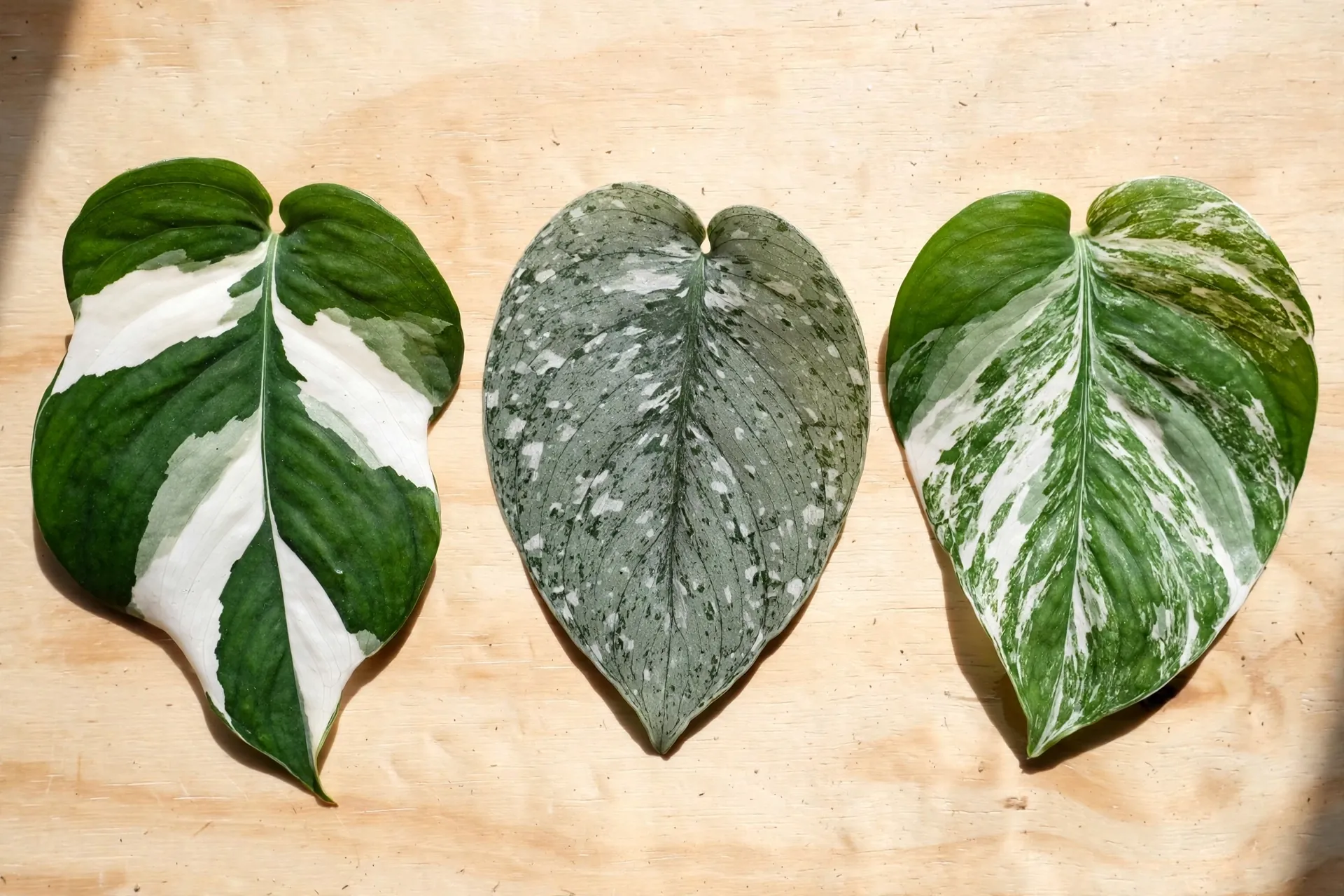
Step 3: Read the white pattern. Clean white blocks with no speckling mean N’Joy. White patches with green-gray speckles inside mean pearls and jade. Broad marbling woven through the leaf means marble queen. Nearly all-white leaves usually mean snow queen, most likely an extremely variegated marble queen.
Step 4: Light history. A golden in dim light loses its yellow and looks like jade, so any hint of yellow rules jade out. Low light also washes out marble queen variegation, so store-shelf IDs stay unreliable until the plant has had a few weeks of decent light.
The easy, common pothos varieties
Golden pothos: The default: fastest grower, widest light tolerance, yellow variegation that intensifies in bright indirect light. “Hawaiian pothos” at rare-plant prices is just a mature golden with huge leaves.
Jade pothos: Solid dark green with no variegation: the most shade-tolerant pothos you can buy. Your pick for a north-facing room with no grow light.
Marble queen pothos: Heavy white marbling on green. Its white areas hold little chlorophyll, so it grows slower and needs bright indirect light. In dim rooms it reverts to green. Full side-by-side here: Golden Pothos vs Marble Queen: Which One Fits Your Home?
Neon pothos: Solid chartreuse leaves that glow in good light and darken to dull green without it. Not the lemon-lime philodendron sold under the “neon” nickname.
The white-variegated cultivars
Slower and fussier than the common four. All want bright indirect light and revert toward green without it.
N’Joy pothos: Crisp white blocks with no speckling, on small thick leaves that grow bushy. A marble queen sport first found in an Indian greenhouse in 2002. Wilts when dry, recovers fast after watering.
Pearls and jade pothos: A University of Florida mutation selection from marble queen, with small leaves carrying speckled white, gray-green, and green patches. One of the slowest growers here. Buy the fullest pot you can find.
Glacier pothos: Compact like N’Joy, with silver-gray streaked white variegation on larger, flatter leaves. Stays small and slow: a natural desk plant.
Manjula pothos: Patented, with wide wavy-edged leaves in an unpredictable cream, silver, mint, and dark green mix. No two leaves match. Give it your brightest indirect spot.
Global green pothos: A patented 2020 introduction with dark green margins around a lime-green center. More chlorophyll than the white types, so it grows faster and tolerates medium light better.
Jessenia pothos: A marble queen sport with stable chartreuse variegation instead of white. Handles slightly lower light than the white-variegated cultivars.
Snow queen pothos: Nearly all-white leaves with green streaks. Whether this is a distinct cultivar or just a very highly variegated marble queen is genuinely debated, so treat the label and the price with suspicion.
The blue, the silver, and the climbers
Cebu blue pothos (Epipremnum pinnatum ‘Cebu Blue’): Narrow, arrow-shaped leaves with a metallic blue-green sheen. Give it a moss pole and the leaves grow dramatically larger and can develop fenestrations, the monstera-style splits. More delicate than standard pothos, and it wants warmth and bright light.
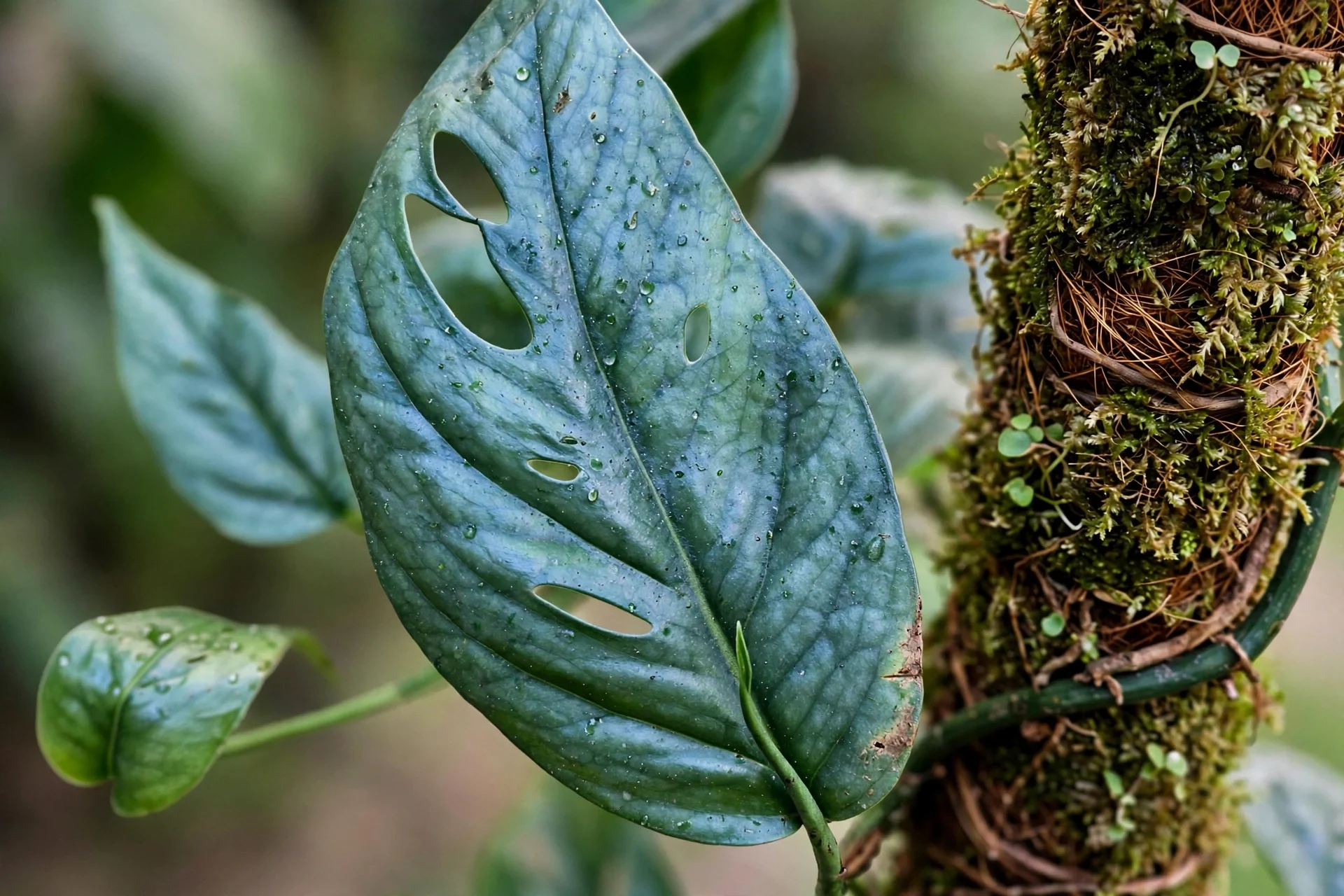
Baltic blue pothos (Epipremnum pinnatum ‘Baltic Blue’): A deeper blue-green pinnatum that also fenestrates when mature and climbing. It needs bright light and a climbing support, or it stays a plain trailing plant.
Satin pothos (Scindapsus pictus): Not a true pothos. Velvety dark-green leaves dotted with silvery spots, sold as silver pothos or under cultivar names like ‘Exotica’ and ‘Silvery Ann’. Care matches pothos closely, but it dislikes cold drafts more.
All 13 pothos varieties compared
| Variety | Leaves | Light needs | Growth speed |
|---|---|---|---|
| Golden | Green with yellow splashes | Low to bright indirect | Fast |
| Jade | Solid dark green | Low to bright indirect | Medium-fast |
| Marble queen | Green with heavy white marbling | Bright indirect | Slow |
| Neon | Solid chartreuse | Bright indirect | Medium |
| N’Joy | Crisp white blocks on green | Bright indirect | Slow |
| Pearls and jade | Speckled white and gray-green | Bright indirect | Very slow |
| Glacier | White with silver-gray streaks | Bright indirect | Slow |
| Manjula | Wavy, cream/silver/mint marbled | Bright indirect | Slow |
| Global green | Dark margins, lime center | Medium to bright indirect | Medium |
| Jessenia | Green with chartreuse splashes | Medium to bright indirect | Slow |
| Snow queen | Nearly all white | Bright indirect | Very slow |
| Cebu blue | Metallic blue-green, arrow-shaped | Bright indirect | Medium |
| Baltic blue | Deep blue-green | Bright indirect | Medium |
Which pothos should you get?
Match the plant to your light first:
- Dark corner, no direct window: Jade, or golden for faster trailing.
- Bright east window, want a statement: Marble queen or manjula.
- A shelf that needs color: Neon, if the spot is genuinely bright.
- Small desk or bookshelf: Glacier or N’Joy, both naturally compact.
- You want a climbing project: Cebu blue on a moss pole.
- Your very first houseplant: Golden. It forgives beginner mistakes.
Do not buy a heavily variegated white pothos for a dim room. You will pay for variegation the plant cannot keep. Skip “rare” listings at five times the normal price until you can identify the plant yourself.
Do different pothos varieties need different care?
Pothos care is 95 percent identical across varieties: water when the top two inches of soil are dry, give bright indirect light, and use a well-draining mix (full care guide). Three differences are real: variegated types need brighter light to hold their patterns, white-variegated types grow slower so they need less fertilizer and repotting, and the pinnatum group wants a climbing support to mature and dislikes cold rooms. Every variety propagates the same way, from a stem cutting below a node (propagation guide). If your trailing variety looks sparse, the fix is the same regardless of cultivar: Why Is My Pothos Leggy?
Every part of a pothos contains calcium oxalate crystals, which irritate mouths and stomachs, so keep all thirteen varieties out of reach of pets and children.
Frequently asked questions
What is the most common pothos variety?
Golden pothos: cheapest, fastest grower, most forgiving, stocked in nearly every shop.
Which pothos is best for low light?
Jade, because its solid green leaves carry the most chlorophyll, with golden as runner-up.
Is cebu blue a real pothos?
Botanically it is Epipremnum pinnatum, a close relative rather than a true pothos, but nurseries sell it as one and its care is nearly identical.
Why is my marble queen turning green?
Low light makes the plant produce extra chlorophyll and the white areas shrink. Move it to brighter indirect light and prune the reverted vines.
What is the fastest-growing pothos?
Golden by a clear margin, with jade close behind. White-variegated cultivars are the slowest.
The variety is a choice, not a gamble
Golden for forgiveness, jade for dark corners, marble queen or manjula for bright-room drama, cebu blue for a climbing project ending in split leaves. Buy the pattern your light can support and propagate your favorite instead of buying it twice. Next step: Pothos Care: The Complete Beginner Guide for Apartments.
Pingback: Is a Pothos Plant Toxic to Cats and Dogs? Symptoms First