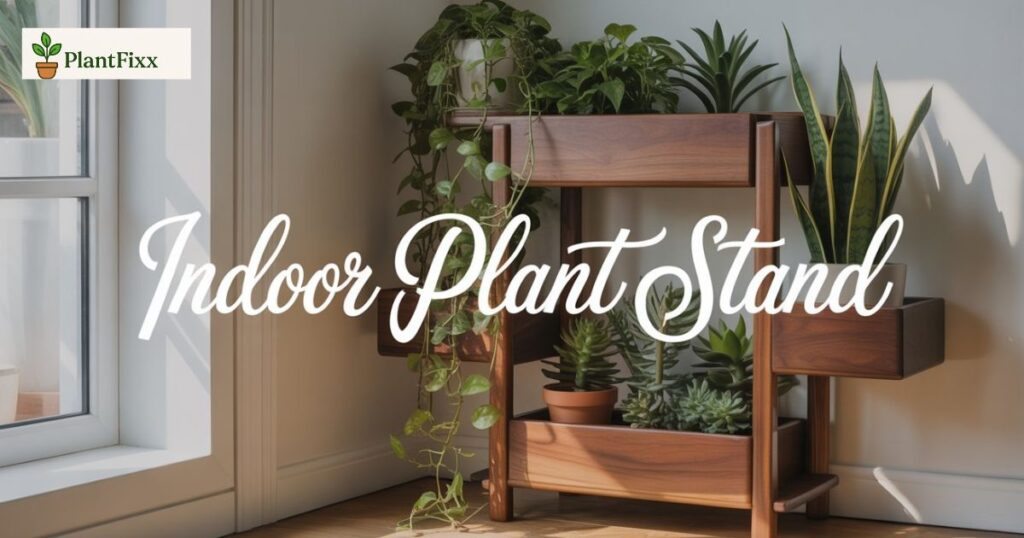
Choose a plant stand by its usable footprint, access for watering and the support it needs. Tiered, corner, floating and freestanding setups solve different space problems. Measure your room and pots before choosing a design.
1. Tiered stands: use vertical space
A tiered stand can keep several pots within a small floor footprint. Check each shelf’s usable width, depth and vertical clearance. A tall plant on a lower shelf may shade another pot or make watering awkward. Confirm whether the manufacturer specifies a load for each shelf or for the whole stand.
A tiered stand suits a collection of small and medium pots better than one large plant. Put the heaviest pots on the lowest shelf, where the stand is most stable, and keep tall plants on the top shelf or beside the stand, where their growth does not press against the shelf above.
Before you buy, measure the vertical gap between shelves and compare it with the full height of each pot plus its plant. A shelf that fits the pot but not the plant forces you to move the plant just as it settles in. If you are comparing taller designs as well, the guide to tall indoor plant stand ideas covers the height checks in more detail.
2. Corner stands: fit an unused area
Measure both walls and leave access for curtains, outlets and cleaning. A corner is useful only if the plants receive suitable light there. Check the base and any anchoring instructions; a narrow shape alone does not establish stability.
A corner stand works best as a home for one statement plant or a narrow tower of small pots. Quarter round and ladder style corner stands use the same corner differently: a ladder leans back against the walls and gives deeper shelves at the bottom, while a quarter round frame keeps a smaller, more even footprint.
Light is the deciding check. Corners are often the dimmest part of a room, so a corner stand suits plants that tolerate lower light, or a corner near a window rather than the far side of the room. The best low light indoor plants guide lists plants that can handle a dimmer corner without stretching toward the window.
3. Floating shelves: keep floor space clear
A shelf can provide room for small pots when the wall and mounting system are appropriate. Follow the shelf and hardware manufacturer’s instructions for the wall type and loading. For a rental, confirm what installation is allowed before drilling. Adhesive hardware should not be assumed suitable for a heavy watered pot.
Floating shelves suit trailing plants and small pots, because the display spreads across the wall instead of the floor. Stagger two or three short shelves rather than running one long shelf: staggered shelves leave room for a trailing pothos to hang without covering the pot below it.
Keep the heaviest watered pots on furniture or the floor, not on the wall. A shelf that holds dry pots safely can be stressed by the same pots after watering, when the mix is saturated. If drilling is not allowed in your rental, a freestanding stand gives a similar raised display without any wall fixing at all.
4. Freestanding wood or metal stands
Compare support spacing, the contact area under the pot and the finish’s exposure to water. Use a level surface and check the stand’s stated load guidance. Include the pot, growing mix, saucer and water when assessing weight. Protect nearby surfaces from spills while keeping the pot’s drainage accessible.
A single freestanding stand is the simplest fix when one plant needs lifting: up to window height, off a cold floor, or out of a walkway. Ring stands hold a pot at one fixed height, tripod stands spread the load across three legs, and pedestal stands give a flat top for a saucer. Match the ring or top size to the pot base, not the pot rim, because a pot that rests on its rim can tilt.
Wood finishes need a saucer or liner between the pot and the stand, because repeated spills can mark or swell the surface. Metal stands handle spills more easily but can rust at the joints if water sits in them, so wipe the contact points dry when you water.
Which setup fits your space?
Choose by the problem you are solving, not by the photo you liked. If your problem is too many small pots on the floor, a tiered stand gathers them into one footprint. If your problem is a dead corner, a corner stand fills it, as long as the light there suits the plant you plan to put on it.
If your problem is no floor space at all, floating shelves move the display onto the wall, provided drilling is allowed and the wall and fixings suit the load. If your problem is one plant sitting too low or in the way, a single freestanding stand is enough, and it is the easiest option to move when you rearrange the room. For more layout driven ideas, the smart indoor plant stand ideas guide works through whole room arrangements.
Measure pot spacing before buying
Record the usable shelf width and depth, widest pot diameter, desired gap and edge clearance. The plant stand fit planner estimates a simple grid in inches or centimeters. It does not assess load capacity, wall fixings or tip resistance.
Check foliage spread separately from the pot footprint. Leave room to lift a pot out, empty its saucer and inspect the leaves. Two setups with the same outside dimensions can provide different usable shelf space.
Match the display to the plants
Check each plant’s light needs before choosing the display location. Rotate or rearrange pots if one plant blocks another’s light. Compare compact snake plant choices and renter-friendly pothos display ideas when floor space is limited.
Arrange plants on the stand so they stay healthy
Place the plants that want the most light nearest the window side of the stand, and the shade tolerant plants on the lower or inner shelves. A tall plant on an upper shelf can shade everything below it, so check the shadow at midday, not just in the morning.
Group plants with similar watering needs on the same shelf. A fern that likes steady moisture and a succulent that likes to dry out can share a stand, but they should not share a shelf, because one watering routine rarely suits both. Turn each pot a quarter turn every week or two so growth stays even instead of leaning one way.
Leave enough room to lift each pot clear of its shelf. If a pot has to be tilted or dragged out, watering and saucer emptying become chores you skip, and skipped saucer checks are how stands and floors get water damage.
Mistakes that waste space and light
The most common mistake is buying by the stand’s outside dimensions. Two stands with the same width can have very different usable shelf space once frame thickness and edge lips are counted, which is why the spacing check above uses your own pot sizes.
Filling every shelf edge to edge is the second mistake. A stand with no gaps blocks light and air, hides the lower plants, and makes the corner feel more crowded than the floor collection did. One empty gap for a trailing plant or a taller pot usually looks and grows better.
The third mistake is placing the stand before checking the door swing, curtain movement and walkway. A stand that fits on paper can still be knocked every day in a narrow room, and a wobbling stand with watered pots is a spill waiting to happen.
A practical comparison checklist
Before ordering, compare actual shelf dimensions, watered pot weights, finish, drainage access, assembly requirements and the seller’s return terms. Confirm any installation or anchoring requirements with the manufacturer. These are setup ideas, not hands-on product ratings or tested load recommendations. For a bigger room, the best plant stands for the living room guide compares larger designs.
What is the best plant stand for a very small room?
The best choice is the one that solves your space problem: a tiered stand for many small pots, a corner stand for an unused corner with suitable light, floating shelves when floor space is gone and drilling is allowed, or a single freestanding stand for one plant. Measure your pots and the usable shelf space before choosing.
How much weight can a plant stand hold?
Only the manufacturer’s stated load guidance can answer that for a specific stand, and it may be given per shelf or for the whole stand. Weigh or estimate the pot with wet mix, saucer and water included, because a freshly watered pot is the heaviest version of it.
Are floating shelves safe for heavy plants?
A floating shelf is only as strong as its fixings and the wall behind it. Follow the shelf and hardware manufacturer’s instructions for your wall type and loading, keep heavy watered pots on furniture or the floor, and do not assume adhesive hardware suits a heavy pot.
What can I use instead of a plant stand in a rental?
A freestanding or tiered stand needs no drilling and moves with you. Floating shelves need permission and suitable fixings, so check your lease first. A sturdy stool, crate or low bookcase can also lift a plant, as long as it is level, stable and protected from spills.
How do I stop a plant stand from wobbling?
Set it on a level surface, check that every leg or the full base makes contact, and keep the heaviest pots low. If the stand still rocks, check the manufacturer’s assembly and anchoring instructions rather than wedging it under load.