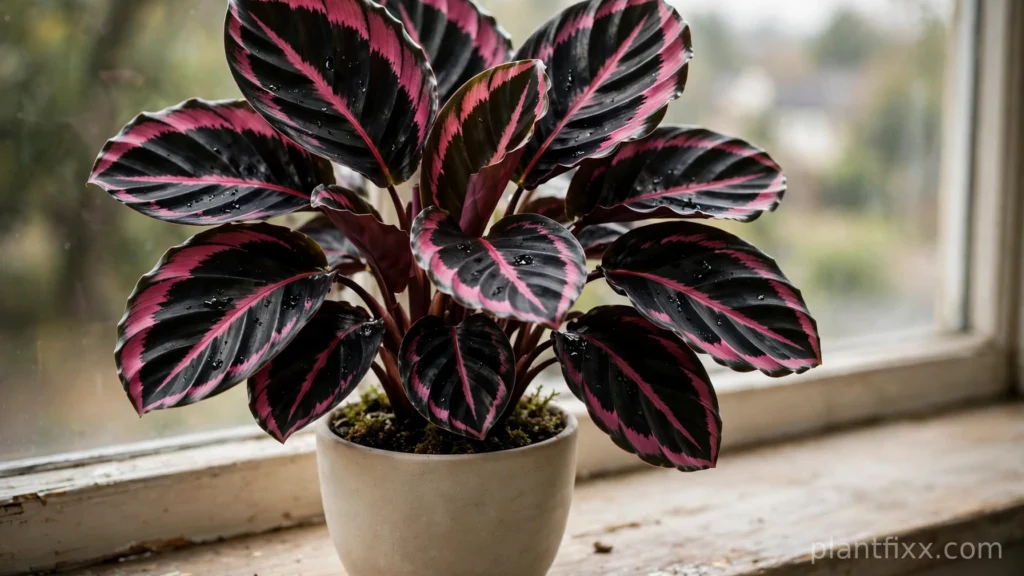
Calathea dottie keeps its near black leaves and bright pink stripe when it gets bright indirect light, evenly moist soil, soft water, and humidity at 50 to 60 percent or higher. Miss the light balance and the stripe fades first, long before the plant looks unwell.
This cultivar of Calathea roseopicta suits small homes better than its dark leaves suggest, and it is non toxic to cats and dogs. The routine below stays focused on Dottie, with general basics kept brief.
You will learn how to confirm Dottie in a shop, why the pink stripe fades at both light extremes, and how to fix brown edges by cause.
What Is a Calathea Dottie Plant: Dark Leaf and Pink Stripe ID
Shop labels use Calathea roseopicta Dottie, and botanists now place the plant as Goeppertia roseopicta Dottie. The RHS lists Goeppertia roseopicta Dottie as the accepted name for this cultivar, with the calathea name kept as a synonym.
North Carolina State Extension notes for the rose painted calathea place the species in the rainforests of Western South America and Western Brazil. It grows there as an understory plant, in warm moist air under tree cover.
Dottie is the dark selection of that species, bred for colour rather than size. A healthy plant forms a compact clump about 1 to 2 feet tall and wide, which suits a shelf or side table.
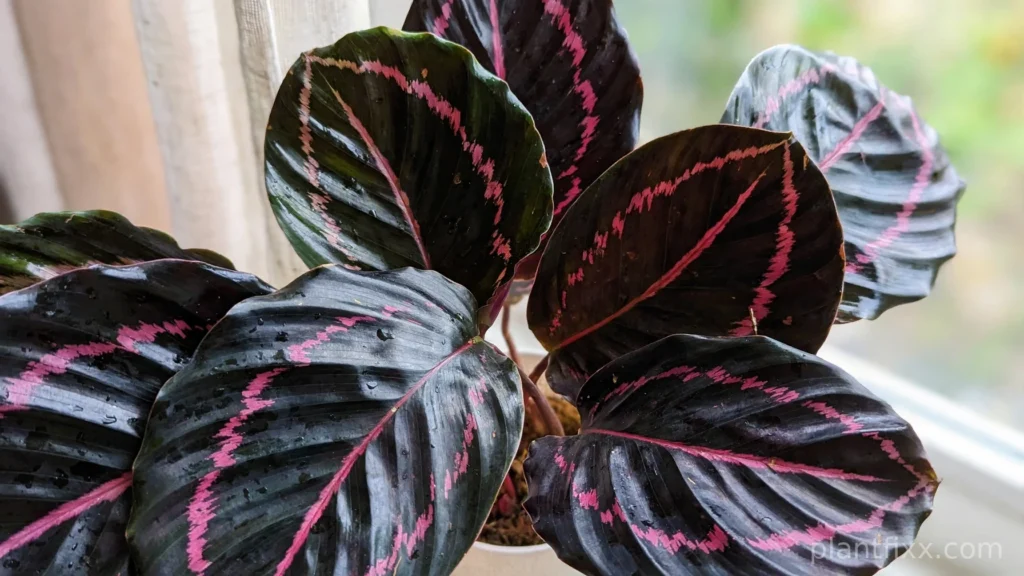
The identification test is the leaf. Look for a broad oval leaf so dark it reads as near black, with one bold pink to magenta stripe along the centre and a thin pink line at the edge.
Turn the leaf over and the underside is purple, the same purple the species shows at night. New leaves unfurl paler and darken with age, so judge the colour on mature leaves, not the newest one.
The closest shop mix up is Medallion, a lighter roseopicta cultivar with a pale centre and cream ring. If the leaf is light in the middle, it is not Dottie, whatever the label says. For the full comparison, see our Calathea Medallion plant care guide.
Calathea Dottie Care at a Glance
| Factor | Target for Dottie | First sign it is off |
|---|---|---|
| Light | Bright indirect, medium tolerated | Pink stripe fades or scorches |
| Water | Evenly moist, top inch dry first | Curling when dry, yellow when soggy |
| Water type | Rain, distilled or filtered | Brown crispy tips and edges |
| Humidity | 50 to 60 percent or higher | Crispy edges, dull dark leaves |
| Temperature | 18 to 27 C, steady | Drooping in cold or drafts |
| Soil | Coir or peat mix with perlite | Stays wet for weeks, or dries in days |
| Feeding | Half strength, monthly, spring and summer | Brown tips from salt build up |
| Propagation | Division at repotting in spring | Leaf cuttings do not root |
What You Need Before You Start
Dottie needs the standard calathea basics, and most homes already own most of them:
- A pot with drainage holes, only 1 to 2 inches wider than the root ball
- An airy mix that holds moisture, recipe in the soil section below
- Rainwater, distilled or filtered water if your tap water is hard
- A pebble tray or small humidifier, or a bright bathroom shelf
- A balanced liquid houseplant fertilizer and clean scissors
Light and the Pink Stripe: Why Colour Fades at Both Ends
The pink stripe is pigment, not paint. Pink and magenta tones come from anthocyanin pigments in the leaf tissue, laid over a very dark green base that is rich in chlorophyll.
That dark base is why Dottie tolerates lower light than pale variegated types. More of its leaf surface can gather light, so a medium light spot still feeds the plant, only more slowly.
Tolerates is not the same as thrives. NC State notes that the bright colouring of this species fades when light is inadequate, and Dottie shows that fade on the stripe before anywhere else.
An east facing window is the simplest seat, on the sill itself or a short step behind it. A south or west window works with a sheer curtain, and a few feet back from the glass is safer than the sill.
This tolerance is why Dottie appears in roundups of the best low light indoor plants for small spaces. The trade off is growth speed and stripe strength, not survival.
When Light Is Too Low
In low light the plant protects itself by favouring green tissue. New leaves open greener, the pink stripe arrives thinner and duller, and the gap between leaves grows longer.
Old leaves keep their colour for months, so judge light by the newest two or three leaves. If each new leaf is less pink than the last, move the plant closer to the window.
When Light Is Too Harsh
Direct sun does the opposite damage, and it is faster. Strong light bleaches the stripe toward pale pink or white, then scorches dry patches that never recover their colour.
Move a scorched plant back in steps, with a few days in each spot. A sudden jump from a bright sill to a dim corner trades scorch for fade, and the plant gains nothing.
Water and Humidity: The Brief Basics for Dottie
Keep the mix evenly moist, never soggy and never bone dry. Water when the top inch feels dry to a finger, water until it drains from the holes, then empty the saucer.
In most homes that is about once a week in spring and summer, and less often in winter. The full watering method for the family sits in our complete calathea plant care guide, so this section stays brief.
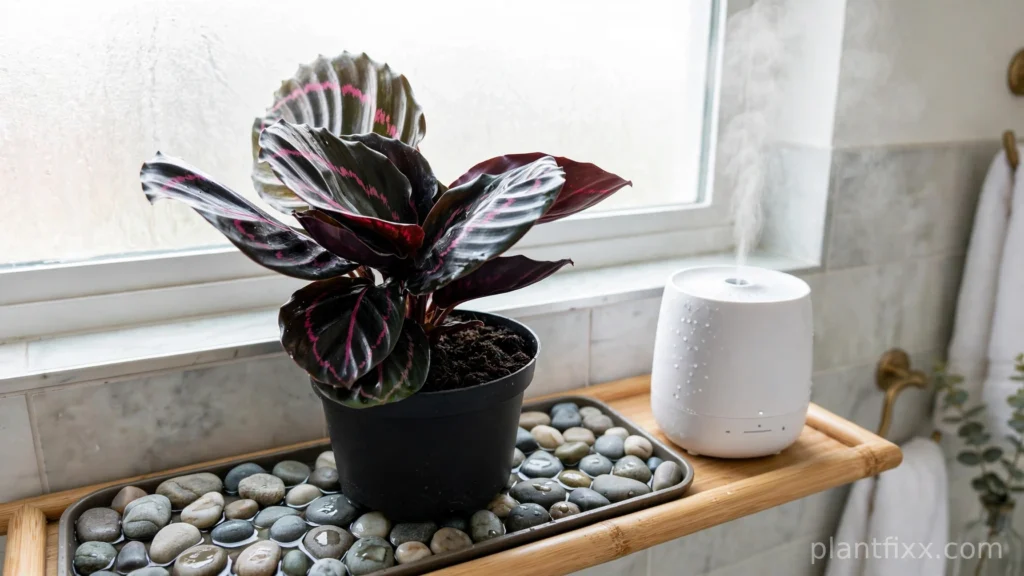
Humidity holds at 50 to 60 percent or higher in a healthy Dottie home. Dry air pulls water from the leaf edges faster than roots replace it, so a humidifier, pebble tray or grouped shelf matters more than misting.
Hold temperature steady at 18 to 27 C, away from radiators, vents and cold window glass. Sudden swings stress this plant more than a steady room at the lower end of the range.
Why the Water Type Shows on Dark Leaves
NC State advises rainwater or distilled water for this species, because fluoride in tap water turns the foliage brown. On near black leaves that browning is easy to spot early, which is a small advantage.
The mechanism is simple. Water rises through the plant and leaves through the leaf surface, but fluoride and salts stay behind and collect at tips and margins, until that tissue burns.
Soil, Pot and Feeding: The Brief Basics
Use 2 parts peat based or coco coir mix, 1 part perlite and 1 part fine bark. Coir and peat hold thin films of water, while perlite and bark keep air pores open after watering.
The mix should feel like a wrung out sponge after a drink, damp and never heavy. Drainage holes are not optional, and plastic or glazed pots hold moisture longer than plain terracotta in warm rooms.
Feed with balanced liquid fertilizer at half the label strength, once a month in spring and summer. Stop in autumn and winter, because food given to a resting plant stays in the mix as salts.
Salt build up shows first at the leaf tips, for the same reason fluoride does. Flush the pot once with plain distilled water if tips brown after a season of feeding at full strength.
Growing Calathea Dottie in a Small Apartment
Dottie earns its space in a small flat because the clump stays compact and upright. It fits a side table, plant stand or deep shelf, and the dark leaves read as a feature against pale walls.
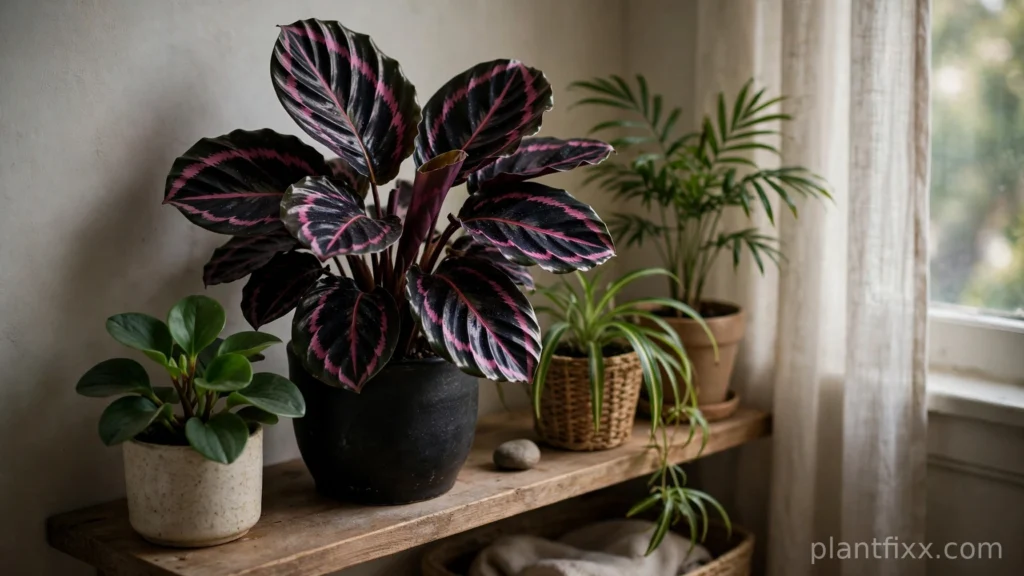
A bathroom with a window is often the best seat. Showers lift air moisture daily, which pairs free humidity with the bright indirect light the stripe needs to stay pink.
In a studio flat, one compact humidifier is enough for a grouped shelf of plants. Put Dottie in the middle of the group, where shared moist air is most stable and edges stay cleanest.
Keep it a few feet back from the glass in winter, because cold panes chill leaves overnight. A stand also lifts the pot off cold floors and out of the path of heating vents.
The night movement helps it earn the shelf space. Leaves fold up in the evening and open by morning, a rhythm explained further in our prayer plant care guide.
Is Calathea Dottie Safe for Cats and Dogs
Yes. The ASPCA lists Calathea as non toxic to cats, dogs and horses, and that listing covers Dottie under its calathea names, so pet homes can keep it without a safety plan.
The contrast is worth knowing. Pothos type leaves carry calcium oxalate crystals that burn a chewing pet mouth, and calathea leaves carry none of them, which is why the listing is clean.
Two honest limits still apply. Eating any plant material can cause mild stomach upset, and fertiliser residue or sprays on leaves are a separate risk, so non toxic does not mean food.
Checking a new plant before it comes home takes a minute. Run it through our pet safe plant checker for cats and dogs, and browse the pet safe low light indoor plants guide for shelf mates.
Brown Edges and Other Dottie Problems
Work every Dottie problem in one check order: soil moisture first, then humidity, then water type, then light. The dark leaves make each pattern easier to read than on a pale plant.
Brown Edges and Crispy Tips
Brown edges have three usual causes here: low humidity, fluoride and minerals in the water, and salt build up from feeding. All three burn the same edge tissue, so the pattern has to separate them.
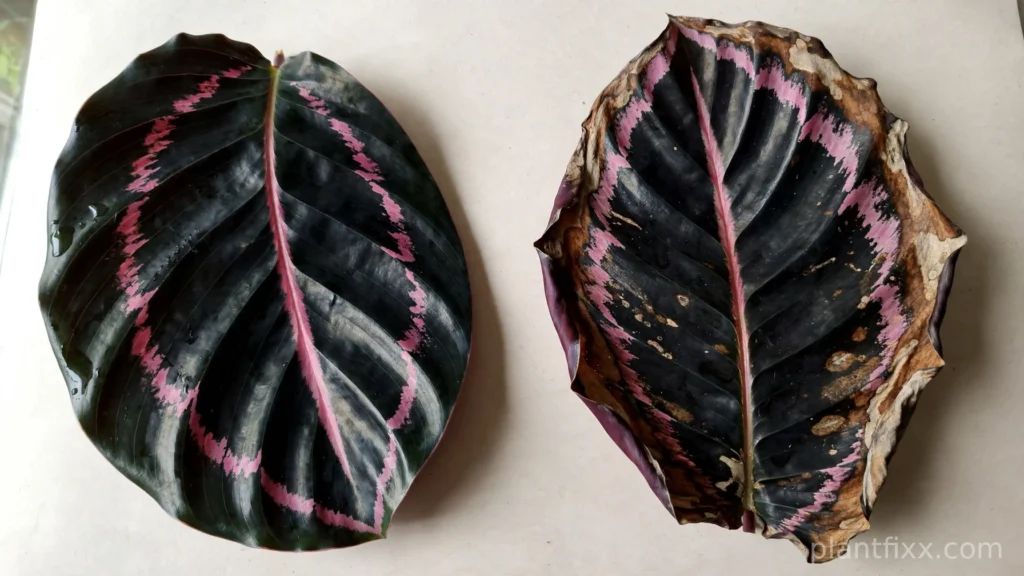
Crisping on many leaves in heated winter weeks points at dry air. Slow browning over months points at water, and browning that follows a feeding season points at salts in the mix.
Correct the cause before you trim, then cut the brown away with clean scissors along the natural curve of the leaf. Brown tissue will not turn green or pink again, so leaving it only hides new damage.
Leaves Curling in the Daytime
A thirsty plant rolls its leaves inward to cut water loss, and dry air triggers the same roll. Check the soil an inch down first, and water if it is dry at that depth.
Stress curling is a different signal from the normal fold the leaves make at night. The night fold lifts whole leaves upward at the stem joint, while a stress curl stays rolled at midday and feels dry.
Yellow Leaves
One older leaf yellowing at the base now and then is normal turnover. Several leaves yellowing together in mix that stays wet for weeks points at roots losing air and starting to rot.
New Leaves With No Pink Stripe
Pale new leaves are a light report, not a feeding problem. Move the plant a step closer to bright indirect light, wait for the next two leaves, and judge the stripe on those.
Pests to Watch For
Spider mites are the main pest, and they favour dry air. Look for fine webbing and pale speckling on leaf undersides, where the dark surface makes early webbing stand out.
Washing leaves and raising humidity handles an early case, because mites struggle in moist air. For mealybugs, scale and aphids, start with a damp cloth wipe, then insecticidal soap if they return.
Fungus gnats set up home in potting mix whose surface never dries. Letting the top inch dry between waterings breaks their cycle, while deeper roots stay moist enough for the plant.
How to Propagate and Repot Calathea Dottie
Dottie propagates by division only, at spring repotting. Leaf and stem cuttings do not root, because new growth comes from the rhizome at the base of the clump, not from leaf tissue.
Water a day ahead, ease the root ball out of the pot, and pull the clump gently apart by hand. Each division needs its own roots and a few leaves, potted at the same depth in fresh mix.
Repot every 1 to 2 years, moving up only 1 to 2 inches in pot size. A far larger pot holds wet mix the roots cannot reach, and that standing moisture invites rot.
Signs Your Care Is Working
- New leaves unfurl with a full pink stripe, as strong as the mature leaves
- Leaves fold up at night and open flat in the morning
- Leaf edges stay clean between monthly checks, with no new browning
- The clump fills its pot evenly, with new leaves from the centre
The Honest Limits: Who Should Skip This Plant
Skip Dottie if your watering style is long neglect. Even moisture is the one habit it will not forgive, and dry soil marks the dark leaves where every guest can see it.
Skip it too if your only spot is a dark corner or a sunny sill. The first fades the stripe to green, and the second bleaches and scorches it, so neither seat keeps the plant you bought.
Choose it if you can offer bright indirect light and steady humidity. Few compact plants give this much colour, and fewer still are listed non toxic for cats and dogs.
The Routine, in One Place
Give calathea dottie bright indirect light, evenly moist soil, soft water and air at 50 to 60 percent humidity or higher. Hold those four steady, and the pink stripe holds with them.
Check the soil with a finger, check the newest leaves for stripe strength, and divide the clump in spring when it outgrows its pot. That small loop is the whole Dottie routine.
Why is the pink stripe on my calathea dottie fading?
Light at either extreme fades it. Too little light makes new leaves greener and duller, while direct sun bleaches and scorches the stripe, so move the plant into bright indirect light and judge the next leaves.
How often do you water a calathea dottie?
Water when the top inch of soil feels dry, roughly weekly in the growing season in a typical home. The finger check decides, because light, pot size and humidity all change the pace.
Why are the edges of my calathea dottie turning brown?
The usual causes are low humidity, fluoride and minerals in the water, and salt build up from feeding. Check them in that order, fix the cause, and trim the brown, because it will not recover.
Is calathea dottie safe for cats and dogs?
Yes. The ASPCA lists Calathea as non toxic to cats, dogs and horses. Eating a lot of leaf can still upset a stomach, as most leaf material does, but it is not a poisoning risk.
Can calathea dottie live in low light?
It tolerates medium and lower light better than pale variegated types, because its dark leaves gather light well. The cost is slower growth and a weaker pink stripe on new leaves.
Can you propagate calathea dottie from a leaf cutting?
No. Cuttings of a single leaf or stem will not root on this cultivar. Divide the clump at spring repotting instead, making sure each piece has its own roots and a few leaves.
How big does calathea dottie get indoors?
About 1 to 2 feet tall and wide is typical, in a compact clump of broad oval leaves. That size fits shelves, side tables and desks in small homes without floor space.