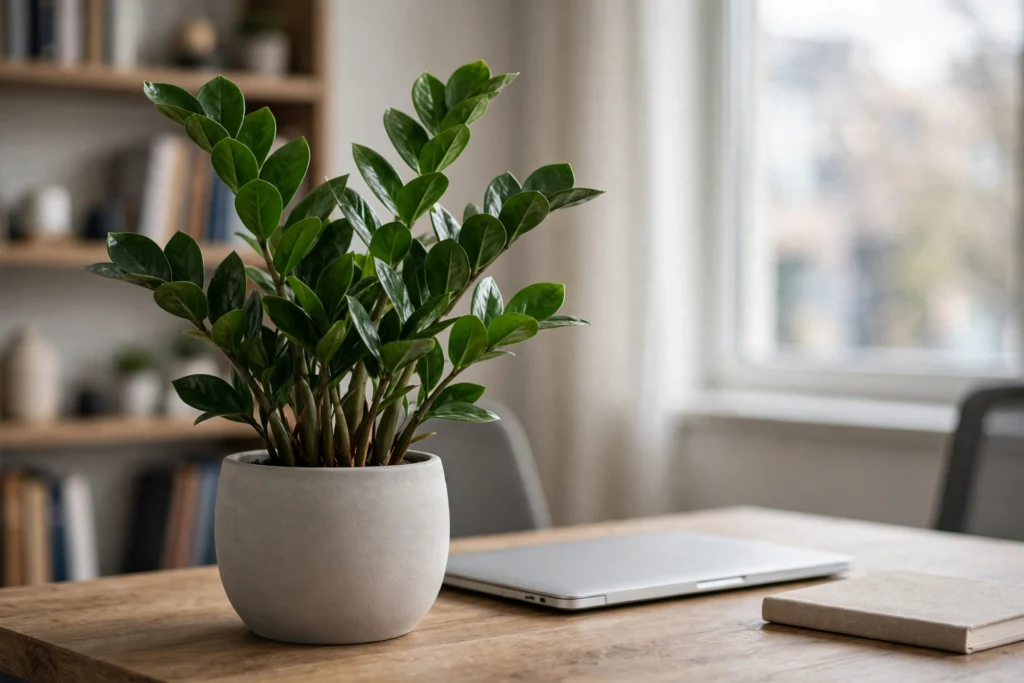
A ZZ plant for office use is one of the smartest plant choices for your desk or workspace. Offices are tough on plants. Light comes from ceiling fluorescents instead of the sun, the air conditioning runs dry all summer, and nobody remembers to water anything between Friday and Monday.
The ZZ plant tolerates all of that. It stores water in thick underground rhizomes, grows happily under fluorescent light, and forgives the watering gaps that kill fussier plants. This guide covers how to place, pot, and water one at work.
You will also get an honest answer on the air purification claims, desk versus floor placement, and what to do when you travel for work.
Quick Answer: Yes, a ZZ plant is one of the best plants you can keep in an office. It survives fluorescent lighting with no window nearby, handles dry air-conditioned air, and can go two to four weeks without water, so weekend gaps and business trips rarely harm it.
Quick Take: A ZZ plant suits office life because its rhizomes store water and its waxy leaflets lose little moisture, which makes it drought tolerant and fine under fluorescent light for 10 to 12 hours a day. Give it a pot with drainage holes, let the soil dry fully between waterings, and keep it clear of direct air conditioner blasts. Expect slow growth, wipe dust off the leaves monthly, and keep fallen leaflets away from pets.
One mistake many people make with an office ZZ plant is treating it like a home plant on a weekly watering schedule. At the office, Friday watering becomes a habit and the plant sits in damp soil all weekend. In practice, an office ZZ plant does better when you check the soil first and skip watering most weeks.
Why ZZ Plants Handle Office Life So Well
A ZZ plant grows from thick, potato-like rhizomes buried under the soil. These rhizomes store water and nutrients, so the plant draws on reserves during dry stretches. It is native to eastern Africa, where rainfall is irregular, and its biology is built around waiting out dry periods.
The leaflets are thick and waxy, which slows water loss. That is why it handles dry, air-conditioned office air without the crispy edges you see on ferns and calatheas. It also tolerates very low light, including rooms lit only by fluorescent fixtures.
This means office neglect usually helps more than it hurts. The plant expects long dry periods and dim conditions.
What You Need Before You Put a ZZ Plant in Your Office
Start with the right setup and the plant nearly takes care of itself.
- A pot with drainage holes. A 6-inch pot suits most desks, and an 8 to 10-inch pot suits a floor plant. Use a decorative pot without holes only as an outer cover.
- Fast-draining potting mix. A standard indoor mix with added perlite or coarse sand works well. Avoid dense garden soil that stays wet.
- A saucer or tray under the pot. This protects desks and floors from water damage.
- A moisture check habit. A wooden chopstick, your finger, or a cheap moisture meter all work. If the soil feels dry several inches down, it is safe to water.
For a complete breakdown of soil mixes, watering technique, and long-term feeding, keep the ZZ plant care guide bookmarked for reference beyond these office basics.
Light: Will Fluorescent Lighting Be Enough?
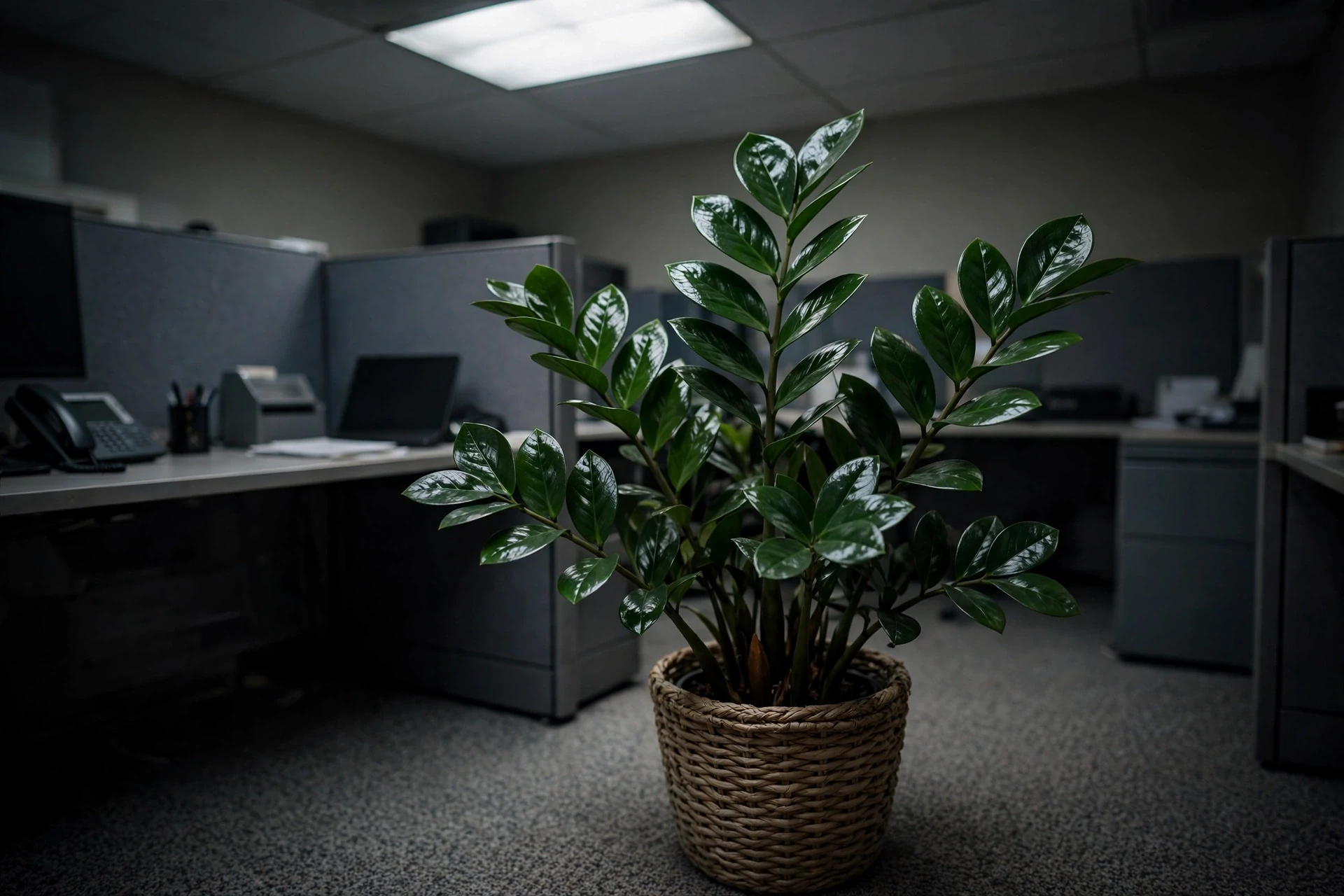
Yes. Standard office fluorescent or LED lighting is usually enough to keep a ZZ plant alive and healthy, as long as the lights run for most of the workday. No window is required.
Place the plant within a few feet of a ceiling fixture and avoid dark corners or spots under a desk where light barely reaches. Growth will be slow in low light, and that is normal. A few new stems per year is fine for a desk plant.
Rotate the pot a quarter turn once a month so stems grow evenly instead of leaning toward the nearest light. If your desk sits next to a window, keep the plant out of direct afternoon sun, which scorches the leaflets. The best low-light spots for ZZ plants guide explains the light logic that applies to offices too.
Watering Around Your Work Schedule
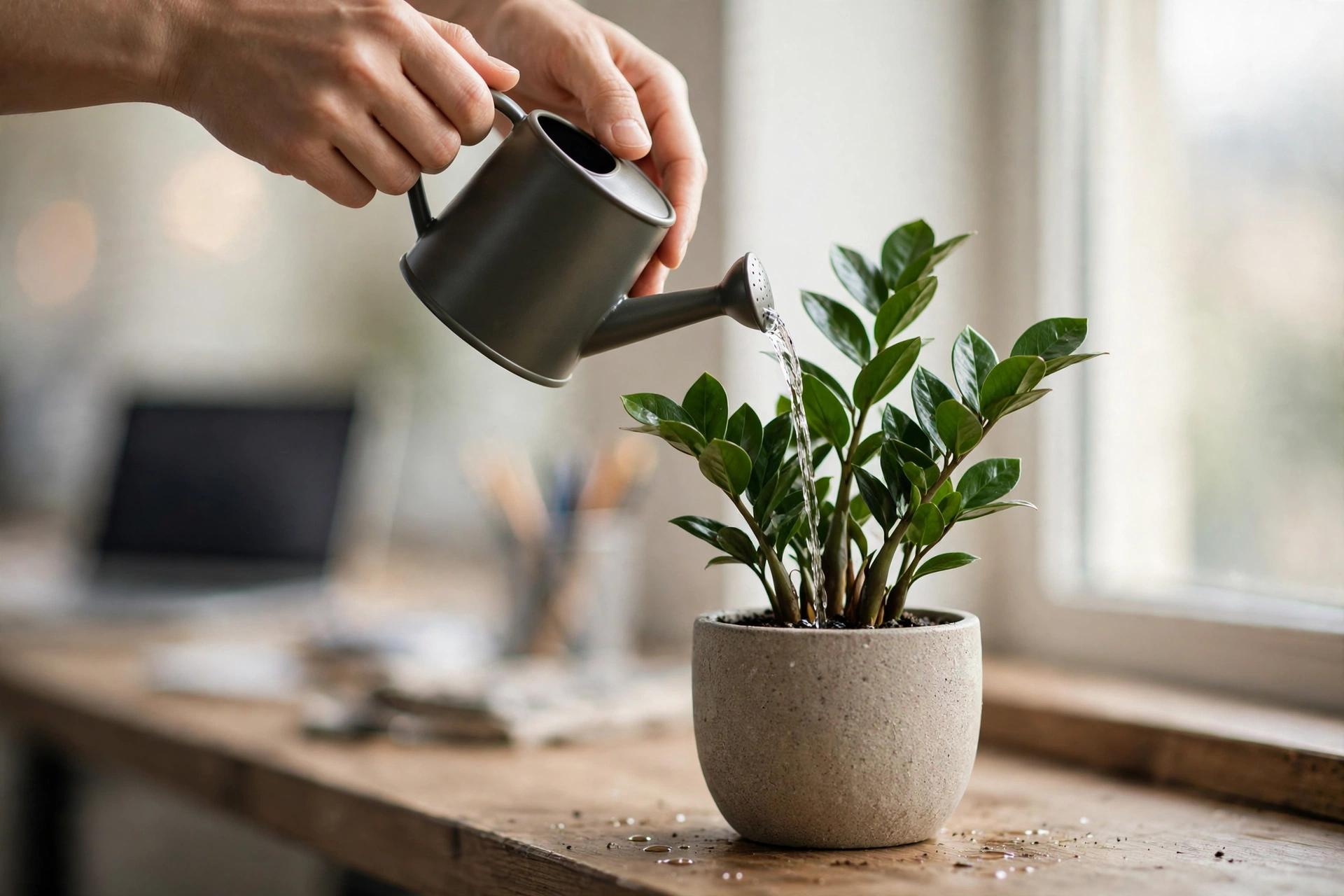
Water follows the soil, not the calendar. Water only when the soil feels completely dry from top to bottom. In most offices this means every two to four weeks in spring and summer, and even less in winter when the plant slows down.
Check before you leave for the weekend, not after you arrive. If the soil is still moist on Friday, leave it alone. If it is fully dry, water deeply and empty the saucer. For seasonal timing, read how often to water a ZZ plant before you set any routine.
Missed weeks are not a problem. The rhizomes cover forgotten waterings, short vacations, and long holiday shutdowns.
Desk vs Floor: Where to Put Your ZZ Plant
The right spot depends on space and plant size. A young ZZ plant in a 6-inch pot is a natural desk plant. A mature plant belongs on the floor where it will not crowd your keyboard or monitor.
| Spot | Best for | Light notes | Watch out for |
|---|---|---|---|
| Desk | Small plants, cubicles, home offices | Usually the most light at seated level | Spills, limited elbow room, knocked-over pots |
| Floor corner | Mature plants, open-plan offices | Further from ceiling lights, so growth is slower | Cleaning staff bumping the pot, direct AC vents |
| Reception or meeting room | Statement plants, waiting areas | Often brighter near entryways | Shared spaces mean nobody takes watering responsibility |
If the plant lives in a shared area, assign one person to water it. A plant with five owners gets watered five times, which is how root rot starts.
Office Air, Air Conditioning, and the Honest Air Purification Story
ZZ plants handle dry, air-conditioned air without misting or a humidifier. Keep the plant a few feet away from the direct blast of an air conditioner or heater vent, since constant hot or cold air on the foliage stresses any plant.
Now the air purification question, answered honestly. In sealed test chambers, University of Copenhagen researchers found that ZZ plants removed measurable amounts of benzene, toluene, ethylbenzene, and xylene (reported at rollingnature.com). That is a real result, but it happened in a sealed box, not a real office.
In real rooms, ventilation dilutes pollutants far faster than plants can absorb them. A Drexel University review calculated that you would need somewhere between 10 and 1,000 plants per square meter to match the air-cleaning effect of sealed-chamber studies (fullygrows.com). One desk plant does not clean your office air in any meaningful way. Dust is the more practical issue: office dust settles on leaflets and blocks the already limited light, so wipe the leaves with a damp cloth once a month.
Signs Your Office ZZ Plant Is Thriving
You know the plant is happy when its stems stand firm and upright, the leaflets look glossy and deep green, and new spears push up from the soil in spring or summer. New growth emerges bright green and darkens as it matures, which is normal.
Another good sign is resistance. If you forgot to water for a month and the plant still looks unchanged, that is the rhizomes doing their job.
Signs Your Office ZZ Plant Is Struggling
Mushy or soft stems at the base point to overwatering and possible rhizome rot, the one condition that can kill this plant. Yellow leaflets on otherwise firm stems usually mean too much water as well.
Wrinkled or curling leaflets with firm stems point the other way, toward underwatering, which is much easier to fix. Just water deeply and resume normal checks. Stems that lean or flop are often simply old growth, and you can prune them at soil level if they bother you.
Act on mushy stems fast. Unpot the plant, cut away soft or rotting rhizome sections with a clean blade, let the cuts dry for a day, and repot in fresh dry mix. Do not water for a week after repotting.
What to Do When Growth Stalls
Stalled growth in an office ZZ plant is usually not a crisis. These plants slow down dramatically in winter and under low light, sometimes producing nothing for months. That pause is normal, not a sign of failure.
Resist the urge to fix a stall with more water or fertilizer. Extra water during dormancy causes rot, and feeding in low light produces weak growth. Check the rhizomes by gently lifting the plant. Firm, potato-like rhizomes mean the plant is alive and waiting.
Give it time and stable conditions. When light and warmth return in spring, new spears usually follow. If a stem is fully yellow, mushy, or dried out, cut it at the base.
Traveling for Work: ZZ Plant Care While You Are Away
A ZZ plant is one of the easiest plants to own if you travel. A healthy plant can go two to three weeks without water and look the same when you return. Longer trips of a month are survivable if the soil was freshly watered before you left.
Before a trip, check the soil and water only if it is fully dry. Skip the self-watering gadgets. They keep soil moist continuously, which is exactly what this plant dislikes. A coworker checking the soil once during a long trip is more than enough backup.
Is a ZZ Plant Safe for the Office?
ZZ plants contain calcium oxalate crystals, which cause mouth and throat irritation if chewed and can irritate skin on contact.
Still, take basic care. Do not place the plant where food is prepared or eaten, pick up fallen leaflets, and wash your hands after handling cut stems. If your office allows dogs, keep the plant on a desk or shelf the dog cannot reach.
FAQs
Do you need a grow light for a ZZ plant in an office?
No. A ZZ plant survives and stays healthy under standard office fluorescent or LED lighting as long as the lights run for most of the workday.
Can a ZZ plant survive in a windowless office?
Yes. ZZ plants tolerate rooms with no windows at all, provided the artificial lighting stays on for roughly 10 to 12 hours a day.
How often should I water a ZZ plant in an office?
Water only when the soil is fully dry, which usually means every two to four weeks in an office, and always empty the saucer so the pot never stands in water.
Do ZZ plants clean office air?
Only slightly. Sealed-chamber research shows they absorb some VOCs, but real-world studies find you would need far more plants than a normal office holds for a meaningful effect.
Are ZZ plants safe around office dogs or cats?
No. ZZ plants are toxic to pets because they contain calcium oxalate crystals, so keep the plant where office animals cannot reach it.
Can I keep a ZZ plant on my desk, or should it go on the floor?
A young plant in a 6-inch pot works well on a desk, while a mature plant spreading 2 to 3 feet wide belongs on the floor.
How big will a ZZ plant get in an office?
Indoors a ZZ plant reaches 2 to 4 feet tall over several years, but low office light keeps growth slow, and compact varieties like Zenzi stay noticeably smaller.
Bringing It All Together
A ZZ plant fits office life because it asks for so little. It handles fluorescent light, dry air, and weeks without water, and it looks polished enough for a reception desk or a boardroom corner. Set it up with drainage, water it only when the soil is dry, and give it one monthly dust wipe.
If you are still deciding between the two toughest office plants, read Snake Plant vs ZZ Plant: Which One Wins? to compare them on light tolerance, watering, and desk friendliness.